
William Shakespeare — Playwright of the English Renaissance
English playwright, poet, and actor whose 39 plays and 154 sonnets reshaped world literature. Rising from a market-town family to part-ownership of London's leading playing company, he wrote across comedy, history, and tragedy under two monarchs, and his posthumous collected works made him the most performed playwright on Earth.
Events
Birth in Stratford-upon-Avon

William Shakespeare was born to John Shakespeare, a glover who served as a town bailiff, and Mary Arden, the daughter of a landed farmer. His baptism was recorded on April 26, 1564, and his birth is traditionally observed on April 23. He grew up in a market town of roughly 1,500 people, where his father's civic status entitled William to a free education at the local grammar school.
Location: Stratford-upon-Avon, England
Marriage to Anne Hathaway

At 18, Shakespeare married 26-year-old Anne Hathaway after the Bishop of Worcester issued a license allowing the wedding after one reading of the banns — an expedited procedure typically used for pregnancies. Daughter Susanna was born six months later, and twins Hamnet and Judith followed in 1585. The next seven years of his life, the so-called "lost years," are undocumented.
Location: Stratford-upon-Avon, England
The "Upstart Crow" Attack in London

Playwright Robert Greene, in a deathbed pamphlet, mocked Shakespeare as "an upstart crow, beautified with our feathers" — the earliest surviving reference to him as a London theater figure. By then he had written early plays including the Henry VI cycle and was emerging as a rival to university-educated dramatists such as Christopher Marlowe and Greene himself. The attack is evidence of how far the Stratford newcomer had risen by his late twenties.
Location: London, England
Venus and Adonis Published
With London theaters closed by plague outbreaks, Shakespeare turned to poetry. His narrative poem "Venus and Adonis," printed by Stratford townsman Richard Field, became a literary sensation, dedicated to the young Earl of Southampton. Its follow-up, "The Rape of Lucrece" (1594), confirmed his standing in print while the playhouses remained dark.
Location: London, England
Joining the Lord Chamberlain's Men
Shakespeare became a founding shareholder and house playwright of the Lord Chamberlain's Men, acting alongside Richard Burbage and writing for the company for the rest of his career. The arrangement — playwright, actor, and part-owner in one — was central to his output and wealth. The company dominated London theater alongside its rival, the Admiral's Men.
Location: London, England
The Death of Hamnet
Shakespeare's only son, Hamnet, died at 11 of unknown causes and was buried in Stratford. Four years later Shakespeare's father was granted a coat of arms, elevating the family to gentle status. Biographers have long noted the proximity of the bereavement to the writing of his greatest tragedies, and the period around 1600-01 produced "Hamlet," whose grief-haunted prince became his most famous character.
Location: Stratford-upon-Avon, England
The Globe Theatre Opens
The Lord Chamberlain's Men, evicted from their old playhouse, built the Globe Theatre in Southwark using timbers from their former venue, with Shakespeare among the financial shareholders. Its opening seasons featured "Julius Caesar" and marked the start of the great tragic period: "Hamlet" (c. 1600), "Othello" (c. 1603), "King Lear" (c. 1605), and "Macbeth" (c. 1606), the latter written in the shadow of the Gunpowder Plot for a new Scottish-born king.
Location: London, England
The King's Men
After James I took the throne on Elizabeth I's death, the new king granted the Lord Chamberlain's Men a royal patent, making them the King's Men — the leading playing company in England. Garter King of Arms allowed the Shakespeare family to display its coat of arms, and the company performed at court far more often than before. Shakespeare's later work, including "King Lear" and "The Tempest," was written under this court connection, with his plays subject to censorship by the Master of the Revels.
Location: London, England
The Tempest and Retirement
"The Tempest," first recorded in performance at court before King James, was probably Shakespeare's last play written alone. Afterward he collaborated on works with John Fletcher, including "Henry VIII" and "The Two Noble Kinsmen." By 1613 he had settled back in Stratford, where he had bought New Place, the town's second-largest house.
Location: London, England
The Globe Fire

During a performance of "Henry VIII," a theatrical cannon set the Globe's thatched roof alight and the theater burned to the ground within an hour. No deaths were recorded. The company rebuilt the Globe with a tiled roof the following year, but Shakespeare's London career was effectively over — the event falling near the end of his working life.
Location: London, England
Death in Stratford

Shakespeare died at 52, traditionally on his birthday, and was buried in the chancel of Holy Trinity Church. His will left the bulk of his estate to Susanna, with the famous second-best bed bequeathed to Anne. Half of his plays existed only in unstable quarto editions, and the permanent survival of the canon was not yet assured.
Location: Stratford-upon-Avon, England
The First Folio
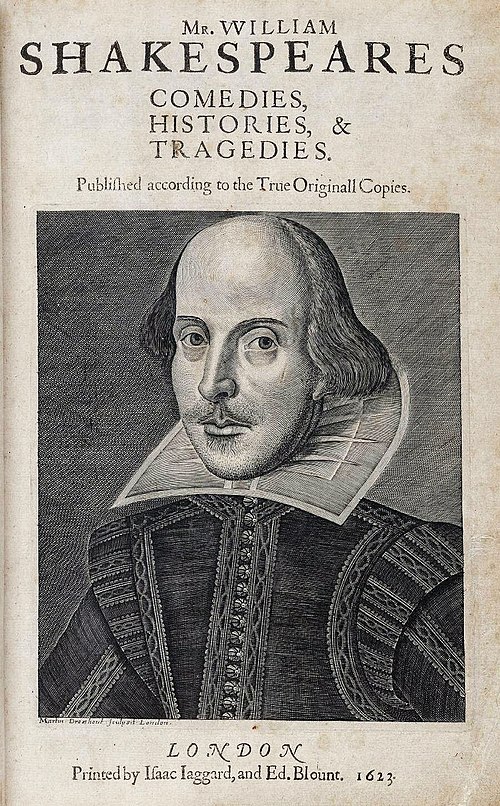
Fellow actors John Heminges and Henry Condell published the First Folio, a collected edition of 36 plays, half of which — including "Macbeth," "The Tempest," and "Twelfth Night" — had never been printed and would otherwise likely have been lost. Ben Jonson's prefatory poem declared Shakespeare "not of an age, but for all time." The Folio fixed the texts that would carry his works into every major living language.
Location: London, England
The Authorship Question and the Literary Legacy

From the mid-19th century, a minority school of doubters — beginning with Delia Bacon and later popularized by works proposing Francis Bacon, the Earl of Oxford, and others as the true author — argued that a Stratford glover's son could not have written the works. Mainstream scholarship attributes the canon to Shakespeare of Stratford, citing the contemporary testimony of Jonson, Heminges, and Condell; documentary evidence of the authorship alternatives has not emerged. The debate itself, spanning court records and literary circles, became a durable feature of his cultural afterlife, alongside the Globe's 1997 reconstruction near its original site.
Location: England