
The War of 1812 (1812–1815)
The war between the United States and Great Britain, fought across North America and the Atlantic during the wider Napoleonic Wars. Driven by British maritime restrictions, the impressment of American sailors, and rivalry over the western fur trade and Native confederacies, the conflict ended in a negotiated peace that left borders unchanged but reshaped national identities on both sides of the border.
Events
The United States Declares War on Britain

For years, Britain's Orders in Council restricted neutral American trade with France, while the Royal Navy stopped American ships to seize alleged deserters; the 1807 Chesapeake-Leopard affair, in which a British warship fired on a US frigate and took four sailors, inflamed public opinion without provoking war. In 1812, with Napoleon's Continental System also squeezing American commerce and frontier settlers blaming British-allied Native confederacies for resistance to American expansion, the so-called War Hawk congressmen Henry Clay and John C. Calhoun pushed the Madison administration toward confrontation.
Location: Washington, D.C., United States
Surrender of Detroit
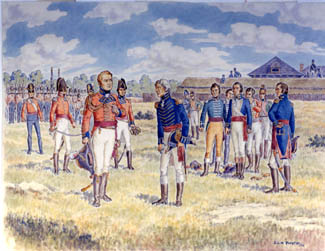
Major General William Hull led about 1,000 American troops into Upper Canada in July 1812, but withdrew to Fort Detroit after Native warriors under Tecumseh disrupted his supply lines and frontier attacks unsettled his militia. On 16 August, British Major General Isaac Brock, with Tecumseh's fighters visible around the fort and artillery positioned opposite, sent a demand for surrender that warned of his "savage ally" and promised no protection if the fort were stormed.
Location: Detroit, Michigan Territory
Old Ironsides — Constitution Defeats Guerriere
On 19 August 1812, the American frigate USS Constitution, commanded by Captain Isaac Hull, encountered HMS Guerriere about 1,200 km (750 miles) east of Boston. After a 35-minute exchange of broadsides, the Guerriere's masts were shot away and her captain struck his colors; the badly damaged British ship was burned the next day as too broken to tow.
Location: Atlantic Ocean
Queenston Heights and the Death of Brock
Before dawn on 13 October 1812, several hundred American troops crossed the Niagara River and seized Queenston Heights, where Brock ordered a frontal uphill assault. Brock, who had blunted the August American invasion and was the most respected British commander in Upper Canada, was killed early in the attack leading his grenadier company up the slope.
Location: Queenston, Upper Canada
The Burning of York
On 27 April 1813, an American force under Zebulon Montgomery Pike landed at York, capital of Upper Canada, and stormed Fort York after brief fighting that killed or wounded many attackers, including Pike himself. American troops occupied the town for several days, looted public property, and burned the parliament buildings and other government structures before withdrawing.
Location: York (present-day Toronto), Upper Canada
Battle of the Thames and the Death of Tecumseh
After the American victory at the Battle of Lake Erie on 10 September 1813 gave the United States control of the lake, British General Henry Procter retreated from the Detroit region with about 800 troops and Tecumseh's confederacy fighters. William Henry Harrison's army of roughly 3,500 Americans overtook the combined British and Native force near the Thames River on 5 October 1813.
Location: Near Chatham, Upper Canada
Lundy's Lane — The War's Bloodiest Battle
On the afternoon of 25 July 1814, an American force under General Jacob Brown encountered a British and Canadian force under General Phineas Riall at Lundy's Lane, near the falls of the Niagara River. What began as an attempt to cut the British line turned into hours of close-quarters fighting in darkness, with units exchanging fire at ranges of a few paces and artillery firing grapeshot into packed ranks.
Location: Near Niagara Falls, Upper Canada
The Burning of Washington
After defeating an American militia force at Bladensburg, Maryland, a British expeditionary force under Major General Robert Ross entered Washington on 24 August 1814 with little resistance. British troops burned the Capitol, the presidential mansion, the Treasury, and other public buildings in an operation that British officers described as retaliation for the American burning of York in 1813; the destruction was largely confined to government property, and commanders restrained wider looting.
Location: Washington, D.C., United States
Fort McHenry and the Defense of Baltimore

On 12 September 1814, a British force advancing on Baltimore after the burning of Washington was repulsed at North Point, where General Ross was killed by American militia. Unable to take the city by land, the British fleet anchored off Fort McHenry at the entrance to Baltimore harbor on the evening of 13 September and bombarded the fort for about 25 hours with rockets and mortars.
Location: Baltimore, Maryland, United States
The Treaty of Ghent

American and British negotiators met in Ghent in August 1814 as the military situation reached a stalemate: Britain's Chesapeake campaign had failed, and American attacks into Canada could not be sustained. The final treaty, signed on 24 December 1814, restored the prewar status quo, exchanging all conquered territory and leaving boundaries as they had been before the war.
Location: Ghent, United Kingdom of the Netherlands
The Battle of New Orleans

On 8 January 1815, a British force of about 8,000 troops under Lieutenant General Sir Edward Pakenham attacked entrenched American positions 8 km (5 miles) southeast of New Orleans, commanded by Major General Andrew Jackson. Behind earthworks raised in days, American regulars, militia, volunteers, Kentucky frontiersmen, free Black soldiers, and auxiliaries associated with the pirate Jean Lafitte fired into the advancing British columns, which suffered roughly 2,000 casualties including Pakenham, against about 70 American losses.
Location: New Orleans, Louisiana, United States