
The Tokugawa Shogunate (1603–1868)
The Tokugawa shogunate, also known as the Edo shogunate, was a feudal military government that ruled Japan for over 250 years. Founded by Tokugawa Ieyasu after his victory at the Battle of Sekigahara, it established a period of unprecedented peace, stability, and cultural flowering while enforcing a strict isolationist policy (sakoku) that limited foreign contact. The shogunate's eventual collapse in the Meiji Restoration paved the way for Japan's rapid modernization and rise as a global power.
Events
The Battle of Sekigahara — Ieyasu Claims Supremacy

Tokugawa Ieyasu leads the Eastern Army to victory over Ishida Mitsunari's Western Army at the Battle of Sekigahara, the largest and most decisive samurai battle in Japanese history. The battle, fought in heavy rain and fog, ends with the defection of several Western-aligned clans to Ieyasu's side. The victory establishes Ieyasu as the de facto military ruler of Japan, ending the Warring States (Sengoku) period that had lasted for over a century. Ieyasu redistributes land to his allies and punishes his enemies, laying the foundation for the Tokugawa shogunate.
Tokugawa Ieyasu Appointed Shogun — The Edo Government is Born

Emperor Go-Yozei formally appoints Tokugawa Ieyasu as shogun, establishing the Tokugawa shogunate with its capital at Edo (present-day Tokyo). The shogunate creates a centralized feudal system with the Tokugawa clan controlling roughly a quarter of Japan's agricultural land, while the rest is allocated to daimyo (feudal lords) ranked as shinpan (related houses), fudai (hereditary vassals), or tozama (outside lords). The emperor remains in Kyoto as a ceremonial figurehead, stripped of political power.
The Siege of Osaka — The Last Rival Falls

Tokugawa Ieyasu besieges Osaka Castle, the stronghold of the Toyotomi clan led by Toyotomi Hideyori (son of the former unifier Hideyoshi). The winter siege ends with a negotiated truce, but in the summer of 1615, the Tokugawa forces storm the castle. Hideyori and his mother commit suicide, and the Toyotomi clan is annihilated. The victory eliminates the last major military challenge to Tokugawa authority. The Tokugawa shogunate now faces no credible internal rivals.
The Buke Shohatto and the Alternate Attendance System

The shogunate issues the Buke Shohatto (Laws for the Military Houses) and establishes the sankin kotai (alternate attendance) system. Daimyo are required to spend every other year in Edo and leave their families in Edo as hostages when returning to their domains. The system keeps the daimyo under surveillance, drains their financial resources through travel costs, and prevents them from accumulating enough wealth to challenge the shogunate. It also stimulates economic development through the construction and maintenance of roads and inns connecting Edo to the provinces.
Christianity Suppressed — The Shimabara Rebellion
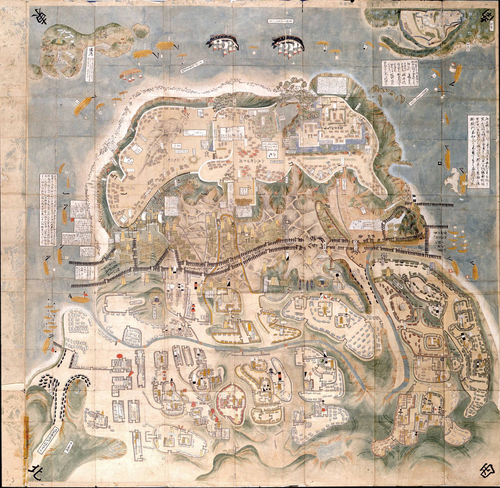
A rebellion of largely Christian peasants and masterless samurai (ronin) erupts at Shimabara, protesting high taxes, famine, and religious persecution. Approximately 37,000 rebels, led by the teenage Amakusa Shiro, hold out against the shogunate's forces for five months in Hara Castle. The rebellion is crushed with the help of Dutch naval artillery, and all surviving rebels are executed. Christianity, which had gained up to 300,000 converts in Japan through Portuguese Jesuit missionaries since the 1540s, is driven underground. The rebellion confirms the shogunate's view of Christianity as a subversive foreign influence.
Sakoku — Japan Closes Its Doors
The Tokugawa shogunate completes its isolationist policy, known as sakoku ("closed country"). Japanese are forbidden from traveling abroad under penalty of death, and the construction of ocean-going ships is prohibited. All European traders except the Dutch are expelled from Japan. Dutch traders are restricted to the artificial island of Dejima in Nagasaki Harbor, under strict supervision. Limited trade continues with China and Korea through designated ports. This policy of national seclusion will last for more than 200 years, preserving Japan's political stability and cultural distinctiveness while cutting it off from global technological and scientific developments.
The Genroku Era — Cultural Flowering
The Genroku era marks the cultural high point of the Edo period, characterized by the rise of a vibrant urban merchant culture. Kabuki theater and ukiyo-e woodblock prints flourish; the haiku poet Matsuo Basho composes his finest works, including The Narrow Road to the Deep North; and the writer Ihara Saikoku publishes tales of the pleasure quarters. Despite the samurai class's loss of martial purpose in times of peace, they maintain their social status, while the merchant class accumulates economic power despite occupying the lowest rung of the Confucian social hierarchy.
Commodore Perry Arrives — The Black Ships
Commodore Matthew C. Perry of the United States Navy arrives at Edo Bay with four heavily armed warships (dubbed "Black Ships" by the Japanese), delivering a letter from President Millard Fillmore demanding that Japan open its ports to American trade and end its isolation. Perry's fleet is the most technologically advanced the Japanese have ever seen, demonstrating the power of modern naval and industrial technology. He announces that he will return the following year for an answer, and then departs. The appearance of the Black Ships triggers a political crisis in Japan, exposing the shogunate's inability to defend the country against foreign pressure.
The Convention of Kanagawa — Japan Opens
Commodore Perry returns with a larger fleet and negotiates the Convention of Kanagawa, the first unequal treaty between Japan and a Western power. The treaty opens the ports of Shimoda and Hakodate to American ships, guarantees the safety of shipwrecked American sailors, and allows a US consul to reside in Shimoda. Similar treaties follow with Britain, Russia, and the Netherlands. The shogunate's inability to reject Perry's demands gravely damages its prestige and triggers a wave of anti-Tokugawa sentiment.
The Harris Treaty — Full Commercial Relations
Townsend Harris, the first American consul to Japan, negotiates the Treaty of Amity and Commerce, giving the United States rights to trade at five ports, fixed low tariffs, and extraterritoriality for American citizens in Japan (exempting them from Japanese law). The treaty is signed without the emperor's approval, further weakening the shogunate's legitimacy. Similar unequal treaties with European powers follow. The resulting economic disruption, inflation, and resentment of foreign privilege fuel the Sonno Joi ("Revere the Emperor, Expel the Barbarians") movement.
The Ansei Purge and the Rise of Reform

Naosuke Ii, the Tairo (Great Elder) of the shogunate, launches a brutal crackdown on opponents of the treaties and the shogunate's policies. Known as the Ansei Purge, it arrests and executes reformers and imperial loyalists, including Yoshida Shoin, a prominent intellectual who had attempted to stow away on Perry's ships. Ii's repressive policies make him widely hated. He is assassinated by samurai in the Sakuradamon Incident in March 1860, marking the beginning of a violent period of political assassination that destabilizes the shogunate.
The Meiji Restoration — The Shogunate Ends

Emperor Meiji, then 15 years old, is declared the rightful ruler of Japan by reformers from the Satsuma and Choshu domains, effectively ending the Tokugawa shogunate. Shogun Tokugawa Yoshinobu had already resigned his post in November 1867, hoping to preserve Tokugawa influence within a new imperial government, but the restoration decree strips the Tokugawa of all authority. The brief Boshin War follows, culminating in the imperial forces' victory. The shogunate's capital of Edo is renamed Tokyo (Eastern Capital), and the emperor moves there from Kyoto. Japan embarks on a rapid program of political, military, and industrial modernization that transforms it into a world power within a generation.