
The Warsaw Uprising (1944)
On August 1, 1944, the Polish underground Home Army rose against the German occupation of Warsaw, timing the revolt to liberate the capital before the Red Army reached it, in the hope of restoring a sovereign Polish state rather than a Soviet client. For sixty-three days roughly 40,000-50,000 Polish fighters, supported by the city's civilian population, fought the German garrison in house-to-house combat that the SS answered with massacres and the systematic demolition of entire districts. The Western Allies flew supply missions from Italy at heavy cost, while Soviet forces halted on the east bank of the Vistula, a decision that remains one of the most debated episodes of the war. The rising ended in surrender on October 3, 1944, followed by the total destruction of the city under Himmler's orders and the deaths of well over 150,000 Polish civilians.
Events
Operation Tempest and the Decision to Rise

The rising grew out of Operation Tempest (Burza), the Home Army's plan to stage nationwide uprisings against the retreating Germans and present the advancing Soviets with an organized, sovereign Polish authority. By late July 1944 Soviet forces had crossed into eastern Poland and German troops in Warsaw were evacuating, prompting the underground government-in-exile's delegate and the Home Army commander, General Tadeusz Bor-Komorowski, to order a rising in Warsaw. The decision was made on July 26-31 with full knowledge that the Red Army was days away and that a rising might fail if Soviet support did not come, and with the explicit political goal of having Warsaw in Polish hands before the Soviets arrived. The order went out for 5 p.m. ("W-hour") on August 1, 1944. Historians have debated the wisdom of the decision ever since, weighing the political aim of sovereignty against the near-certainty of catastrophic losses.
Location: Warsaw, Poland
W-Hour — The Rising Begins

At 5 p.m. on August 1, 1944, some 40,000-50,000 members of the Home Army (Armia Krajowa), of whom only about 2,500-4,000 were armed with serviceable weapons, attacked German positions across Warsaw, seizing large parts of the city center, the Old Town, Mokotow, Zoliborz, and Powisle within days. The German garrison of roughly 25,000, including police, SS, and Luftwaffe units, was thrown back to strongpoints, and the rising briefly controlled much of the capital. The population of the city, about a million people, largely supported the rising, and the underground state's organs — courts, postal service, press — operated openly in liberated districts. On August 3-4 the Home Army's radio operators made contact with London, and the rising became known worldwide, turning the battle into a political event as well as a military one. The Germans, surprised, appealed to reinforcements and to Heinrich Himmler, who ordered Warsaw crushed and its population exterminated or expelled.
Location: Warsaw, Poland
Allied Relief Efforts and Soviet Inaction

From early August the Western Allies attempted to supply the rising by air. From August 4 the RAF and Polish squadrons flew from Brindisi, Italy, a 1,600-kilometer round trip under heavy German flak, dropping supplies whose accuracy was poor and whose effects were limited; of 83 flights in August and September, losses were severe, and low-level re-supply from London's request to use Soviet airfields was refused by Stalin for weeks. On September 13, after the rising's military situation had already deteriorated, Soviet aircraft began their own supply drops over the city, and from September 14 Polish and Soviet units flew from seized bridgehead airfields. The Western Allies' attempts to use Soviet-controlled airfields were rebuffed until September 18, when a single large American shuttle flight from Italy to Poltava dropped supplies with heavy losses and limited effect. The Soviet halt on the Vistula, variously explained by military exhaustion and by Stalin's interest in seeing the non-communist underground destroyed, remains one of the war's most contested controversies.
Location: Warsaw, Poland / Brindisi, Italy
The Wola Massacre

From August 5 to 12, 1944, SS, police, and collaborationist units under Himmler's orders murdered tens of thousands of Polish civilians in the Wola district, in what became the largest single massacre of the rising and one of the largest of the entire war in occupied Europe. Men, women, and children were shot in the streets and in hospitals, including patients and staff of the Wola hospital, and bodies were burned in courtyards on pyres. In parallel, units under Oskar Dirlewanger and other commanders carried out the systematic clearance of the city's western districts, killing civilians including in the Ochota district under Ukrainian and Russian collaborationist units. Estimates of the dead in Wola alone range from 30,000 to 65,000; overall civilian deaths during the rising are estimated at 150,000-200,000. The massacres shocked even some German commanders and served no military purpose; they were terror as policy, intended to break the rising and depopulate the city.
Location: Warsaw, Poland
The Fall of the Old Town

By late August the rising's strongest position, the Old Town, was under concentrated assault by German forces using heavy artillery, aerial bombing, Goliath tracked mines, and systematic tunnel warfare under the ruins. On September 2, after weeks of siege in which perhaps 30,000 people were killed or wounded and tens of thousands of civilians and fighters escaped or were captured through the sewers, the Old Town fell. The Home Army had hoped to hold the district to anchor the rising and to preserve a corridor to the city center; its loss was the rising's turning point. German forces then pressed into Powisle and Czerniakow, splitting the insurgent zone, and by mid-September the rising was confined to isolated pockets in the city center, Mokotow, and Zoliborz, with the population trapped in ruins without water, food, or medical care.
Location: Warsaw, Poland
Capitulation
With no hope of relief and tens of thousands of civilians at risk of starvation and massacre, the Home Army's commander General Tadeusz Bor-Komorowski signed the capitulation on October 2, 1944, after 63 days of fighting. In a significant legal concession, the German command under SS-Obergruppenführer Erich von dem Bach-Zelewski agreed to treat Home Army fighters as prisoners of war rather than as illegal combatants, a status the Germans had refused for most of the war to the underground's fighters. Roughly 15,000-20,000 Home Army soldiers went into captivity, joining thousands of civilians deported to camps, while the remaining population of central Warsaw, some 500,000 people, was expelled from the city. The rising's military outcome was a defeat, but the Home Army had held out far longer than most observers expected, and its fighters' conduct was later recognized in Allied and Polish memory as an act of national survival rather than a strategic error alone.
The Destruction of Warsaw
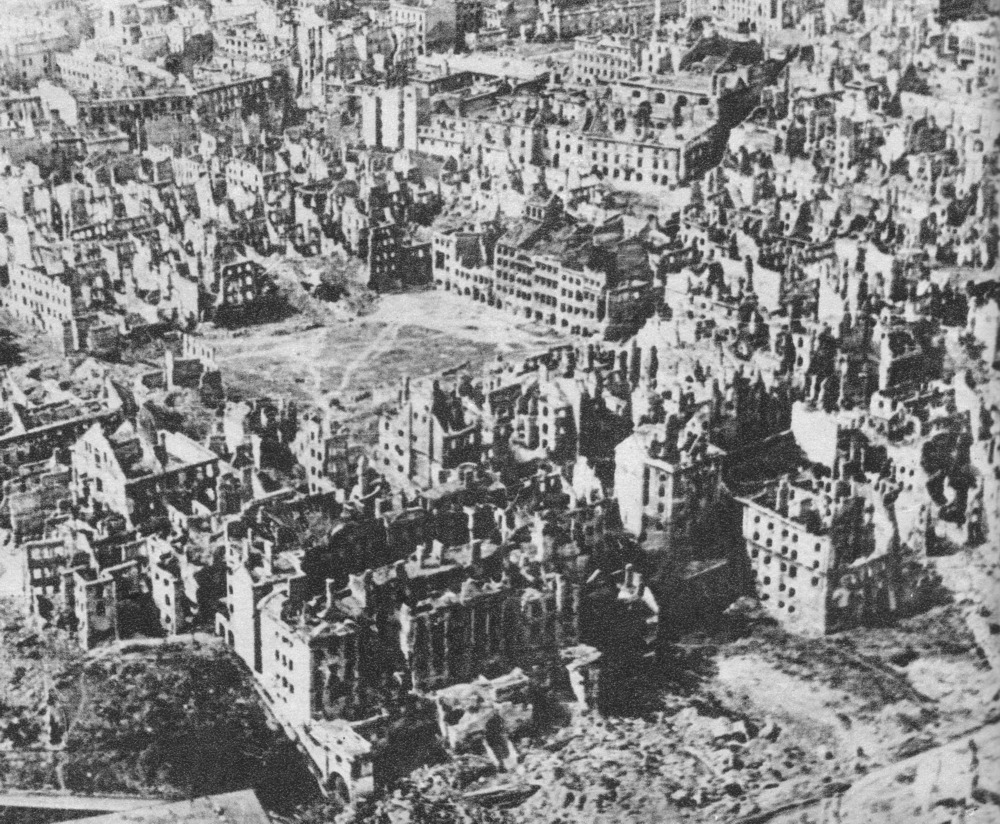
After the capitulation, on Himmler's explicit orders, German forces began the planned destruction of the city, burning and dynamiting building by building into January 1945. The systematic demolition, carried out by specially organized destruction battalions, razed an estimated 85 percent of Warsaw, including the Royal Castle, entire historic districts, libraries, and archives, with the express purpose of erasing the Polish capital and its national heritage. Huge collections were destroyed, including the famous State Library's collections of manuscripts. By the time the Red Army entered Warsaw on January 17, 1945, the city was a field of rubble with a few thousand people in hiding. The destruction of Warsaw is regarded as one of the largest single acts of deliberate urban destruction in modern history and formed the basis of Poland's postwar reconstruction and, much later, UNESCO's recognition of the rebuilt Old Town.
Location: Warsaw, Poland
Memory and Controversy
The rising's place in Polish memory has been contested ever since. Under communist Poland it was officially downplayed, and veterans of the Home Army were discriminated against, the rising having been a project of the anti-communist underground state. After 1989 it became a central national commemoration, marked annually on August 1 at 5 p.m. with citywide sirens and mourning. The historiographical debate centers on the wisdom of launching the rising: critics argue its leaders gambled the city's population on a political objective they could not achieve, while defenders argue the political stakes of sovereignty against Stalin made the gamble the underground's only realistic option, and that Soviet inaction was the decisive betrayal. The rising also shaped Polish identity in exile and at home, and the rebuilt Warsaw Old Town, inscribed by UNESCO in 1980, stands as a physical monument to both its destruction and its survival.