
The Pacific Proving Grounds (1946-1958)
From 1946 to 1958 the United States used the Marshall Islands as its principal nuclear test site, conducting 105 atmospheric and underwater detonations with a combined yield of roughly 210 megatons, nearly 80 percent of the total yield of all US nuclear tests. The program displaced entire island communities, spread fallout across inhabited atolls, and produced the 1954 Castle Bravo accident, the worst US radiological disaster. Compensation, cleanup, and health studies of the testing's legacy continue decades after the last atmospheric test.
Events
Bikini Islanders Relocated for Nuclear Testing

In 1946 the US Navy moved the residents of Bikini Atoll to the smaller and less productive Rongerik Atoll to clear the way for nuclear tests, presenting the relocation as temporary. Rongerik's lagoon could not support the community's traditional fishing and subsistence life, and within a year the relocated islanders were malnourished. The episode began a decades-long pattern in which Marshallese communities were moved repeatedly, from Rongerik to Kili Island and elsewhere, without a durable settlement of their claim to their home atoll.
Location: Bikini Atoll, Marshall Islands
Operation Crossroads Test Able

The United States detonates test Able, a nuclear bomb dropped from an aircraft over a target fleet assembled at Bikini Atoll, in the first of two tests designed to study the effects of atomic weapons on warships. The exercise, part of Operation Crossroads, marks the start of the Pacific Proving Grounds as a testing range. Able sinks several target vessels but produces little unexpected contamination.
Location: Bikini Atoll, Marshall Islands
Operation Crossroads Test Baker

The underwater detonation of test Baker sends a column of seawater and radioactive debris over the target fleet, becoming one of the most photographed nuclear explosions in history. Unlike Able, Baker heavily contaminates the target ships and the lagoon itself, demonstrating that a nuclear blast at or below the sea surface spreads lethal radioactivity beyond the immediate blast zone. The test forces the US Navy to abandon plans to return the target fleet to service and leaves the Bikini lagoon contaminated.
Location: Bikini Atoll, Marshall Islands
UN Creates the Strategic Trust Territory of the Pacific Islands

The United Nations grants the United States a strategic trusteeship over Micronesia, the only such trusteeship ever granted to the United States, covering some 2,000 islands across 3 million square miles (7.8 million square km). The trusteeship directive requires the United States to promote the economic advancement and self-sufficiency of the inhabitants and to protect them against loss of their lands and resources. Five days later, the US Atomic Energy Commission formally establishes the Pacific Proving Grounds, placing the trust territory at the center of the US nuclear weapons testing program.
Location: Bikini Atoll, Marshall Islands
Bikini Islanders Relocated to Kili Island

After a US investigative team concludes in late 1947 that the Bikini community on Rongerik is starving and must be moved immediately, the islanders are relocated again, to Kili Island. The columnists and investigators who documented the situation note that the residents are "actually and literally starving to death," and international press criticize the US Navy for ignoring them. Kili, which lacks a surrounding reef and lagoon, cannot support the islanders' traditional way of life, and the community remains in exile from Bikini.
Location: Kili Island, Marshall Islands
Castle Bravo Detonation
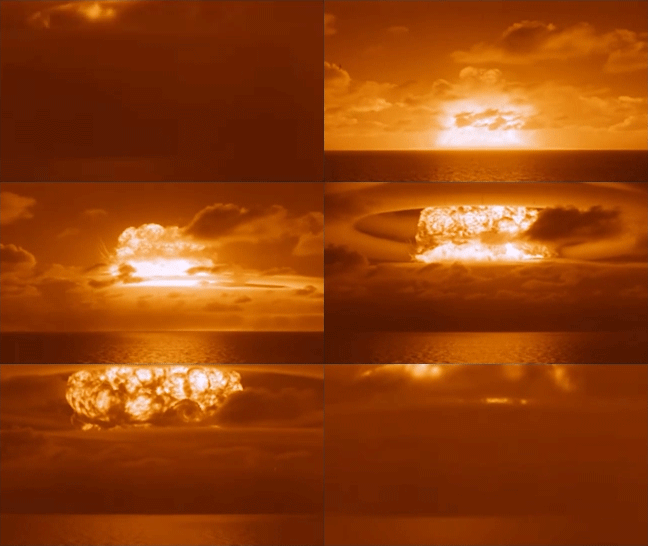
The United States detonates Castle Bravo, the first test of a lithium deuteride-fueled thermonuclear weapon using the Teller-Ulam design and the most powerful nuclear device the United States has ever detonated. The yield reaches 15 megatons, roughly two and a half times the predicted 6 megatons, because of unforeseen reactions involving lithium-7. The miscalculation spreads heavy radioactive fallout, much of it pulverized coral, across downwind atolls including several that had not been evacuated, and turns Bravo into the worst US radiological disaster of the nuclear era.
Location: Bikini Atoll, Marshall Islands
Daigo Fukuryu Maru Crew Contaminated by Fallout
The Japanese tuna fishing boat Daigo Fukuryu Maru (Lucky Dragon No. 5), operating roughly 130 km east of Bikini Atoll, is blanketed by Castle Bravo fallout, and its 23 crew members develop acute radiation syndrome. Chief radioman Kuboyama Aikichi dies on September 23, 1954, becoming the first fatality attributed to hydrogen bomb fallout. The incident sparks outrage in Japan and worldwide, contributes to an international movement against atmospheric nuclear testing, and leads the United States to pay 15.3 million dollars in compensation to Japan.
Location: Pacific Ocean, east of Bikini Atoll
Rongelap and Utirik Atolls Evacuated
Three days after the Bravo detonation, US authorities evacuate the residents of Rongelap and Ailinginae atolls, who had been blanketed with fallout and suffered radiation sickness, and later those of Utirik. A 2010 scientific assessment later concludes that among the 82 people exposed on Rongelap and Ailinginae in 1954, roughly 55 percent of cancers over their lifetimes are attributable to fallout radiation, with a large uncertainty range, along with a smaller but measurable excess for the Utirik population.
Location: Rongelap Atoll, Marshall Islands
Final Atmospheric Tests in the Pacific Proving Grounds
During 1958 the United States conducts the last atmospheric and underwater nuclear tests in the Marshall Islands, closing the testing period that began with Operation Crossroads in 1946. Over the twelve years of testing the US had conducted 105 atmospheric and underwater tests in the Pacific; the Marshall Islands tests, only 14 percent of all US tests by count, account for nearly 80 percent of the total yield, an estimated 210 megatons. International alarm over fallout, sharpened by Castle Bravo, pushes the United States and the Soviet Union toward the Limited Test Ban Treaty of 1963, which ended atmospheric testing.
Location: Bikini Atoll, Marshall Islands
Radiation Exposure Compensation Act Payments to Marshall Islanders
The United States establishes the Radiation Exposure Compensation Act, creating a compensation program for people exposed to fallout from nuclear testing. Through the act and related claims programs, at least 759 million dollars has been paid to Marshall Islanders for their exposure, alongside a separate 15.3 million dollar payment to Japan after the Castle Bravo accident. Many of the islands remain contaminated decades later, and scientific studies conclude that roughly 1.6 percent of cancers among the exposed Marshallese population are attributable to fallout radiation.
Location: Washington, D.C., United States