
The Katyn Massacre (1940)
In spring 1940 the Soviet NKVD executed nearly 22,000 captured Polish officers, police, and intelligentsia on Stalin's direct order, burying many of them in the Katyn Forest. When Nazi Germany discovered the graves in 1943, Moscow blamed the Germans and the lie held for fifty years, protected by wartime alliance politics and postwar silence. The Soviet acknowledgment of 1990 and the Russian State Duma's 2010 condemnation made Katyn a defining case study in historical denial and memory politics.
Events
Soviet Invasion of Poland and Mass Captivity
On 17 September 1939 the Soviet Union invaded eastern Poland under the secret protocol of the Molotov-Ribbentrop Pact, sixteen days after the German invasion from the west. Soviet forces took roughly 250,000 Polish soldiers, police officers, and border guards prisoner, in many cases without significant fighting since the Polish army was already collapsing against Germany. Thousands of captured officers were sent to special NKVD camps at Kozelsk, Starobelsk, and Ostashkov, where the NKVD subjected them to interrogation and political screening. The prisoner population included large numbers of reservists: physicians, professors, engineers, and clergy who formed the backbone of Poland's educated elite. Soviet authorities refused to treat them as prisoners of war under any convention they were prepared to honor. The camps would hold this group for six months before its fate was decided.
Location: Eastern Poland
The Politburo Execution Order

On 5 March 1940, the Soviet Politburo, in a decision signed by Stalin and countersigned by Voroshilov, Molotov, and Mikoyan, with Kalinin and Kaganovich concurring, ordered the execution of the Polish officer prisoners and selected inmates of western Ukraine and Belarus. The document classified the victims as "hardened and uncompromising enemies of Soviet authority." Lavrentiy Beria, head of the NKVD, had proposed the killings to permanently decapitate Polish society and ease the Sovietization of eastern Poland. The order specified shooting without summoning the prisoners or presenting charges, without documents, and without notifying next of kin. It represented a deliberate program of destroying Poland's leadership class rather than a battlefield decision. The one-page Politburo resolution survived in the Soviet archives and was published after 1990, providing documentary proof of the decision at the highest level.
Location: Moscow, Soviet Union
The Executions of April and May 1940

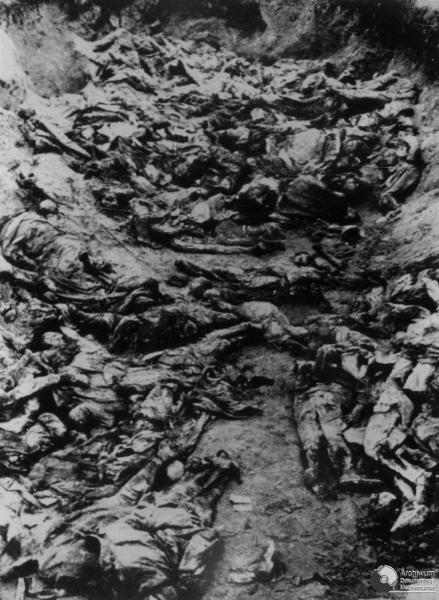
Between April and May 1940 the NKVD carried out mass executions at several sites: prisoners from Kozelsk were shot in the Katyn Forest near Smolensk, Starobelsk prisoners were killed in NKVD premises in Kharkiv, and Ostashkov prisoners were shot in the basement of the Kalinin (Tver) NKVD headquarters. In total 21,857 Polish prisoners were killed, according to the figure recorded in a Russian government list published in the 1990s: about 8,000 officers, 6,000 police officers, and the rest landowners, officials, clergy, and other members of the intelligentsia. The victims were ethnically diverse, including Ukrainians, Belarusians, and an estimated 700 to 900 Polish Jews. Each prisoner was shot in the back of the head and buried in mass graves. Families were left without information, and the killings remained officially unknown outside the NKVD. The operation was among the most systematic decapitations of a nation's elite in modern history.
Location: Katyn Forest, Smolensk Oblast, Soviet Union
Germany Announces the Discovery

On 13 April 1943, Berlin Radio announced that German forces, then occupying the Smolensk region after their invasion of the Soviet Union, had discovered mass graves in the Katyn Forest containing thousands of Polish officers in Polish uniforms, killed by pistol shots to the back of the neck. The Goebbels propaganda ministry exploited the discovery to split the Allies, publicizing the graves to the world and inviting an International Commission of European forensic experts, along with Polish Red Cross representatives, to examine the site. The exhumations recovered thousands of bodies with dated letters and diaries establishing that the victims had been alive in spring 1940. The German announcement forced Moscow into response, and Soviet authorities claimed the Germans had murdered the prisoners in 1941. Both occupying powers had now killed Poles en masse, and each sought to weaponize the graves for propaganda.
Location: Katyn Forest, Smolensk Oblast
Stalin Breaks with the Polish Government-in-Exile
When the London-based Polish government-in-exile, disturbed by German claims, asked the International Committee of the Red Cross on 20 April 1943 to investigate the Katyn graves, Stalin seized the opening. On 26 April 1943 the Soviet Union severed diplomatic relations with the Polish government-in-exile, denouncing it as collaborating with Hitler. The rupture had long-term consequences: it cleared the way for Stalin to sponsor the rival Union of Polish Patriots and, in 1944, the Soviet-backed Lublin committee that became communist Poland's foundation. Western Allied governments discouraged the Polish request to avoid damaging the alliance with Moscow, an early signal of the wartime silence that would follow. The Polish government's principled insistence on the truth cost it its place among the Allied decision-makers. Katyn thus altered the diplomacy of the war and the postwar fate of Poland.
Location: Moscow, Soviet Union
The Burdenko Commission and the Enforced Lie
After Soviet forces recaptured the Smolensk region, a commission headed by academician Nikolai Burdenko issued a January 1944 report blaming the German army for the Katyn killings, citing forensic claims that were later shown to be fabricated, including forged spring-1941 documents planted in the graves. The Soviet version became the official truth in the Soviet bloc and was enforced in communist Poland, where discussion of Katyn was censored for decades and the phrase "Katyn crime" could itself invite prosecution. Wartime Western governments had received intelligence confirming Soviet responsibility, including reports from POW sources, but publicly endorsed the Soviet account for alliance reasons; a 1952 US House select committee under Ray Madden concluded the Soviets carried out the killings and called the suppression of the facts a stain on the record of the war. The enforced lie outlived Stalin by nearly four decades. Historians regard the Katyn cover-up as a foundational case of state historical denial.
Location: Moscow, Soviet Union
Gorbachev Acknowledges NKVD Responsibility
On 13 April 1990, TASS, on the fiftieth anniversary week of the executions, published the Soviet government's acknowledgment that Beria's NKVD had carried out the Katyn killings on Stalin's orders, breaking the official lie after fifty years. Mikhail Gorbachev handed Polish authorities archival materials and opened a joint investigation, while Poland's Solidarity-led government commemorated the victims publicly for the first time. Soviet and later Russian prosecutors (1990-2004) confirmed Soviet responsibility for the massacres but refused to classify them as war crimes, closed the case on the grounds that the perpetrators were dead, and classified key files. The acknowledgment transformed Polish-Soviet relations but left questions of legal classification and full disclosure unresolved. Russia's Supreme Court in later years partially declassified volumes used in an earlier ruling. The truth was admitted; the accountability remained incomplete.
Location: Moscow, Soviet Union
The Duma Condemnation and Memory Politics
On 26 November 2010 the Russian State Duma approved a declaration explicitly condemning Stalin and other Soviet officials for ordering the Katyn massacre, a statement driven by warming relations with Poland after Russian Prime Minister Putin and Polish Prime Minister Donald Tusk jointly commemorated the victims at Katyn in April 2010. The rapprochement was shadowed days later by the Smolensk air crash that killed Polish President Lech Kaczynski and 95 others en route to the Katyn commemoration, an event that itself became entangled with Katyn memory in Polish politics. The European Court of Human Rights in Janowiec v. Russia (2012) found that Russia's investigation had fallen short but declined to rule the case admissible on the merits. In 2021 the Russian Ministry of Culture downgraded the Katyn memorial complex from federal to regional heritage status, signaling renewed official distance. Katyn remains a barometer of Russian-Polish relations and of how states confront their buried crimes.
Location: Moscow, Russia