
The History of Money
Money began as accounting: tally marks, grain debts, and ledgers in the temples of Mesopotamia predate any coin by thousands of years. Stamped metal coinage emerged in Lydia in the 7th century BC and spread through the Greek and Roman economies, while Song China invented true paper money in 1023 and European banknotes followed in the 17th century. The gold standard, Bretton Woods, and the 1971 end of dollar-gold convertibility transformed money from a commodity-backed token into pure fiat, and credit cards plus electronic banking moved exchange onto networks. Bitcoin's launch in 2009 opened the question of stateless digital money. Across five millennia, societies have repeatedly reinvented how they record debt, store value, and settle exchange.
Events
Money of Account Appears in Mesopotamia

Long before coins existed, temple scribes in Mesopotamia recorded debts, grain deliveries, and labor obligations on clay tablets, creating the earliest known money of account. Commodity goods such as barley, livestock, and cowrie shells circulated as media of exchange, but the decisive development was the ledger: a recorded credit that could be transferred, settled, and held over time. Accounting records dating back more than 7,000 years have been excavated in the region, and scholars such as David Graeber argue that credit ledgers, not barter, were the original form of money. Tally sticks used for correspondence counting go back as far as the Ishango bone, roughly 20,000 years old, found near one of the sources of the Nile. The Mesopotamian system already contained the essential logic of money, representing value as a recorded claim rather than a physical token.
Location: Mesopotamia (Iraq)
The First Coins Are Minted in Lydia

In the late 7th century BC, under King Alyattes of Lydia, the state began stamping small lumps of electrum, a natural gold-silver alloy, with official emblems, producing the first true coinage. These coins carried a guaranteed weight and purity backed by the king's seal, which allowed them to circulate at face value rather than by assay at every transaction. Lydia's successor Croesus introduced bimetallic gold and silver coinage around 550 BC, establishing a standard that Greek city-states quickly imitated. The innovation spread from Iberia to India within two centuries and transformed long-distance trade by providing a portable, countable, and standardized store of value. Numismatists treat these Lydian electrum issues as the starting point of the entire coinage tradition, and examples survive in major museum collections.
Location: Sardis, Lydia (Turkey)
Rome Introduces the Denarius

Around 211 BC, during the Second Punic War, the Roman Republic reformed its monetary system and introduced the silver denarius, which became the standard coin of the Mediterranean world for the next four centuries. The denarius financed Rome's armies and integrated the economies of Italy, Iberia, North Africa, and the eastern Mediterranean into a single monetary zone. Over time successive emperors reduced the coin's silver content to fund military spending, a debasement that accelerated in the 3rd century AD under emperors such as Caracalla and contributed to the inflation crisis of that era. The denarius is repeatedly cited in classical sources, from the Gospels' tribute question to Roman pay records, and its debasement is a textbook case of the political pressures on state money. Roman coin hoards found across Europe trace the currency's reach and decline.
Location: Rome, Italy
Song China Issues the First Government Paper Money
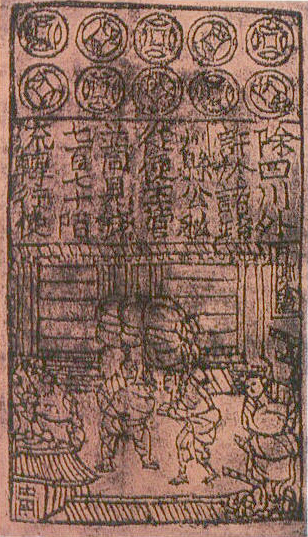
In 1023 the Song dynasty's imperial government took over private promissory notes circulating in Sichuan and issued the world's first state-backed paper currency, the Jiaozi, from a government printing bureau in Chengdu. Paper money solved a real logistical problem: Sichuan's iron coinage was so heavy that large transactions required carts of metal, and merchants had long traded receipts as a substitute. The Song state standardized the notes, imposed denomination limits, and managed convertibility, though later over-issuance under the Jin and Yuan dynasties produced severe depreciation. Marco Polo's account of Yuan paper currency, written in the 1280s, introduced the concept to European readers and became one of the most discussed passages of his travels. Song China's experiment established paper as a genuine state instrument of monetary policy centuries before Europe adopted it.
Location: Chengdu, Song China
The Spanish Dollar Becomes the World Trade Coin
Spain's 1497 monetary reform created the eight-real piece, the "piece of eight" or Spanish dollar, minted in huge quantities from Mexican and Peruvian silver after the 1540s. The coin circulated from Manila to Amsterdam to the American colonies and remained legal tender in the United States until 1857, making it the closest thing to a global currency before the modern era. Its ubiquity influenced monetary standards worldwide: the U.S. dollar, the Chinese yuan, the Mexican peso, and numerous other currencies trace their names and decimal structure directly to the Spanish dollar. Its silver came from mines such as Potosí, whose output financed Habsburg wars and reshaped global trade flows in the 16th and 17th centuries. The coin's persistence across empires made it the de facto standard of exchange for three centuries.
Location: Spain / Global
Stockholms Banco Issues Europe's First True Banknotes
In 1661 Johan Palmstruch's Stockholms Banco began issuing Europe's first true paper banknotes, credit notes that circulated as currency and could be redeemed for the bank's coin deposits. The innovation spread quickly: the Bank of England was founded in 1694 partly to finance government borrowing and soon issued notes of its own, and by the 18th century banknotes were a standard instrument of European finance. Palmstruch's bank over-issued and collapsed in 1668, a cautionary episode that shaped later banking regulation, but the note itself had proven its utility. Paper currency allowed states and banks to expand credit far beyond their metal reserves, laying the foundation for modern central banking. Sweden's Riksbank, the direct successor of Stockholms Banco, is recognized as the world's oldest central bank.
Location: Stockholm, Sweden
Britain Adopts the Gold Standard
In 1821 Britain completed the transition to full convertibility of banknotes into gold, formalizing the classical gold standard that would anchor international finance for the next century. The move built on Isaac Newton's 1717 mint valuation of gold, which in practice put Britain on a de facto gold standard long before the law caught up. Under the system, currencies were defined as fixed weights of gold, exchange rates between gold-standard countries were stable, and international trade expanded on that predictability. Britain's dominance of 19th-century commerce made sterling and gold the core of global finance, and most major economies adopted the standard by the 1870s. The system was suspended during World War I, briefly restored in the 1920s, and abandoned in the 1930s, a trajectory that set up the Bretton Woods negotiations of 1944.
Location: London, United Kingdom
Bretton Woods Creates the Postwar Monetary Order
In July 1944, 44 Allied nations met at Bretton Woods and agreed to a postwar monetary system in which the U.S. dollar was pegged to gold at $35 an ounce and other currencies were pegged to the dollar. The conference also created the International Monetary Fund and the World Bank, institutions designed to stabilize exchange rates and finance reconstruction and development. The system underpinned three decades of unprecedented trade growth but contained an inherent contradiction: the world needed dollars for reserves, yet dollar expansion threatened the gold backing, the dilemma economist Robert Triffin identified. On August 15, 1971 President Richard Nixon suspended dollar-gold convertibility, ending the system's central promise and inaugurating the modern era of freely floating fiat currencies. The Bretton Woods institutions continue to operate as pillars of the international monetary system.
Location: Bretton Woods, New Hampshire
The Credit Card Launches Consumer Electronic Payment
In 1950 Frank McNamara founded Diners Club after a legendary Manhattan dinner in which he realized he had forgotten his wallet, issuing the first multi-purpose charge card to a small group of New York businessmen. The card created the model of a third-party payment network that settled between merchants, banks, and consumers, a structure that BankAmericard (later Visa) and Master Charge (later Mastercard) scaled nationally and internationally in the following decades. Payment cards, and the electronic clearing infrastructure behind them, moved the center of gravity of money from cash to account-based credit and debit. Automatic teller machines appeared from 1967, and electronic funds transfer networks expanded through the 1970s and 1980s. The shift made consumer credit a mass-market product and set the stage for today's digital and mobile payment systems.
Location: New York, United States
Bitcoin Introduces Decentralized Digital Money
On January 3, 2009 an anonymous developer using the name Satoshi Nakamoto mined the first block of the Bitcoin network, creating the first decentralized digital currency that operates without any bank or state issuer. The project had been outlined in a whitepaper published on October 31, 2008, in the aftermath of the global financial crisis, proposing a peer-to-peer electronic cash system secured by proof-of-work and a public ledger. Bitcoin's market value grew from effectively nothing to hundreds of billions of dollars over the following decade, and thousands of competing cryptocurrencies and blockchain platforms followed. Governments and central banks responded with regulation, and many began exploring sovereign digital currencies of their own. The innovation reopened a five-thousand-year-old question, who has the authority to define and issue money, and made the answer genuinely contestable for the first time in the modern era.
Location: Global (internet)