
The Fight Against the Sicilian Mafia
Italy's confrontation with the Sicilian Mafia became one of the modern era's defining struggles between organized crime and the state. From the first parliamentary commission of the 1960s through the landmark Maxi Trial of 1986-1987, prosecutors such as Giovanni Falcone and Paolo Borsellino turned cooperating witnesses into a judicial weapon that put hundreds of bosses in prison. The Mafia answered with assassinations that stunned the country, and the state answered with emergency laws, prison regimes, and long manhunts that ended with the arrests of Salvatore Riina, Bernardo Provenzano, and Matteo Messina Denaro. The conflict reshaped Italian law, politics, and civil society, and its methods have been adopted by anti-mafia efforts worldwide.
Events
Ciaculli Bombing Provokes First State-Wide Response
On June 30, 1963, a car bomb in the Palermo suburb of Ciaculli killed seven police and military officers sent to defuse it, at the climax of a bloody internal Mafia war. The massacre transformed the conflict from a Mafia feud into a war against the Mafia, prompting the first concerted state anti-mafia effort in postwar Italy. Within a week the newly formed parliamentary Antimafia Commission held its first meeting, and a wave of arrests followed across Sicily. The bombing demonstrated that the Mafia's violence was no longer confined to its own members or to rural territory. The shock of Ciaculli set the terms of the state's engagement for the next three decades.
Location: Ciaculli, Palermo, Italy
Italy's First Anti-Mafia Law

In May 1965 the Italian Parliament passed Law 575, the first statute to use the word Mafia in Italian legislation. The law allowed special surveillance, forced residence outside a suspect's home region, and suspension of licenses and authorizations for people suspected of belonging to Mafia-type associations. Its practical effect was limited because the statute offered no legal definition of a Mafia association and no serious asset-seizure powers, and enforced removal spread Mafia networks into northern and central Italian cities. The commission that produced it spent thirteen years on its work before delivering a final report in 1976 that documented the Mafia's penetration of public institutions. Amending this framework became the central legislative task of the following decades.
Location: Rome, Italy
Rognoni-La Torre Law Creates the Mafia Criminal Association Offense
Following the May 1982 assassination in Palermo of General Carlo Alberto Dalla Chiesa, the senior anti-terrorism commander sent to fight the Mafia, Parliament passed the Rognoni-La Torre Law (Law 646/1982) in September. The law introduced Article 416-bis of the penal code, defining criminal association of the Mafia type and, crucially, allowing confiscation of assets that defendants could not legitimately account for. For the first time the state could prosecute the organization itself rather than individual crimes. The asset-conflict mechanism became the model for anti-organized-crime statutes worldwide. The law passed amid a wave of killings that made its urgency undeniable.
Location: Rome, Italy
Tommaso Buscetta Becomes the First Major Collaborator of Justice
In 1984, after the new Mafia leadership under Salvatore Riina ordered the murder of his two sons and other relatives, the Palermo boss Tommaso Buscetta decided to cooperate with the judicial authorities. His testimony to Giovanni Falcone, first in Rome and New York and then at the Palermo trials, provided the first insider's systematic account of Cosa Nostra's structure, its commission, and its rules. Buscetta's collaboration made possible the evidentiary core of the Maxi Trial and of US prosecutions in the Pizza Connection case. Earlier attempts at collaboration, such as Leonardo Vitale's in 1973, had been dismissed, and their authors killed. The pentiti framework that grew from Buscetta's choice became the state's most effective investigative instrument.
Location: Palermo, Italy / New York, USA
The Maxi Trial Opens in the Palermo Bunker
On February 10, 1986, the Maxi Trial against Cosa Nostra opened in a specially built fortified courthouse inside Palermo's Ucciardone prison, with 475 defendants in a single proceeding. Giovanni Falcone led the prosecution team alongside Paolo Borsellino and other magistrates of the Palermo pool, using the testimony of dozens of collaborating witnesses. The defendants included most of the organization's senior leadership, and the trial was held in the face of threats and intimidation of jurors and judges. It was the first time the Mafia was tried as an organization rather than as a series of individual crimes. The proceeding drew worldwide attention to the Italian judiciary's method.
Location: Palermo, Italy
341 Convictions Confirmed by Italy's Supreme Court
The first-degree Maxi Trial verdict of December 16, 1987, convicted 341 defendants with sentences including 19 life terms, and on January 30, 1992, Italy's Supreme Court of Cassation confirmed the judgments in full. The confirmation made the Maxi Trial a legal landmark: Cosa Nostra existed as a provable organization, and its structure and crimes were established facts in Italian law. The Cassation ruling also documented relations between mafiosi and public officials, findings that implicated parts of the political establishment. Riina's faction responded to the confirmed verdicts with a terror campaign against the state. The ruling's findings on collusion remain a reference point in Italian political debate.
Location: Rome, Italy
The Assassinations of Falcone and Borsellino
On May 23, 1992, a half-tonne bomb exploded on the motorway near Capaci under Giovanni Falcone's car, killing the judge, his wife Francesca Morvillo, and three escort officers. On July 19, 1992, a bomb killed Paolo Borsellino outside his mother's apartment in Palermo along with five escort officers. The killings, ordered by the Riina faction in retaliation for the Maxi Trial verdicts, were the deadliest attacks on the Italian state since the 1980s. Their funerals drew the country's largest public gatherings in a generation, and the runway at Capaci became a memorial. The assassinations triggered the state's harshest emergency measures and a determination that the Mafia's military strategy had failed to break the judiciary.
Location: Capaci and Palermo, Italy
Article 41-bis and the Emergency Prison Regime
In the months after the assassinations, Parliament extended and mass-applied the strict 41-bis prison regime, severing jailed bosses from nearly all outside contact and from communication with their organizations. The measure, first introduced for terrorist prisoners in the 1980s and extended to the Mafia from 1991, was credited by prosecutors with breaking the bosses' command capacity from prison and prompting mass defections of collaborators. Defense lawyers and some civil-liberties groups challenged the regime before the Constitutional Court and the European Court of Human Rights, which upheld it with procedural conditions that Italy was required to implement. The debate over 41-bis continues in Italian politics to this day. The regime remains a cornerstone of anti-Mafia strategy.
Location: Rome, Italy
Arrest of Salvatore Riina, Boss of Bosses
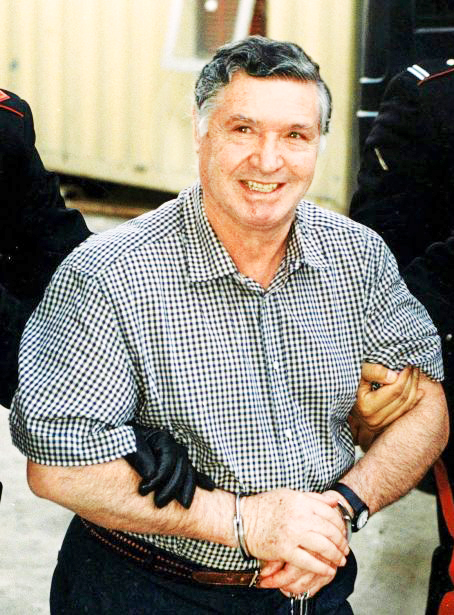
On January 15, 1993, Carabinieri officers stopped a car in Palermo and arrested Salvatore Riina, the Corleone boss who had directed the terror campaign and spent 23 years as a fugitive. The arrest, conducted without a shot, demonstrated the effectiveness of the intelligence work pioneered by Falcone's team and continued by successors after his death. Riina was already serving multiple life sentences from the Maxi Trial and subsequent trials, and he later died in prison in 2017. His capture marked the failure of the strategy of war against the state that the Corleone leadership had pursued. Further long manhunts would take Provenzano in 2006 and Messina Denaro in 2023, each after decades underground.
Location: Palermo, Italy
Civil Society's Anti-Mafia Economy and the Arrest of Matteo Messina Denaro

On January 16, 2023, Carabinieri arrested Matteo Messina Denaro, the last of Cosa Nostra's boss-of-bosses figures, at a private clinic in Palermo after three decades as a fugitive. His capture was the work of a generations-long investigative effort and of the kind of social cooperation that had grown since the 1990s, when grassroots organizations and the addiopizzo movement, founded in 2004, pushed businesses and consumers to refuse Mafia protection money. The organization that once terrorized the state has been reduced to a fragmented network under constant law-enforcement pressure, though it continues to profit from extortion and drug trafficking, and investigations still expose public-sector collusion. The arc from Ciaculli to this arrest spans the modern Italian state's capacity to confront organized crime. Messina Denaro died in custody in September 2023.
Location: Palermo, Italy