
The Tang Dynasty (618-907 AD)
The Tang dynasty was an imperial dynasty of China that ruled from 618 to 907 AD, with an interregnum from 690 to 705 when Empress Wu Zetian seized the throne. Historians generally regard the Tang as a high point of Chinese civilization and a golden age of cosmopolitan culture, with territory surpassing that of the Han dynasty and cultural influence extending across East Asia.
Events
Founding of the Tang Dynasty

Li Yuan, the Duke of Tang and governor of Taiyuan, took advantage of the collapse of the Sui dynasty to seize power. In winter 617, Li Yuan occupied Chang'an and acted as regent to the puppet child-emperor Yang You. On 18 June 618, news arrived of the murder of Sui Emperor Yang by General Yuwen Huaji, and Li Yuan declared himself Emperor Gaozu of the newly founded Tang dynasty. Li Yuan had risen in rebellion in 617 with his son Li Shimin and his daughter Princess Pingyang, who raised and commanded her own troops. The House of Li was of Han Chinese origin but with Xianbei heritage through Li Yuan's mother Duchess Dugu.
Location: Chang'an, China
Xuanwu Gate Incident and Taizong's Reign

On 2 July 626, Li Shimin, the Prince of Qin, ambushed and killed his elder brother Crown Prince Li Jiancheng and younger brother Li Yuanji at the Xuanwu Gate of the Tang palace, in what became known as the Xuanwu Gate Incident. Fearing assassination, Li Shimin took this preemptive action before his father's planned deposition of him. His father Emperor Gaozu abdicated shortly thereafter, and Li Shimin ascended the throne as Emperor Taizong. Despite contradicting the Confucian value of filial piety, Taizong proved a capable leader who listened to the advice of his council. In 628, he held a Buddhist memorial service for the casualties of war, and in 629 he had Buddhist monasteries erected at the sites of major battles.
Location: Chang'an, China
Defeat of the Eastern Turks

During the Tang campaign against the Eastern Turks, the Eastern Turkic Khaganate was destroyed after the capture of its ruler Illig Qaghan by the famed Tang military officer Li Jing, who later became a Chancellor of the Tang dynasty. With this victory, the Turks accepted Taizong as their khagan, a title rendered as Tian Kehan, in addition to his rule as emperor of China. On 11 June 631, Emperor Taizong sent envoys to the Xueyantuo bearing gold and silk to secure the release of enslaved Chinese prisoners, succeeding in freeing 80,000 Chinese men and women and returning them to China. This victory marked the beginning of Tang dominance over the northern steppe.
Location: Inner Asia
Annexation of the Western Regions and Protectorate General

Under Emperor Taizong, military campaigns were dispatched to the Western Regions against Gaochang in 640, Karasahr in 644 and 648, and Kucha in 648. The Silk Road, initially formulated during the Han dynasty, was reopened by the Tang in 639 when Hou Junji conquered the West, remaining open for almost four decades. Under Emperor Gaozong, the Western Turkic Khaganate was finally annexed in 657 after General Su Dingfang's defeat of Khagan Ashina Helu at the Battle of Issyk Kul. Emperor Gaozong established several protectorates governed by a Protectorate General, extending Chinese sphere of influence as far as Herat in western Afghanistan.
Location: Tarim Basin, Central Asia
Xuanzang's Return from India

The Buddhist monk Xuanzang (d. 664) completed a 17-year pilgrimage to India in 645, returning with valuable Sanskrit texts to be translated into Chinese. His journey was later recorded in the Great Tang Records on the Western Regions, compiled by Bianji. Xuanzang's travels brought back detailed accounts of Buddhist sites and scholarship, contributing to the flourishing of Buddhism during the Tang period. Buddhism became a major influence in Chinese culture, with native Chinese sects such as Chan (Zen) Buddhism gaining prominence. Major translators at Chang'an worked on Buddhist texts, and the religion's influence spread to Korea, Japan, and other parts of East Asia.
Location: Chang'an, China
Establishment of the Equal-Field System and Civil Service Examinations

The Tang maintained a civil-service system by recruiting scholar-officials through standardized examinations and recommendations to office. The earliest law code to survive was established in 653, divided into 500 articles specifying different crimes and penalties. The Tang Code was largely retained by later Chinese dynasties, including the Ming code of 1397, and was also adopted by neighboring polities in Vietnam, Korea, and Japan. By the late 7th century, the jinshi degree had become the primary route to high office, displacing hereditary privilege. Students of Confucian studies were candidates for the imperial examinations, which tested both knowledge of the Confucian classics and literary abilities including poetry composition.
Location: China
Conquest of Goguryeo Korea
With joint attacks by Silla and Tang armies under commander Li Shiji, the Kingdom of Goguryeo was destroyed by 668 AD after years of conflict. The Tang had initially established a military campaign against Goguryeo in 644 but withdrew after failing to overcome the successful defense led by General Yŏn Kaesomun. The Tang-Silla alliance had earlier defeated Baekje and their Yamato Japanese allies at the Battle of Baekgang in August 663. From 668 to 676, the Tang Empire controlled northern Korea. However, Silla broke the alliance in 671 and began the Silla-Tang War, expelling Tang forces by 676. The Tang abandoned Korean campaigns after an Eastern Turk revolt in 679.
Location: Korean Peninsula
Empress Wu Zetian's Zhou Dynasty
Having entered Emperor Gaozong's court as a lowly consort, Wu Zetian acceded to the highest position of power in 690, establishing the short-lived Wu Zhou dynasty. She proclaimed the Tianshou era of Wu Zhou on 16 October 690, becoming the only legitimate Chinese female emperor in history. To legitimize her rule, she circulated a document known as the Great Cloud Sutra, predicting a female monarch who would dispel disaster from the world. She introduced numerous revised written characters for the language, which reverted to original forms after her death. Arguably her most important legacy was diminishing the hegemony of the Northwestern aristocracy, allowing people from other clans to become more represented in Chinese politics.
Location: Luoyang, China
Emperor Xuanzong's Reign and the Tang Zenith
Emperor Xuanzong's 44-year reign, beginning in 712, has been characterized as a golden age of economic prosperity and pleasant lifestyles within the imperial court. Xuanzong abolished the death penalty in 747, and in 730 there were only 24 executions in the empire. He bowed to the consensus of his ministers and made efforts to staff government ministries fairly. His chancellor Zhang Jiuling worked to reduce deflation and increase the money supply, while his successor Li Linfu favored government monopoly over coinage. The Tang capital at Chang'an, with population reaching two million, was the largest city in the world for much of the dynasty's existence and was cosmopolitan, with Persians, Central Asians, Japanese, Koreans, and others living within.
Location: Chang'an, China
Battle of Talas
At the Battle of Talas in 751, the Tang army led by Gao Xianzhi was defeated by the Abbasid Caliphate army under Ziyad ibn Salih near present-day Tashkent. Sources differ on force numbers, with Chinese sources stating the Tang army suffered 20,000 to 30,000 casualties. The battle is sometimes credited with marking the moment when paper-making technology was transmitted to the Islamic world, after Tang papermakers were captured. The defeat ended Tang westward expansion in Central Asia, though Chinese influence had already begun to decline. The battle is also remembered in Chinese sources as one of the major military setbacks of the Tang.
Location: Talas River, Central Asia
An Lushan Rebellion
An Lushan, a half-Sogdian, half-Turkic Tang commander since 744, led a massive rebellion beginning in 755 with an army of more than 100,000 troops, the most serious challenge to the Tang dynasty. After capturing Luoyang, An Lushan named himself emperor of a new, but short-lived, Yan state. The court fled Chang'an. The heir apparent raised troops in Shanxi and Emperor Xuanzong fled to Sichuan, calling upon the help of the Uyghur Khaganate in 756. The Uyghurs helped recapture Chang'an but demanded enormous tribute in silk. Even Abbasid Arabs assisted in putting down the rebellion. An Lushan was killed by one of his eunuchs in 757, but the rebellion and its aftermath continued to devastate the empire until 763.
Location: Northern China
Tang Cultural Influence on East Asia
The Tang exerted a powerful cultural influence over neighboring East Asian nations, particularly Japan and Korea. Japanese envoys to China continued until 894, when Emperor Uda halted them upon persuasion by Sugawara no Michizane. The Japanese Emperor Tenmu established his conscripted army on the Chinese model, based his state ceremonies on the Chinese model, and constructed his palace at Fujiwara on the Chinese model of architecture. Cities like Heian-kyo (present-day Kyoto) were arranged in a checkerboard street pattern following the Chang'an model. The Japanese monk Ennin (794-864) wrote of his travels along the Grand Canal, and the monk Enchin stayed in China from 839 to 847, and again from 853 to 858. The Tang-equal-field system was implemented in Japan and Korea.
Location: East Asia
Great Persecution of Buddhism

In 845, Emperor Wuzong shut down 4,600 Buddhist monasteries along with 40,000 temples and shrines, forcing 260,000 Buddhist monks and nuns to return to secular life. This episode, which became known as one of the Four Buddhist Persecutions in China, marked a major reversal of the Tang dynasty's earlier support for Buddhism. The prominent status of Buddhism in Chinese culture had begun to decline as the dynasty and central government weakened during the late 8th and 9th centuries. Although the ban was lifted just a few years later, Buddhism never regained its once dominant status. This period also saw a revival of interest in native Chinese philosophies such as Confucianism and Taoism.
Location: China
Huang Chao Rebellion
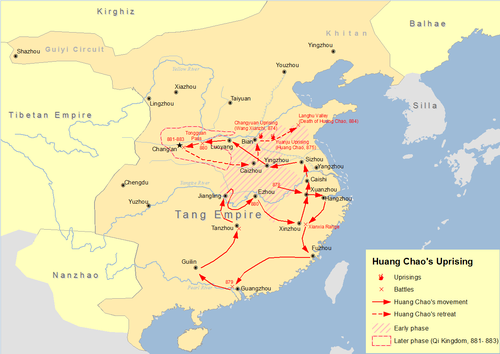
A rebellion by Huang Chao (874-884) devastated both northern and southern China, took an entire decade to suppress, and resulted in the sacking of both Chang'an and Luoyang. In 878-879, Huang's army committed a massacre in the southern port of Guangzhou against foreign Arab and Persian Muslim, Zoroastrian, Jewish, and Christian merchants. A medieval Chinese source claimed that Huang Chao killed eight million people. The Tang never recovered from Huang's rebellion, which paved the way for the later overthrow of the dynasty. Large groups of bandits in the size of small armies ravaged the countryside in the last years of the Tang, smuggling illicit salt and ambushing merchants.
Location: China
End of the Tang Dynasty

During the last two decades of the Tang dynasty, the gradual collapse of central authority led to the rise of rival military figures Li Keyong and Zhu Wen in northern China. In 901, from his power base of Kaifeng, Zhu Wen seized control of the Tang capital Chang'an. By 903, he forced Emperor Zhaozong to move the capital to Luoyang, and in 904 he assassinated Emperor Zhaozong. In 905, Zhu executed the brothers of Emperor Ai and many officials. In 907, the Tang dynasty ended when Zhu deposed Ai and took the throne for himself, establishing the Later Liang dynasty and inaugurating the Five Dynasties and Ten Kingdoms period. A year later, Zhu had the deposed Emperor Ai poisoned. Li Keyong's son Li Cunxu later declared a "restored" Tang (Later Tang) in 923, but southern China remained splintered until Song reunification in 960.
Location: Luoyang, China