
Sun Yat-sen — Founding Father of Modern China
Sun Yat-sen was a Chinese revolutionary, physician, and political philosopher who is revered as the Father of Modern China for his role in overthrowing the Qing dynasty and founding the Republic of China. His Three Principles of the People - nationalism, democracy, and livelihood - shaped the political trajectory of modern China and continue to influence governance across the Chinese-speaking world.
Events
Birth and Education

Sun Yat-sen was born Sun Te-ming on November 12, 1866, in the village of Cuiheng in Guangdong province, southern China, during the late Qing dynasty. He received an early education in Hawaii (1879-1882) before attending a medical school in Guangzhou. He graduated from the Hong Kong College of Medicine for Chinese in 1892, qualifying as one of the earliest Western-trained physicians in China. His education abroad exposed him to modern political ideas and Western democratic institutions.
Founding of the Revive China Society and First Uprising

Concerned by China's weakness in the face of foreign powers and corrupt Qing rule, Sun founded the Revive China Society (Xingzhonghui) in Honolulu in November 1894, the first modern revolutionary organization in the Chinese diaspora. The society subscribed to the slogan "Expel the barbarians, restore China, and establish a united government." In 1895, Sun organized a first uprising in Guangzhou, which failed before it could properly begin. Sun fled China into exile, beginning a 16-year period abroad.
Exile and Development of Revolutionary Philosophy

After the failed Guangzhou uprising, Sun traveled to Japan, Europe, and the United States, raising funds and support among overseas Chinese communities. In 1896, he was kidnapped by Qing agents in London and held at the Chinese legation, narrowly escaping execution after public outcry. The incident made him internationally famous. In Europe, he studied Western political systems and refined his revolutionary philosophy, eventually formulating his Three Principles of the People.
Founding of Tongmenghui
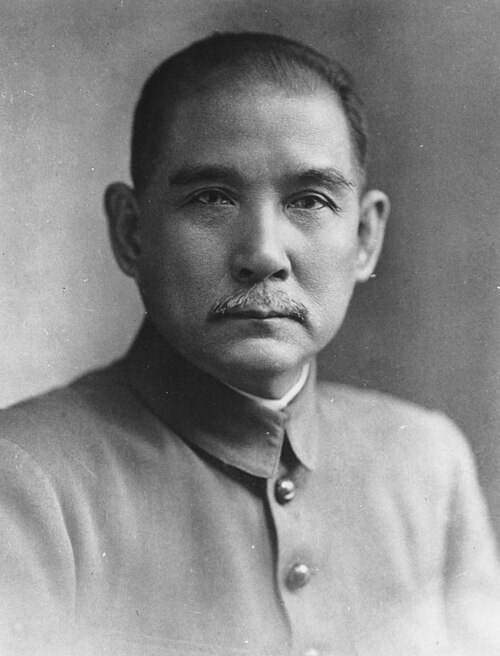
Sun founded the Tongmenghui (United League) in Tokyo on August 20, 1905, uniting several Chinese revolutionary groups under a single banner. The organization adopted Sun's Three Principles of the People: minzu (nationalism - ending Manchu rule and foreign domination), minquan (democracy - establishing a republic), and minsheng (livelihood - land reform and social welfare). The Tongmenghui organized a series of armed uprisings across southern China between 1906 and 1911, all of which failed, but each failure built revolutionary momentum.
Wuchang Uprising and the Xinhai Revolution
An army mutiny in Wuchang on October 10, 1911, sparked the Xinhai Revolution. Provinces across China rapidly declared independence from the Qing dynasty. The revolution succeeded where earlier attempts had failed due to widespread discontent with Qing rule. Sun was in the United States when he learned of the uprising. He returned to China in December 1911, and on January 1, 1912, was inaugurated as the first Provisional President of the Republic of China in Nanjing.
Provisional Presidency and Ceding Power to Yuan Shikai
Sun served as Provisional President of the Republic of China for just 69 days, from January 1 to March 10, 1912. To secure the abdication of the Qing emperor and avoid civil war, Sun agreed to cede the presidency to the powerful northern general Yuan Shikai on the condition that Yuan would pressure the emperor to abdicate and establish a republican government. When he stepped down, Sun declared that this was a necessary sacrifice for national unity. Yuan Shikai's subsequent turn toward autocracy and self-declared emperorship proved Sun's concerns justified.
The Second Revolution and Exile in Japan
After Yuan Shikai ordered the assassination of the parliamentary leader Song Jiaoren and consolidated autocratic power, Sun launched the "Second Revolution" in July 1913 - a military uprising of southern provinces against Yuan. The rebellion was quickly crushed, and Sun fled to Japan, where he reorganized his followers into a new revolutionary party. In Japan, he also married Soong Ching-ling, who became his political partner.
The Constitutional Protection Movement
Sun established a rival military government in Guangzhou, southern China, known as the Constitutional Protection Movement, aiming to restore the 1912 constitution that Yuan Shikai had dissolved. He was appointed Grand Marshal of a military government in 1917. Despite internal divisions and shifting alliances with local warlords, Sun maintained a base of power in Guangdong. In 1921, he was elected President of the Rump Republic in Guangzhou, but was forced to flee to Shanghai in 1922 when his ally Chen Jiongming turned against him.
Soviet Alliance and Reorganization of the Kuomintang
Facing military setbacks, Sun agreed to an alliance with the Soviet Union through the Sun-Joffe Manifesto of January 1923. The Soviet Union provided advisors, funding, and military assistance. Sun reorganized his party, renamed the Kuomintang (Nationalist Party), along Leninist lines with centralized leadership and a party army. He established the Whampoa Military Academy in 1924 with Chiang Kai-shek as its commandant and Zhou Enlai as political commissar. These reforms created the structure that would eventually unite China under KMT rule after Sun's death.
Three Principles of the People Finalized
Sun delivered a series of lectures in Guangzhou in January 1924, formally articulating his Three Principles of the People. He introduced a more radical interpretation that included "Three Great Policies": alliance with the Soviet Union, cooperation with the Chinese Communist Party, and support for peasants and workers. He also delivered the "Fundamentals of National Reconstruction," outlining a three-stage political transition for China: military unification, political tutelage, and constitutional democracy.
Final Journey and Death
Sun traveled to Beijing in late 1924 at the invitation of northern warlords to discuss national reunification, but the talks went nowhere. He was diagnosed with terminal liver cancer. Sun died on March 12, 1925, at age 58. His body was first placed at the Temple of Azure Clouds in Beijing, then moved to his permanent mausoleum in Nanjing in 1929. Sun Yat-sen is revered as the "Father of the Nation" by both the Republic of China in Taiwan and is acknowledged by the People's Republic of China as a "great national hero and patriot" who helped end imperial rule.