
The Spanish Inquisition (1478-1834)
The Tribunal of the Holy Office, authorized by Pope Sixtus IV in 1478 and administered by the Spanish Crown, pursued religious orthodoxy across the Spanish Empire for over three centuries. Originally aimed at identifying crypto-Jews among converted Catholics, it expanded to target Muslims, Protestants, and other groups, prosecuting an estimated 150,000 people and shaping Spanish society through expulsions, property confiscation, and blood-purity laws.
Events
Papal Bull Authorizes the Inquisition

Pope Sixtus IV issued the bull Exigit sincerae devotionis affectus, granting King Ferdinand II of Aragon and Queen Isabella I of Castile the authority to appoint inquisitors to deal with baptized Christians suspected of reverting to Jewish rites. The monarchs had requested the bull after reports of crypto-Judaism among conversos in Andalusia. The papal grant made the Spanish Inquisition distinct from the Medieval Inquisition, which had operated under papal control.
First Inquisitors Appointed
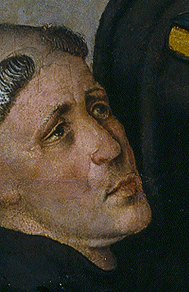
The Dominican friars Miguel de Morillo and Juan de San Martin were appointed as the first inquisitors of the new tribunal. Their appointment marked the operational beginning of the Spanish Inquisition, and tribunals were subsequently established in eight Castilian cities by 1492, including Toledo, Cordoba, and Valladolid.
First Auto-da-fe Executions in Seville
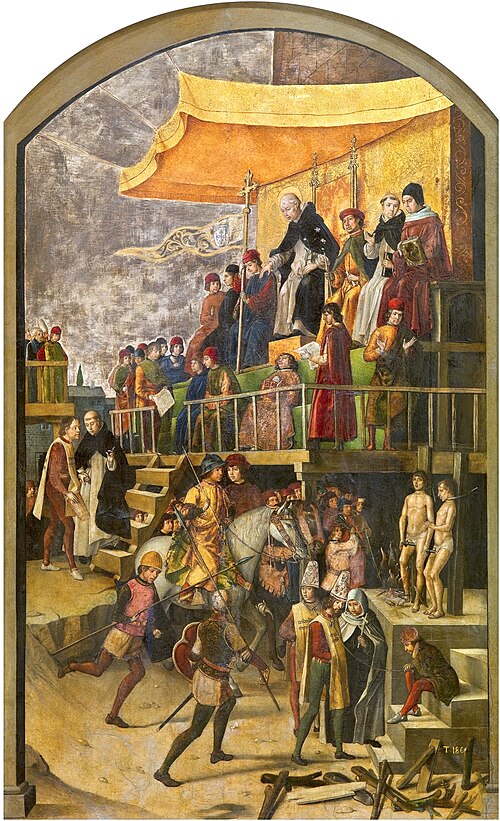
Six people were burned alive at the first auto-da-fe execution held in Seville. The public ceremonies, in which sentences were read and convicted heretics were handed to civil authorities for execution, became a defining feature of the Inquisition. Thousands of conversos fled in the following years, and the Crown confiscated the property of those convicted.
Torquemada Named Inquisitor General

Pope Sixtus IV appointed the Dominican friar Tomas de Torquemada, confessor to the Catholic Monarchs, as Inquisitor General of Aragon, Catalonia, and Valencia, uniting all Spanish Inquisition activity under a single leader. Torquemada subsequently codified inquisitorial procedures in a 28-article instruction manual in 1484, a code that remained largely unchanged for over three centuries. Under his leadership the Inquisition intensified its campaign against conversos.
The Alhambra Decree Expels the Jews of Spain

Ferdinand and Isabella issued the Alhambra Decree, ordering all Jews in Castile and Aragon to convert to Catholicism or leave the kingdoms by August 1492 under penalty of death and property confiscation. Estimates of those expelled range from 40,000 to 100,000, with many fleeing to Portugal, North Africa, and the Ottoman Empire. The decree was prompted in part by Torquemada's argument that remaining Jews encouraged conversos to revert to Judaism. The expulsion remained formally in effect until 1968.
Muslims of Granada Ordered to Convert

A royal decree forced Muslims in the Kingdom of Granada to convert to Christianity or face expulsion, following the completion of the Reconquista in 1492. The converted Muslims, known as Moriscos, subsequently came under Inquisition jurisdiction on suspicion of secretly practicing Islam. In the Crown of Aragon, most Muslims faced the same choice after the Revolt of the Brotherhoods (1519-1523).
The War of the Alpujarras and Morisco Persecution
A Morisco uprising broke out in the Alpujarras mountains of Granada, driven by resistance to forced conversion, heavy taxation, and the suppression of Arabic language and customs. The revolt was suppressed by royal forces by 1571, and about half the region's Moriscos were dispersed across Castile. In the aftermath, the Inquisition intensified its focus on Moriscos, who comprised 82% of the Granada tribunal's cases from 1560 to 1571.
Expulsion of the Moriscos
King Philip III, advised by the Duke of Lerma, ordered the expulsion of all Moriscos from Spain, citing fears of collaboration with Ottoman-backed Barbary pirates and doubts about the sincerity of their conversions. An estimated 300,000 Moriscos, about 4% of Spain's population, were expelled over the following years, with many settling in North Africa. The expulsion damaged the economies of Valencia and Aragon, which depended on Morisco labor.
The Grand Auto-da-fe of 1680
King Charles II presided over a grand auto-da-fe in Madrid marking his marriage, an event that drew an estimated 50,000 spectators. The tribunal sentenced 118 people, mostly conversos of Jewish descent, to penalties ranging from penance to execution by burning. The event illustrated both the public spectacle of Inquisition justice and the continuing focus on converso communities more than a century after the expulsion of Jews.
The Inquisition Is Abolished

A royal decree abolished the Spanish Inquisition, ending 356 years of operation. The institution had declined in the 18th century as Enlightenment ideas spread and its jurisdiction was curtailed, though it continued prosecuting cases of crypto-Judaism until 1818 and Freemasonry into the 1820s. Its abolition followed years of criticism from liberals and the broader context of political upheaval in Spain during the reign of Isabella II.