
The Spanish Armada (1588)
The Spanish Armada campaign of 1588, in which Philip II of Spain sent a fleet to invade England and relieve his army in the Netherlands, and its aftermath through the end of the Anglo-Spanish War in 1604. The campaign consolidated Protestant rule in England, demonstrated the dominance of naval gunnery, and left shipwrecks from Scotland to Ireland.
Events
War Between Spain and England Begins
Open war broke out between Philip II of Spain and Elizabeth I of England after English troops landed in the Netherlands to aid the Dutch revolt. Philip II, whose stated aims included restoring Catholicism in England and halting English support for Dutch rebels and privateering against Spanish treasure fleets, began planning an invasion of England.
Location: England / Netherlands
Drake "Singes the King of Spain's Beard" at Cadiz
Francis Drake led an English fleet into Cadiz harbor, destroying dozens of ships and tons of stores intended for the invasion fleet. The raid delayed the Armada's departure by about a year and, together with a later raid off Portugal, disrupted Spanish supply lines and water barrels.
Location: Cadiz, Spain
The Armada Sails from Lisbon

The Armada, roughly 130 ships commanded by the Duke of Medina Sidonia, finally put to sea from Lisbon. Storms scattered the fleet, forcing a regroup at Corunna in northern Spain before it could sail for the English Channel toward its planned linkup with the Duke of Parma's army in the Netherlands.
Location: Lisbon, Portugal
The Armada Sighted in the Channel

English beacons relayed news as the Armada was sighted off Cornwall. In the running battles down the Channel, the Spanish kept their crescent formation, but English ships, more maneuverable and with longer-range gunnery, harassed the fleet without allowing the close boarding action the Spanish soldiers aboard preferred.
Location: off The Lizard, Cornwall, England
Fireships at Calais and the Battle of Gravelines

Anchored off Calais awaiting Parma's barges, the Armada was broken up on the night of 28 July by English fireships. At the Battle of Gravelines the next day, English guns battered the Spanish fleet before wind and tide carried it away from its rendezvous, ending any chance of invasion.
Location: Gravelines, France
Retreat Around Scotland and Ireland

With no safe route back through the Channel, Medina Sidonia steered north around Scotland and down Ireland's Atlantic coast. September storms wrecked many ships on Irish shores; thousands of Spanish sailors and soldiers died, and perhaps half of the original fleet failed to return to Spain.
Location: North Sea, Scotland, and Ireland
Elizabeth's Tilbury Speech
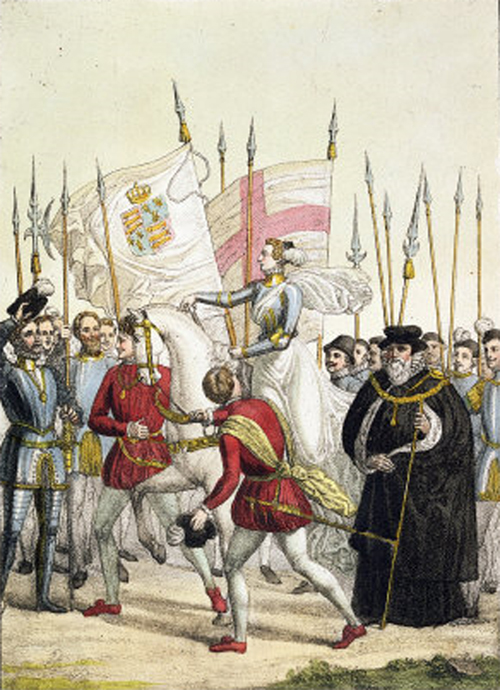
As the crisis eased, Elizabeth I reviewed troops at Tilbury and delivered one of the most quoted speeches in English history, declaring she had the body of a weak and feeble woman but the heart and stomach of a king. England celebrated, though the war with Spain continued for sixteen more years.
Location: Tilbury, England
The English Counter Armada Fails
England launched its own expedition to Portugal in 1589, led by Drake and John Norris, aiming to restore the pretender Dom Antonio and seize Spanish treasure. It failed with heavy losses to disease and combat, showing that neither power could strike a decisive blow against the other.
Location: Portugal
Treaty of London Ends the War
After two decades of raids, blockades, expeditions, and Ireland's Nine Years' War drawing in both powers, the new king James I and Philip III signed the Treaty of London, ending hostilities. Spain recognized Protestant England as a permanent fixture of European politics, while Dutch independence continued to be fought out until 1648.
Location: London, England