
The Song Dynasty -- China's Golden Age of Innovation (960-1279)
The Song dynasty ruled China from 960 to 1279, presiding over one of the most brilliant cultural, technological, and economic epochs in world history. Spanning the Northern Song (960-1127) and Southern Song (1127-1279) periods, it saw the invention of movable type printing, the first use of paper money, the earliest recorded compass navigation, the first chemical formula for gunpowder, and an economic revolution that produced the world's largest GDP per capita at the time. The dynasty fell to the Mongol Yuan dynasty in 1279 after a prolonged resistance.
Events
Founding of the Song Dynasty

Zhao Kuangyin, a military inspector general of the Later Zhou dynasty, usurps the throne and proclaims himself Emperor Taizu of Song. He begins the systematic conquest of the remaining Ten Kingdoms, ending the chaotic Five Dynasties and Ten Kingdoms period and reunifying most of China under a single imperial rule.
Reunification of China Under Song Rule

Following a series of military campaigns, the Song dynasty completes the conquest of the Northern Han, the last of the remaining Ten Kingdoms. However, a subsequent invasion of Liao territory ends in defeat at the Battle of Gaoliang River, establishing the northern border with the Khitan Liao dynasty that would persist for decades.
The Chanyuan Treaty Establishes Peace with Liao
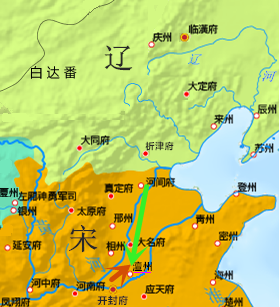
After years of costly warfare between the Song and the Khitan Liao dynasty, the two empires negotiate the Chanyuan Treaty. The Song agrees to pay an annual tribute of silk and silver to the Liao in exchange for peace. The treaty secures nearly 120 years of relative stability along the northern border, allowing the Song to focus on internal development.
First Use of Paper Money in World History
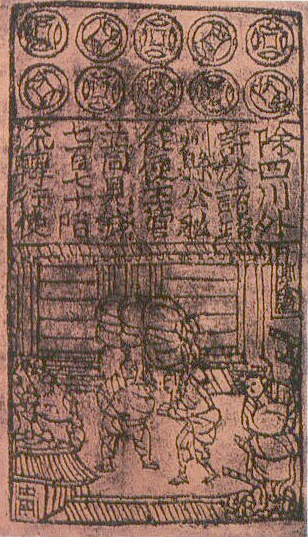
Facing a shortage of copper coinage and the impracticality of iron coins for large transactions, the Song dynasty establishes a government bureau in Chengdu to issue the world's first official paper money, known as jiaozi. This innovation transforms commerce, enabling the large-scale trade that fueled the Song economic revolution.
The Western Xia Declares Independence, Sparking War
Li Yuanhao, leader of the Tangut people, declares himself Emperor Jingzong of Western Xia, establishing the Western Xia dynasty as an independent state. This triggers a series of wars with the Song dynasty (1040-1044) in which Western Xia forces inflict heavy losses on Song armies. The conflict ends with the Song agreeing to pay an annual tribute to Western Xia.
Movable Type Printing Invented

The artisan Bi Sheng invents movable type printing, using individual ceramic characters that can be arranged, inked, and pressed onto paper -- centuries before Gutenberg's press in Europe. While woodblock printing remained dominant in China due to the complexity of thousands of Chinese characters, the invention laid the foundation for future developments in printing technology.
Earliest Recorded Chemical Formula for Gunpowder

The Song military manual Wujing Zongyao (Complete Essentials for the Military Classics) records the first known chemical formula for gunpowder, a mixture of saltpeter, sulfur, and charcoal. The manual also describes early explosive devices including thunderclap bombs and fire arrows propelled by gunpowder. This is the earliest definitive written evidence of gunpowder as a military technology.
Earliest Recorded Use of the Compass for Navigation
The Wujing Zongyao military manual also describes a magnetic compass used for navigation, the earliest known written record of the compass as a maritime instrument. Chinese fleets would increasingly rely on compass navigation, contributing to the expansion of maritime trade routes during the Southern Song period.
Wang Anshi's New Policies Reforms
Chancellor Wang Anshi, under Emperor Shenzong, launches sweeping reforms known as the New Policies. These include low-interest agricultural loans, tax reforms, a militia system, and government regulation of commerce to reduce inequality and strengthen the state. The reforms provoke intense political factionalism between reformers and conservatives, a division that would plague Song governance for decades.
The Jingkang Incident -- Fall of Northern Song
Jurchen Jin dynasty forces capture the Song capital of Kaifeng, along with Emperor Qinzong, his father (the retired Emperor Huizong), and much of the imperial court. This catastrophic defeat, known as the Jingkang Incident, marks the end of the Northern Song period. The Song court retreats southward, relocating the capital to Lin'an (modern Hangzhou), beginning the Southern Song era.
The Southern Song Flourishes in the South
Emperor Gaozong establishes the Southern Song capital at Lin'an. Despite losing the northern half of the empire, the Southern Song experiences a remarkable period of economic and cultural flourishing. Maritime trade expands dramatically via ports like Quanzhou, agricultural productivity increases with new rice strains, and the population grows to approximately 65 million. Hangzhou becomes one of the world's largest and most prosperous cities.
Mongol Invasion Begins
After conquering the Jin dynasty, the Mongol Empire under Ogedei Khan launches a full-scale invasion of the Southern Song. The Song mounts a fierce resistance, using its navy and fortified cities to hold off the Mongol advance for decades. The war would outlast multiple Mongol khans, becoming one of the longest and most costly campaigns in Mongol military history.
Fall of Lin'an and End of the Song Dynasty

After the Song capital of Lin'an falls to Mongol forces in 1276, loyalist forces flee south with the child emperor Zhao Bing. In the final battle at Yamen, the Song fleet is decisively defeated by the Mongol Yuan navy. Prime Minister Lu Xiufu, seeing no hope, jumps into the sea with the eight-year-old emperor in his arms, ending the Song dynasty. The Mongol Yuan dynasty now rules all of China.