
The Sino-Soviet Split (1956-1989)
The ideological and geopolitical rupture between the world's two largest communist states, which turned allies into rivals, brought them to armed clashes in 1969, and pushed China toward the United States — reshaping the Cold War into a strategic triangle.
Events
The Sino-Soviet Alliance
Mao Zedong and Stalin signed the Sino-Soviet Treaty of Friendship, Alliance and Mutual Assistance, formalizing the communist bloc's largest partnership. Stalin provided loans, industrial equipment, and technical experts for China's reconstruction — on terms Mao later resented as the terms of a senior partner dealing with a subordinate.
Location: Moscow, USSR
The Secret Speech Crisis
At the 20th Party Congress, Khrushchev denounced Stalin and proclaimed "peaceful coexistence" with the capitalist West. Mao, who had modeled his rule partly on Stalin's methods and believed revolutionary struggle should continue, saw the speech as revisionist betrayal. The Warsaw Pact's crushing of the Hungarian uprising that November deepened the disagreement over who led world communism.
Location: Moscow, USSR
The Taiwan Strait and the Joint Fleet Dispute
Mao bombarded Kinmen (Quemoy) without warning his ally, testing whether the USSR would risk war with the United States over Chinese priorities. Earlier in 1958 Mao had rejected Khrushchev's proposals for a joint fleet and long-wave radio stations as infringements on Chinese sovereignty. Moscow's caution during the crisis convinced each side the other was unreliable.
Location: Taiwan Strait
Moscow Reneges on the Bomb
The Soviet Union abrogated its 1957 agreement to supply China with an atomic bomb sample and technical assistance, as détente with the United States made nuclear proliferation to an unpredictable ally undesirable. The unilateral withdrawal of nuclear aid convinced Beijing to pursue the bomb alone — China tested its first nuclear device in 1964 — and became a core Chinese grievance.
Soviet Technicians Withdrawn
Moscow suddenly ordered home all Soviet technical experts — roughly 1,390 advisers — and took their blueprints with them, mid-project, as open polemics erupted at a Bucharest congress. Chinese industrial and defense programs were disrupted for years, and the schism became public and irreversible. In 1963, the parties' "Open Letter" polemics turned the split into a worldwide competition for leadership of the communist movement.
The Zhenbao Island Clashes

Chinese and Soviet forces fought a pitched battle on Zhenbao Island, leaving around 50 Soviet soldiers dead, with further clashes in Xinjiang that August. The two sides issued irreconcilable accounts of who fired first. The fighting brought the nuclear-armed neighbors to the brink of full-scale war and prompted both to reassess their global positions.
Location: Zhenbao (Damansky) Island, Ussuri River
The Kosygin-Zhou Airport Meeting
After months of crisis, Soviet Premier Alexei Kosygin and Chinese Premier Zhou Enlai met at Beijing's airport and agreed to preserve the border status quo and avoid further clashes. The de-escalation did not heal the rift: both sides continued preparing for war, and Mao began quietly exploring an opening to the United States as a counterweight to Soviet power.
Location: Beijing, China
Nixon in Beijing

President Richard Nixon traveled to China — the first U.S. presidential visit to the People's Republic — meeting Mao and signing the Shanghai Communiqué. Mao's "playing the American card" against Moscow completed the Cold War's transformation into a triangle, in which each of the three superpowers courted one against another. The Soviet Union now faced enemies on both flanks.
Location: Beijing, China
China Punishes Vietnam, Moscow Occupies Afghanistan
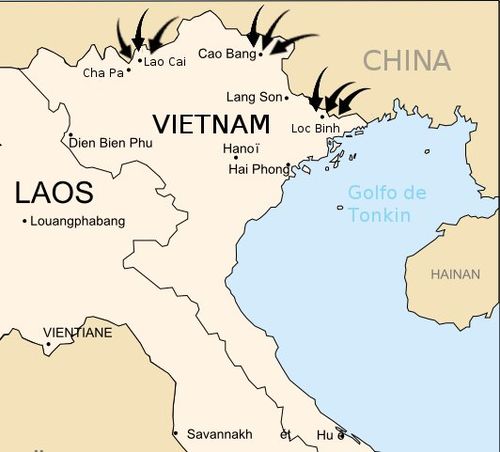
China invaded Vietnam, a Soviet treaty ally, after Hanoi's occupation of Cambodia and expulsion of ethnic Chinese — a border war that ended in March with heavy casualties on both sides. When the Soviet Union invaded Afghanistan that December, China joined the United States in arming the resistance. The split had become a full strategic confrontation fought through proxies.
Gorbachev Normalizes Relations
Mikhail Gorbachev met Deng Xiaoping in Beijing, formally normalizing relations 30 years after the split began — as pro-democracy students occupied Tiananmen Square, a reminder that the summit sidelined. The Sino-Soviet rivalry formally closed with the Soviet collapse in 1991, by which time China had already turned toward market reforms and, after the Cold War, toward renewed rivalry with a diminished Russia's western adversary.
Location: Beijing, China