
Simon Bolivar — The Liberator of South America
Simon Bolivar was a Venezuelan military and political leader who liberated much of South America from Spanish colonial rule. Known as El Libertador, his vision of a united Latin America shaped the political destiny of an entire continent.
Events
Birth in Caracas

Simon Jose Antonio de la Santisima Trinidad Bolivar Palacios Ponte y Blanco was born in Caracas, Captaincy General of Venezuela, the fourth and youngest child of a wealthy creole family. His family owned plantations, copper mines, and slaves, making them among the wealthiest in Venezuela. Both parents died before Bolivar was nine, and he was raised by his uncle and a tutor who introduced him to Enlightenment philosophy.
European Education and Marriage

Bolivar traveled to Spain, as was common for upper-class creole families. In Madrid, he was introduced to Enlightenment philosophy and married Maria Teresa Rodriguez del Toro y Alaysa. The couple returned to Venezuela in 1802, but Maria Teresa died of yellow fever in 1803, just months after their arrival. Bolivar was devastated and swore never to remarry.
The Oath on Monte Sacro

After his wife's death, Bolivar embarked on a Grand Tour of Europe. In Rome, on Monte Sacro (the Aventine Hill), with his tutor Simon Rodriguez, Bolivar knelt and swore an oath: "I swear before you, by the God of my fathers, by my forefathers, by my honor and my country, that I will not rest my soul nor my arm until I have broken the chains that bind us to Spanish rule." This vow became the driving force of his life.
The Cartagena Manifesto

After the collapse of the First Republic of Venezuela, Bolivar fled to New Granada (modern Colombia) and wrote the "Cartagena Manifesto," one of his most important political documents. He analyzed the reasons for the republic's failure — lack of strong central authority, disunity, and failure to crush the opposition — and called for the liberation of Venezuela as part of a broader strategy for South American independence.
The Admirable Campaign and "El Libertador"

Bolivar led the "Admirable Campaign," a daring military operation from New Granada into Venezuela. He captured Merida and Trujillo, where he issued his "Decree of War to the Death" against Spanish forces. On August 6, 1813, he entered Caracas and was proclaimed "El Libertador" (The Liberator) of Venezuela. He established the Second Republic of Venezuela and was granted dictatorial powers.
The Jamaica Letter

After the collapse of the Second Republic, Bolivar fled to Jamaica. He wrote his famous "Jamaica Letter," a visionary political document that outlined his vision for a united Spanish America. He predicted the future of South American nations and advocated for republican government, criticizing monarchy and calling for a federation of independent states. The letter remains one of his most important writings.
Haitian Support and the Promise to Abolish Slavery

In exile in Haiti, Bolivar met Haitian revolutionary leader Alexandre Petion, who agreed to provide military support for Bolivar's liberation campaign. In exchange, Bolivar promised to abolish slavery in the territories he liberated. This Haitian support was crucial to Bolivar's return to Venezuela. He kept his promise, abolishing slavery in the territories he controlled.
The Battle of Boyaca and the Liberation of New Granada

In one of the most audacious military campaigns in history, Bolivar led his army across the freezing, flooded Andes mountains during the rainy season, losing many men but achieving complete surprise. He defeated the Spanish at the Battle of Boyaca, a decisive victory that liberated New Granada (modern Colombia). The battle established Bolivar's reputation as a military genius.
Founding of Gran Colombia

The Congress of Angostura established the Republic of Gran Colombia, uniting Venezuela, New Granada (Colombia and Panama), and later Ecuador into a single state. Bolivar was named president. Gran Colombia was to be the foundation of his dream of a united South America. The congress also drafted a constitution that established a strong central government with a president for life.
The Battle of Carabobo and the Liberation of Venezuela
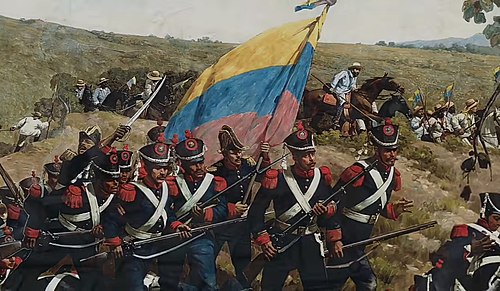
Bolivar's forces decisively defeated the Spanish Royalist army at the Battle of Carabobo, securing Venezuelan independence. The battle was a turning point in the South American wars of independence. After the victory, Bolivar entered Caracas, completing the liberation of his homeland. His deputy, Antonio Jose de Sucre, was instrumental in the victory.
The Liberation of Ecuador

Bolivar's forces, commanded by General Antonio Jose de Sucre, defeated Spanish forces at the Battle of Pichincha, liberating Ecuador. Shortly after, Bolivar met with the other great liberator of South America, Jose de San Martin, at the Guayaquil Conference. The two leaders discussed the future of South America. San Martin, who had liberated Argentina and Chile, resigned and left Bolivar to complete the liberation of Peru.
The Liberation of Peru and the Battle of Ayacucho
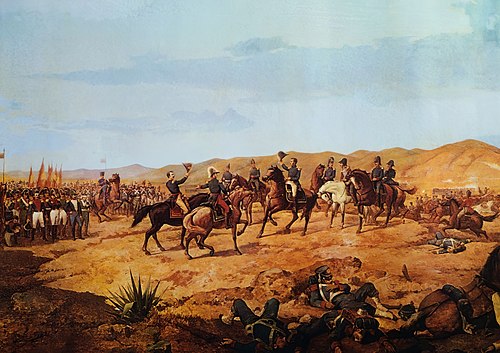
Sucre, commanding Bolivar's forces, defeated the last major Spanish army in South America at the Battle of Ayacucho in Peru. The victory ended Spanish colonial rule in South America. Bolivar was appointed dictator of Peru and created a new nation from Upper Peru, which was named Bolivia in his honor on August 6, 1825.
The Congress of Panama
Bolivar convened the Congress of Panama, an ambitious attempt to unite the newly independent Latin American republics into a single confederation with a common military, mutual defense pact, and a supranational parliament. The congress was attended by Gran Colombia, Peru, Mexico, and Central America. However, the resulting treaties were never ratified by any nation, and the dream of Latin American unity failed.
The Collapse of Gran Colombia
Bolivar's dream of a unified South America unraveled as regional factions, separatist movements, and political rivalries tore Gran Colombia apart. Venezuela and Ecuador declared independence. Bolivar was forced to resign the presidency. Increasingly disillusioned, he declared that "America is ungovernable" and that "those who have served the revolution have plowed the sea."
Death and Legacy
Bolivar died of tuberculosis at the age of 47 at the Quinta de San Pedro Alejandrino in Santa Marta, Colombia. He was impoverished at his death, having given away his fortune to the independence cause. His final words were reportedly: "Damn it! How will I ever get out of this labyrinth?" His remains were later moved to the National Pantheon of Venezuela in Caracas. Bolivar is revered as the greatest hero of Latin American independence, with nations, currencies, cities, and streets named after him throughout the continent.