
The Silk Road — The Ancient Network That Connected East and West (c. 130 BCE - 1450s CE)
Chinese imperial envoy Zhang Qian is dispatched by Emperor Wu of Han to seek allies against the Xiongnu. Though captured and held for a decade, his journeys (138-126 BCE) bring back detailed reports of Central Asian civilizations, establishing the diplomatic and commercial contacts that will become the Silk Road.
Events
Buddhism Spreads Along the Silk Road

Buddhism spreads from India to China via the Silk Road, carried by monks and merchants along the trade routes. The Kushan Empire plays a key role in the transmission. Buddhist monasteries spring up along the routes, serving as religious centers and waystations for travelers. The religion becomes deeply rooted in China by the 4th century.
Han Dynasty Opens the Silk Road
The Han Dynasty formally opens trade routes to the West, establishing the Protectorate of the Western Regions to secure control. Chinese silk, tea, and porcelain begin flowing westward while horses, camels, and gold come east. The Great Wall is extended to protect the trade routes.
Zhang Qian's Missions to Central Asia
Chinese imperial envoy Zhang Qian is dispatched by Emperor Wu of Han to seek allies against the Xiongnu. Though captured and held for a decade, his journeys (138-126 BCE) bring back detailed reports of Central Asian civilizations, establishing the diplomatic and commercial contacts that will become the Silk Road.
Tang Dynasty: Golden Age of the Silk Road

Under the Tang Dynasty (618-907 CE), the Silk Road reaches its peak. The Tang control the eastern routes from their capital Chang'an (modern Xi'an), the world's largest city. Trade flourishes, and cultural exchange brings Nestorian Christianity, Manichaeism, and Zoroastrianism to China alongside goods.
Papermaking Spreads to the Islamic World

After the Battle of Talas between the Tang Chinese and the Abbasid Caliphate, Chinese papermakers are captured and their knowledge of papermaking is transmitted to the Islamic world. Paper mills are established in Samarkand and Baghdad, revolutionizing record-keeping, scholarship, and eventually reaching Europe.
Mongol Empire Unifies the Silk Road

The Mongol Empire under Genghis Khan and his successors conquers the vast stretch from China to Eastern Europe, creating the largest contiguous land empire in history. The Pax Mongolica (Mongol Peace) provides unprecedented security along the Silk Road, allowing safe passage for merchants, missionaries, and diplomats across Eurasia.
Marco Polo Travels to China

Marco Polo, a Venetian merchant, travels the Silk Road to the court of Kublai Khan in China. His account of his 24-year journey, The Travels of Marco Polo, becomes one of the most influential travel books ever written, sparking European fascination with Asia and influencing later explorers including Christopher Columbus.
The Black Death Spreads Along the Silk Road
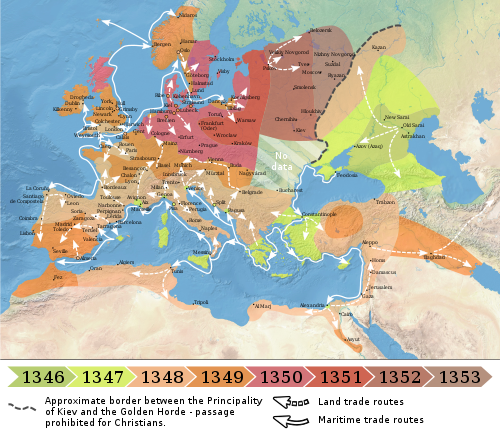
The bubonic plague, originating in Central Asia, spreads along the Silk Road to Crimea and into Europe, carried by fleas on rats aboard merchant caravans and ships. The Black Death kills an estimated 30-60% of Europe's population between 1346 and 1353, fundamentally reshaping European society, labor, and economics.
Zheng He's Maritime Expeditions

Admiral Zheng He of the Ming Dynasty leads seven massive maritime expeditions (1405-1433) across the Indian Ocean, reaching as far as East Africa. These voyages demonstrate China's naval power and establish tributary trade networks, but the Ming court later abandons the expeditions and destroys the ships.
Fall of Constantinople and Ottoman Control
The Ottoman Empire captures Constantinople, ending the Byzantine Empire. Ottoman control over the eastern Mediterranean and overland routes disrupts the traditional Silk Road, increasing costs for European traders. This prompts European powers to seek alternative maritime routes to Asia.
The Age of Discovery Replaces the Silk Road
Vasco da Gama reaches India by sailing around Africa, establishing the first direct maritime trade route from Europe to Asia. The Age of Discovery opens new sea routes that gradually replace the overland Silk Road as the primary arteries of Eurasian trade, shifting global commerce from land to sea.
The Term "Silk Road" Is Coined
German geographer Ferdinand von Richthofen coins the term "Seidenstrasse" (Silk Road) in his seminal work on Chinese geography. The name, referring to the lucrative silk trade that traveled the routes, becomes the universally recognized label for the ancient network of trade routes connecting East and West.
Chinese Silk Reaches Rome
By the first century CE, Chinese silk is widely sought after in Rome, Egypt, and Greece. The Roman Senate passes laws to curb the import of silk, which is considered decadent, but demand only grows. The Parthian Empire serves as the vital middleman connecting the network to the Mediterranean.
UNESCO World Heritage Designation
UNESCO designates the "Silk Roads: the Routes Network of Chang'an-Tianshan Corridor" as a World Heritage Site, recognizing its outstanding universal value. The designation covers 33 sites across China, Kazakhstan, and Kyrgyzstan. A second corridor, the Zarafshan-Karakum Corridor, is added in 2023.