
The Sengoku Period and the Unification of Japan (1467-1615)
A 148-year era of civil war, social upheaval, and territorial reunification in Japan that followed the collapse of the Ashikaga shogunate and ended with the establishment of the Tokugawa shogunate. The Sengoku period saw the rise of the Three Great Unifiers — Oda Nobunaga, Toyotomi Hideyoshi, and Tokugawa Ieyasu — who successively brought the warring daimyō under central authority. The era transformed Japanese warfare, society, religion, and foreign relations, and laid the institutional foundations of early modern Japan.
Events
The Onin War Begins
On 6 May 1467, the Onin War broke out in Kyoto between two great provincial warrior houses, the Hosokawa and the Yamana, ostensibly over a shogunal succession dispute but drawing in nearly every major daimyō. The war lasted until 1477 and devastated Kyoto, destroying most of the city and leaving tens of thousands dead. It ended without a clear victor, but it fatally weakened the Ashikaga shogunate, whose authority over the provinces had already been eroding. The war's social effects were profound: a rise in gekokujō — "the low overthrowing the high" — as retainers displaced their lords, and a flourishing of armed peasant leagues (ikki) that would shape Japanese politics for the next century.
Location: Kyoto, Japan
The Portuguese Introduce the Arquebus
In 1543, Portuguese traders shipwrecked on the island of Tanegashima introduced the matchlock arquebus to Japan. Within a decade, Japanese smiths — most famously the city of Sakai — were producing the weapon in large numbers, transforming Japanese warfare. The Takeda clan, under Takeda Shingen, pioneered mass arquebus tactics at the Battle of Nagashino in 1575, with Oda Nobunaga deploying 3,000 firearms in rotating volleys to break a Takeda cavalry charge. The Portuguese also brought new trade goods, Christianity, and the beginning of the "Nanban trade" with Europe that would shape Japan's commercial and cultural connections for the next century.
Location: Tanegashima, Japan
The Arrival of Francis Xavier and Christianity
On 15 August 1549, the Jesuit missionary Francis Xavier landed at Kagoshima and began the Christian mission to Japan. The Kirishitan (Christian) community grew rapidly under the patronage of daimyō like Ōtomo Sōrin of Bungo and Arima Harunobu, reaching perhaps 300,000 adherents by 1580. The mission produced the first Japanese publications using movable type and Latin script, and Japanese Kirishitan would later send the Tenshō embassy to Rome in 1582. Christianity would eventually be banned by Tokugawa Iemitsu in 1612-1614, with thousands of martyrs, and the ban would remain in force for over 250 years.
Location: Kagoshima, Japan
Oda Nobunaga's Rise and the Battle of Okehazama
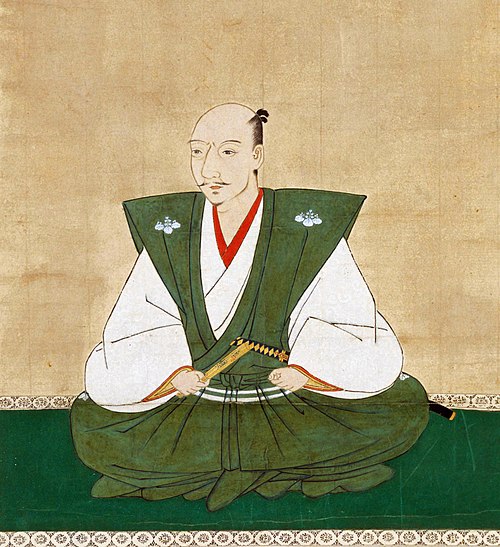
On 19 May 1560, Oda Nobunaga — the daimyō of Owari — led a small force in a surprise attack on the much larger Imagawa army marching on Kyoto at Okehazama, killing Imagawa Yoshimoto in his camp during a sudden rainstorm. The victory gave Nobunaga control of Owari and Mino provinces and established his reputation as a brilliant, ruthless commander. The battle is one of the most celebrated in Japanese military history. Nobunaga went on to deploy massed arquebusiers at Nagashino-Shitaragahara in 1575, a tactical revolution that made infantry firearms a decisive battlefield force.
Location: Okehazama, Owari Province, Japan
Nobunaga Enters Kyoto and Ends the Ashikaga Shogunate
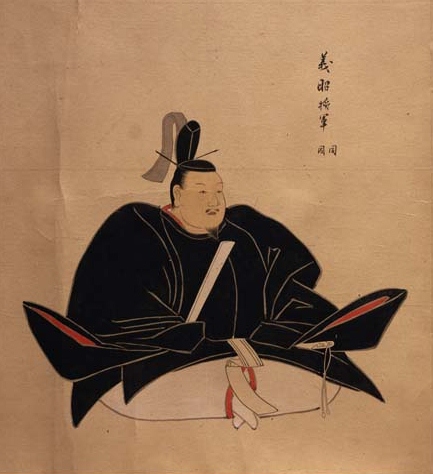
In 1568, Oda Nobunaga marched on Kyoto at the head of a large army, ostensibly to support Ashikaga Yoshiaki as shōgun. Within five years, relations between the two broke down. In 1573, Nobunaga expelled Yoshiaki from Kyoto, formally ending the Ashikaga shogunate that had governed Japan since 1336. Nobunaga ruled from Kyoto as the de facto military dictator of central Japan, controlling perhaps a third of the country by 1582. His brutal destruction of the Ikkō-ikki Buddhist leagues — most notoriously the burning of the Enryaku-ji temple complex on Mount Hiei in 1571, with thousands killed — made him feared and respected in equal measure.
Location: Kyoto, Japan
The Honnō-ji Incident
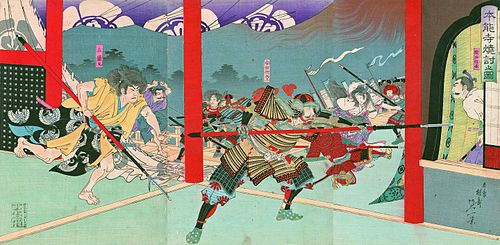
On 21 June 1582, Oda Nobunaga was assassinated at Honnō-ji temple in Kyoto by his general Akechi Mitsuhide, who sought to seize power for himself. Nobunaga committed suicide in the burning temple. The coup was quickly avenged by Toyotomi Hideyoshi, then a leading general of Nobunaga, who defeated Akechi at the Battle of Yamazaki eleven days later. The incident was a turning point in the unification process: it elevated Hideyoshi from a general of Oda to a potential successor, beginning the consolidation that would, within eight years, complete the unification of Japan.
Location: Kyoto, Japan
Toyotomi Hideyoshi Completes the Unification

In 1590, Toyotomi Hideyoshi completed the unification of Japan by forcing the Hōjō clan of Odawara to submit after a three-month siege. The Hōjō had been the last major independent power, controlling the Kanto region; their defeat left no major daimyō outside Hideyoshi's authority. In 1585, Hideyoshi had been appointed kampaku (imperial regent), the highest civil office. He instituted a nationwide land survey (Taikō kenchi), the "sword hunt" (katanagari) that separated peasants from warriors, and a class system that classified all Japanese as samurai, peasant, artisan, or merchant. Hideyoshi died in 1598 with the unification achieved but the succession unresolved.
Location: Odawara, Sagami Province, Japan
Hideyoshi's Invasions of Korea
On 13 April 1592, Toyotomi Hideyoshi launched the first of two massive invasions of Korea, intending to use it as a base for the conquest of Ming China. The initial Japanese force of about 158,000 overwhelmed Korean defenses and captured Seoul within weeks, but the Korean navy under Admiral Yi Sun-sin repeatedly defeated the Japanese fleet using ironclad "turtle ships" and innovative tactics, preventing Japanese resupply. Ming China sent 100,000 troops to reinforce Korea. A second invasion in 1597 also failed. The wars killed an estimated 100,000-200,000 Koreans and 50,000-100,000 Japanese, ended without achieving Hideyoshi's goals, and remain a defining trauma in Korean historical memory.
Location: Busan, Korea
The Battle of Sekigahara
On 21 October 1600, Tokugawa Ieyasu defeated the Western Army — a coalition of daimyō loyal to the Toyotomi heir Hideyori — at Sekigahara in central Japan. The battle, with about 160,000 combatants, was the largest in Japanese history. Ieyasu's victory was secured by the defection of the Kikkawa clan and other Western Army units during the battle. The result gave Ieyasu control of the Toyotomi domains and the loyalty of the major daimyō in eastern and northern Japan. The battle is conventionally regarded as the decisive moment of national unification, opening the way for the Tokugawa shogunate.
Location: Sekigahara, Mino Province, Japan
The Tokugawa Shogunate Is Established
On 24 March 1603, Tokugawa Ieyasu was appointed shōgun by the Emperor Go-Yōzei, establishing the Tokugawa shogunate. He was followed by his son Hidetada (1605-1623) and grandson Iemitsu (1623-1651). Ieyasu redistributed daimyō domains (the "fudai" and "tozama" classifications), ordered daimyō to alternate residence in Edo (the "sankin-kōtai" system formalized in 1635), and laid the administrative, legal, and class foundations for over 250 years of internal peace. Ieyasu died in 1616, but the institutions he established would define early modern Japan until the Meiji Restoration of 1868.
Location: Kyoto and Edo, Japan
The Siege of Osaka and the End of the Toyotomi
On 8 June 1615, after the Summer Campaign of the Osaka siege, Osaka Castle fell to Tokugawa forces and the young Toyotomi Hideyori committed suicide, extinguishing the Toyotomi line. The Winter Campaign of 1614 had ended with a negotiated peace that the Tokugawa then broke, and Toyotomi retainers had rallied tens of thousands of warriors under the "True Christianity" banner. The fall of Osaka was the last major military engagement of the Sengoku period, removing the only plausible alternative to Tokugawa rule. Some scholars date the end of the Sengoku period to Sekigahara (1600) or to Hideyoshi's unification (1590), but the Osaka campaigns of 1614-1615 are the conventional endpoint.
Location: Osaka, Japan