
The Seljuk Empire (1037-1194)
The Turkic empire that swept out of Central Asia to rule from the Mediterranean to the borders of India, ended Buyid control of Baghdad, shattered Byzantine power in Anatolia, and triggered the Crusades. The Seljuks fused steppe military power with Persian bureaucratic statecraft and left the architecture of Sunni Islamic governance and a Turkic Anatolia that endures today.
Timeline
Tughril Declares Independence

Tughril Beg, leader of the Oghuz Turkic Seljuk clan, seized Nishapur from the Ghaznavid Empire and struck coins in his own name, founding an independent state. The Seljuks had converted to Sunni Islam and entered the Iranian world as both conquerors and champions of the Abbasid caliphate.
Location: Nishapur, Persia
The Battle of Dandanaqan
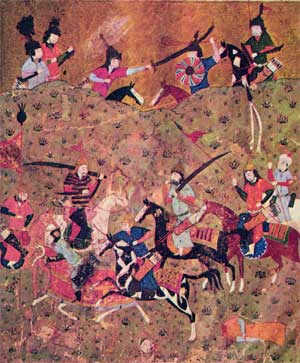
Seljuk horsemen routed the Ghaznavid army of Mas'ud I near Merv, breaking Ghaznavid domination of Greater Khorasan. The victory gave the Seljuks eastern Persia and announced a new steppe power to the Islamic world.
Location: Near Merv, Khorasan
Tughril Enters Baghdad

Tughril entered Baghdad and overthrew the Shia Buyid dynasty that had dominated the Abbasid caliphs for over a century. The caliph al-Qa'im invested him with the title of sultan, making the Seljuks the effective protectors of the Sunni caliphate and the most powerful state in the Islamic world.
Location: Baghdad, Iraq
The Nizamiyya and the Sunni Revival
The vizier Nizam al-Mulk founded the Nizamiyya madrasas, beginning with Baghdad, as state-backed colleges of Sunni jurisprudence that countered Shia and scholastic rivals. Together with his treatise on statecraft, the Siyasatnama, Nizam al-Mulk made the Seljuk state the model of Persianate Islamic bureaucracy.
Location: Baghdad, Iraq
The Battle of Manzikert
Sultan Alp Arslan's army crushed the Byzantine forces of Emperor Romanos IV, who was captured in the battle. The decisive victory broke Byzantine authority in Anatolia and opened the plateau to Turkic settlement, beginning the long-term Turkification of Asia Minor and the process that would eventually produce modern Turkey.
Location: Manzikert, Anatolia
The Golden Age of Malik-Shah
Under Malik-Shah I (1072-1092) the empire reached its greatest extent, from Syria to Central Asia, with a reformed solar calendar and a flourishing of Persian science and letters, including the astronomer Omar Khayyam. Isfahan's Friday Mosque and the empire's other great buildings set the pattern of Persian-Islamic architecture for centuries.
Location: Isfahan, Persia
The Sultanate of Rum Is Founded
Suleiman ibn Qutalmish, a Seljuk kinsman, established the independent Sultanate of Rum in conquered Anatolia, ruling from Nicaea. This successor state, after the Mongol invasions of the 13th century, would give rise to the Ottoman beylik and thus to the Ottoman Empire itself.
Location: Nicaea (Iznik), Anatolia
Fragmentation After Malik-Shah
The near-simultaneous deaths of Malik-Shah and the vizier Nizam al-Mulk in 1092 triggered succession wars that broke the empire into rival branches ruled by Seljuk princes. The fragmentation meant that when the First Crusade arrived in Anatolia and Syria, the Seljuk world met it divided.
The First Crusade Meets a Divided Seljuk World
Crusader armies took Nicaea in 1097 and Jerusalem in 1099 while Seljuk princes fought each other rather than the invaders. The Seljuk inability to unite, driven by the succession system of shared family rule, allowed the crusader states to establish themselves on former Seljuk territory.
Location: Anatolia and Syria
The Battle of Qatwan Ends Eastern Expansion
A Seljuk coalition under Ahmad Sanjar was decisively defeated by the Buddhist Kara-Khitan (Western Liao) forces at Qatwan, one of the largest battles of the century. The defeat halted Seljuk expansion into Central Asia and began the erosion of their authority in the east.
Location: Qatwan, near Samarkand
The Fall of the Great Seljuks

Toghrl III, the last Great Seljuk sultan, was killed in battle against the rising Khwarazmian Empire, ending the Great Seljuk line. The Seljuk legacy survived through successor states, above all the Sultanate of Rum, and through the Persianate administrative and religious institutions they embedded across the Middle East.
Location: Rayy, Persia