
The Rwandan Genocide (1994)
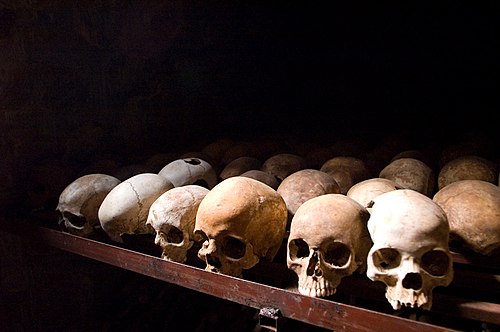
Over the course of 100 days from April to July 1994, Hutu extremists in Rwanda systematically murdered an estimated 500,000 to 800,000 Tutsi and moderate Hutu in one of the fastest genocides in history. Rooted in colonial-era ethnic divisions and stoked by propaganda, the genocide unfolded while the international community stood largely passive, reshaping Central Africa's political landscape for decades.
Events
Background of Ethnic Divisions and Civil War
Long-standing ethnic tensions between Hutu and Tutsi, hardened by Belgian colonial policies of racial classification and identity cards, culminated in a 1990 invasion by the Tutsi-led Rwandan Patriotic Front (RPF). A 1993 peace accord (the Arusha Accords) attempted a power-sharing solution, but Hutu extremists opposed any compromise.
Assassination of President Habyarimana
Rwandan President Juvenal Habyarimana's plane is shot down by a surface-to-air missile as it approaches Kigali airport, killing all aboard. The attack, still disputed in origin, serves as the trigger for the pre-planned genocide. Within hours, Hutu extremists set up roadblocks across Kigali.
Location: Kigali, Rwanda
Genocide Begins — Assassination of Moderate Leaders
The genocide begins in earnest. Prime Minister Agathe Uwilingiyimana, a moderate Hutu, is assassinated along with her husband. Ten Belgian peacekeepers protecting her are captured, tortured, and killed. Moderate Hutu politicians across the political spectrum are systematically executed. The Presidential Guard and Interahamwe militia begin house-to-house searches for Tutsi families.
Location: Kigali, Rwanda
International Withdrawal and Escalation
Belgium withdraws its peacekeeping contingent after the murder of its soldiers. The UN Security Council votes to reduce UNAMIR forces from 2,500 to 270. Foreign nationals are evacuated by French, Belgian, and Italian troops. The international community's failure to reinforce the peacekeeping mission or authorize intervention removes the last obstacle to mass murder.
Location: Kigali, Rwanda
Massacres at Churches and Schools
Tutsi families seeking refuge in churches, schools, and hospitals are systematically massacred. At Nyarubuye, thousands sheltering in a Catholic church are killed by grenades, guns, and machetes. At the Sainte-Famille church in Kigali, militias separate Tutsi from Hutu and murder them. The genocidal violence spreads from Kigali to every corner of Rwanda.
Location: Nationwide, Rwanda
RPF Resumes Offensive
The Rwandan Patriotic Front under Paul Kagame breaks the ceasefire and resumes military operations from the north. While the RPF fights to defeat the genocidal government forces and stop the killings, its advance triggers further refugee flows. The RPF captures significant territory in the east and north.
Systematic Rape and Sexual Violence
An estimated 250,000 to 500,000 Tutsi women are systematically raped during the genocide. Hutu extremists use sexual violence as a weapon of genocide, often accompanied by deliberate HIV infection. The International Criminal Tribunal for Rwanda later prosecutes rape and sexual violence as acts of genocide and crimes against humanity for the first time in international law.
UN Finally Authorizes Intervention
After more than a month of inaction, the UN Security Council acknowledges that genocide is occurring and authorizes UNAMIR II with 5,500 troops. However, disputes over funding and equipment delay deployment until the genocide is nearly over. The United States avoids using the term genocide to avoid obligations under the Genocide Convention.
France Launches Operation Turquoise
France launches Operation Turquoise, a UN-authorized humanitarian mission to establish a safe zone in southwestern Rwanda. While the mission saves some lives, critics charge it allows genocidaires to escape into Zaire through French-controlled territory. The RPF condemns the intervention as supporting the Hutu Power regime.
RPF Captures Kigali
The RPF captures Kigali after weeks of heavy fighting. The genocidal government flees to Zaire. Paul Kagame declares the war and genocide over. By this point, an estimated 500,000 to 800,000 Tutsi and moderate Hutu have been killed — approximately 75 percent of the Tutsi population in Rwanda.
Location: Kigali, Rwanda
Mass Exodus of Hutu Refugees to Zaire
Approximately 2 million Hutu civilians, including many genocidaires, flee into eastern Zaire (now Democratic Republic of the Congo) in one of the fastest mass refugee movements in history. Refugee camps become bases for Hutu Power insurgents, destabilizing the region and triggering the First Congo War (1996-1997), which leads to the overthrow of Zaire's President Mobutu.
Establishment of the ICTR
The UN Security Council establishes the International Criminal Tribunal for Rwanda (ICTR) to prosecute those responsible for genocide and crimes against humanity. The ICTR sets landmark precedents: defining rape as an act of genocide, holding media figures accountable for incitement, and establishing that genocide can be committed by state actors and non-state actors alike.