
The Punic Wars — Rome vs. Carthage (264–146 BC)
Three devastating wars between the Roman Republic and the Carthaginian Empire that decided the fate of the western Mediterranean. Spanning 264 to 146 BC, these conflicts featured Hannibal's legendary crossing of the Alps, the battle of Cannae — one of history's greatest military defeats — and culminated in the complete destruction of Carthage. The Punic Wars established Rome as the dominant power of the ancient Mediterranean world, with consequences that shaped Western civilization for millennia.
Events
Carthage Destroyed — The Third Punic War
Despite the harsh treaty, Carthage recovers economically within 50 years. Rome, alarmed by this resurgence and egged on by Cato the Elder who ends every speech with "Carthago delenda est" (Carthage must be destroyed), declares war in 149 BC under the pretext of Carthaginian resistance to Numidian encroachments. The Third Punic War is a brutal three-year siege. In 146 BC, Roman forces under Scipio Aemilianus storm the city. The Romans slaughter or enslave the population, and systematically raze Carthage. Legend holds that the city was sowed with salt. The Carthaginian territories become the Roman province of Africa.
The Battle of Zama — Hannibal's First and Only Defeat
Hannibal and Scipio meet at Zama for the decisive battle of the war. For the first and only time, Hannibal is outmaneuvered and defeated. Scipio's tactics nullify Hannibal's war elephants and his Roman and Numidian cavalry rout the Carthaginian flanks before striking the infantry center from behind. Carthage surrenders, accepting harsh terms: surrender of all overseas territories, destruction of its navy (all but 10 ships), payment of 10,000 talents in reparations, and a prohibition on waging war without Roman permission.
Scipio Africanus Invades Africa and Hannibal Recalled
While Hannibal remains trapped in southern Italy, the Roman general Publius Cornelius Scipio (later Africanus) launches a direct invasion of the Carthaginian homeland in North Africa. Scipio defeats Carthaginian forces in several engagements and allies with the Numidian king Masinissa, whose cavalry proves crucial. Carthage, facing collapse, urgently recalls Hannibal and his army from Italy after 15 years of campaigning. Hannibal evacuates his remaining forces and returns to Africa.
The Battle of Cannae — Hannibal's Masterpiece
Hannibal achieves his greatest victory at Cannae, where his outnumbered army of 50,000 annihilates a Roman force of approximately 86,000. Using a double-envelopment maneuver, Hannibal's Gallic and Iberian infantry in the center falls back deliberately, drawing the Romans into a pocket while his Numidian and Carthaginian cavalry circles behind to close the trap. Between 50,000-70,000 Romans are killed, including 80 senators and the consul Lucius Aemilius Paullus. Cannae remains one of the most devastating single-day losses in military history.
Fabius Maximus and the Strategy of Attrition
After the disaster at Cannae, the Roman Senate appoints Quintus Fabius Maximus as dictator. Fabius rejects pitched battle against Hannibal and instead adopts a strategy of attrition — shadowing Hannibal's army, cutting supply lines, avoiding engagement, and wearing down the invaders through harassment. This "Fabian strategy" proves unpopular with Romans who demand decisive action, earning Fabius the nickname "Cunctator" (the Delayer). Nevertheless, the strategy denies Hannibal the decisive victory he needs to force Rome to surrender.
Hannibal Crosses the Alps
In one of the most famous military feats in history, Hannibal leads a Carthaginian army of approximately 40,000 men, 8,000 cavalry, and 37 war elephants across the Alps from Iberia into Italy. The crossing takes 15-20 days through treacherous mountain terrain, snow, and hostile Gallic tribes. Hannibal loses thousands of men and most of his elephants during the crossing, but achieves total strategic surprise. Rome, expecting an invasion by sea, is caught completely off guard.
Hannibal's Siege of Saguntum Ignites the Second Punic War
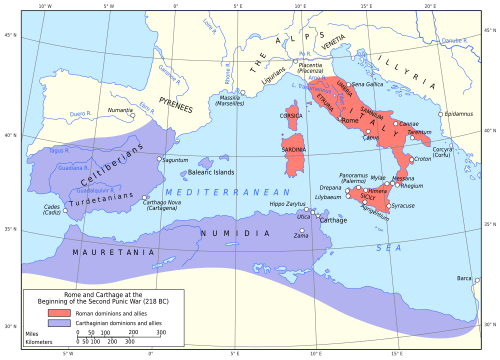
Hannibal Barca, the 28-year-old Carthaginian commander in Iberia, lays siege to Saguntum, a Roman ally. The siege lasts eight months and the city falls in 218 BC. When Rome demands Hannibal's surrender, Carthage refuses. Rome declares war, beginning the Second Punic War. Hannibal famously swore as a child to his father Hamilcar that he would "never be a friend of Rome," and now makes good on that oath by planning an audacious invasion of Italy itself.
The Aegates Islands — Rome Wins the First Punic War
After two decades of war, Rome builds a new fleet funded by private loans from wealthy citizens. The fleet decisively defeats the Carthaginian navy at the Battle of the Aegates Islands. Carthage, exhausted and unable to resupply its forces in Sicily, sues for peace. The Treaty of Lutatius requires Carthage to evacuate Sicily, pay 3,200 talents in war reparations, and release Roman prisoners. Sicily becomes Rome's first province outside the Italian peninsula.
The Mercenary War and Carthage's Recovery

Carthage, unable to pay the mercenaries who fought in the First Punic War, faces a devastating revolt known as the Mercenary War (241-237 BC). Libyan soldiers and unpaid mercenary armies besiege Carthage itself. The conflict is brutally suppressed by Hamilcar Barca, Hannibal's father, after years of savage fighting. Rome takes advantage of Carthage's weakness to seize Sardinia and Corsica, further humiliating its rival and deepening Carthaginian grievances.
Battle of Cape Ecnomus — Largest Naval Battle of Antiquity

A massive Roman fleet of 330 ships transports four legions to invade North Africa. Carthage intercepts with 350 ships off Cape Ecnomus in what is likely the largest naval battle in history by number of combatants. Using the corvus effectively, the Romans destroy or capture 30 Carthaginian ships and land their army in Africa. The invasion initially succeeds under consul Marcus Atilius Regulus but ends in disaster when the Romans are defeated and Regulus is captured.
Rome Builds a Navy and Wins at Mylae
Recognizing that Sicily cannot be taken without naval supremacy, Rome builds a fleet of quinqueremes using a captured Carthaginian warship as a template. The Romans develop the corvus, a boarding bridge that turns sea battles into infantry engagements. At the Battle of Mylae, Consul Gaius Duilius leads the new Roman fleet to its first major naval victory, destroying or capturing 50 Carthaginian ships.
The First Punic War Begins Over Sicily
The First Punic War erupts when Rome intervenes in a dispute between the Mamertines (Italian mercenaries in Messana) and Syracuse. Carthage, which controls much of western Sicily, sides against the Mamertines. Rome sends a military force to Messana, provoking open war with Carthage. The conflict pits the land-based Roman Republic against Carthage's maritime empire and will last 23 years.