
Peter the Great — Tsar and First Emperor of Russia
Russian tsar (1682-1725) who forcibly transformed Russia into a European power. He built the country's first navy, founded Saint Petersburg, reformed the army, church, and civil service, and proclaimed the Russian Empire after defeating Sweden in the Great Northern War. His legacy remains contested: celebrated as a modernizer, condemned for the brutality of his methods, including the death of his own son.
Events
Birth in Moscow
Pyotr Alekseyevich is born to Tsar Alexis and Natalya Naryshkina. After his father's death in 1676 he grows up largely outside court politics, developing his lifelong obsession with boats, soldiers, and Western technical crafts.
Location: Moscow, Russia
Co-Tsar Under a Regency
After a Streltsy uprising, ten-year-old Peter is made co-tsar with his half-witted half-brother Ivan V, with their sister Sophia as regent. Power struggles with Sophia end in 1689 when her second coup attempt fails; Peter rules jointly until Ivan's death in 1696, then alone.
Location: Moscow, Russia
The Azov Campaigns and Russia's First Navy
After a failed first attempt in 1695, Peter takes the Ottoman fortress of Azov using a fleet built in a single winter at Voronezh — Russia's first naval force. The victory secures a modest southern port and proves his conviction that Russia needs a navy.
Location: Azov, Russia
The Grand Embassy to Europe
Peter travels incognito through Western Europe — working in Dutch and English shipyards, inspecting factories and arsenals, and recruiting hundreds of engineers, officers, and craftsmen for Russian service. The embassy's diplomatic aim of an anti-Ottoman coalition fails, but the technical mission reshapes the Russian state.
Location: Zaandam, Dutch Republic
Suppression of the Streltsy and Cultural Decrees
Returning home, Peter crushes a new Streltsy revolt with mass executions and dissolves the old musketeer corps. He decrees that nobles shave their beards and adopt Western dress, the first of a series of imposed cultural reforms resented by traditionalists, including much of the clergy.
Location: Moscow, Russia
Outbreak of the Great Northern War and Defeat at Narva
Peter declares war on Sweden for control of the Baltic, joining Denmark, Saxony, and Poland. The young Charles XII destroys the much larger Russian army at Narva — a humiliation Peter treats as a spur, rebuilding and drilling his forces into a modern army over the following years.
Location: Narva, Sweden (now Estonia)
Founding of Saint Petersburg

Peter founds a new city on the Neva delta, taken from Sweden, at the cost of enormous forced labor and thousands of lives in the marshlands. Intended as Russia's window on Europe, it becomes the capital a decade later, symbolizing his reorientation of the state westward.
Location: Saint Petersburg, Russia
Victory at Poltava
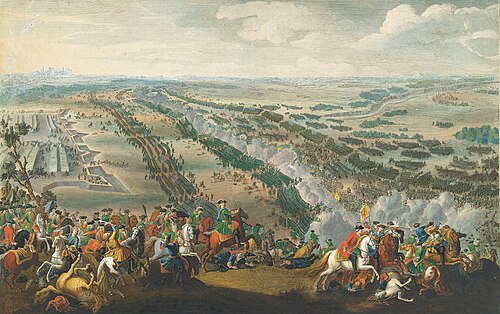
Peter's reformed army destroys Charles XII's invading Swedish force at Poltava, the decisive battle of the Great Northern War. Sweden's era as a great power ends; Russia becomes the dominant Baltic power, and the course of Northern European history changes.
Location: Poltava, Ukraine
The Trial and Death of Tsarevich Alexei

Peter's son and heir Alexei, who had opposed his father's reforms and fled to Austria, is returned, tried by torture, and dies in prison after sentencing. The episode darkens Peter's reputation among contemporaries and among later historians critical of his autocracy.
Location: Saint Petersburg, Russia
Treaty of Nystad and the Proclamation of Empire

The Treaty of Nystad (September 1721) ends the Great Northern War with Russia keeping Estonia, Livonia, and Ingria. In October the Senate proclaims Peter Emperor of All Russia, formally declaring the Russian Empire and adopting the title Imperator in the European style.
Location: Saint Petersburg, Russia
The Table of Ranks

Peter establishes the Table of Ranks, a 14-grade hierarchy in the military, civil, and court service that ties noble status to state service rather than birth. The reform becomes one of the most durable institutions of imperial Russia, lasting until 1917.
Location: Saint Petersburg, Russia
Founding of the Academy of Sciences and Death
Peter decrees the founding of the Academy of Sciences in Saint Petersburg, recruiting European scholars such as Euler and Bernoulli to the new capital. He dies in February 1725 without naming a successor, leaving the empire he built to a century of palace coups that begin with his widow Catherine I.
Location: Saint Petersburg, Russia