
The Pacific Voyages of Captain James Cook (1768–1779)
Three Royal Navy expeditions that mapped the Pacific, tested longitude and scurvy science, opened the region to European colonization, and ended with Cook's death in Hawaii — a legacy celebrated and contested ever since.
Events
From Collier Apprentice to Navy Surveyor
James Cook, a Yorkshire farm laborer's son apprenticed in the coal-shipping trade out of Whitby, enlisted in the Royal Navy in 1755 at age 26. During the Seven Years' War he charted the St. Lawrence River approaches before the British capture of Quebec in 1759 and then spent the 1760s surveying Newfoundland, work that brought him to the attention of the Admiralty and the Royal Society.
Location: Whitby, England
First Voyage Departs — HMS Endeavour
The Endeavour sailed with a joint Royal Navy-Royal Society mission: observe the transit of Venus from Tahiti, then follow sealed orders to search for the supposed southern continent. Aboard were naturalist Joseph Banks and astronomers whose observations made the voyage as much a scientific expedition as a naval one.
Location: Plymouth, England
New Zealand Circumnavigated and Mapped
After observing the transit of Venus in June 1769, Cook reached New Zealand in October, becoming the first European known to chart its coastline in full. His six-month circumnavigation established that New Zealand was two large islands, not part of a southern continent, and the first meetings with Maori mixed trade and diplomacy with fatal violence.
Location: Poverty Bay, New Zealand
The East Coast of Australia Claimed
Sailing west, Cook charted 3,200 kilometers (about 2,000 miles) of Australia's previously unrecorded east coast, botanizing at Botany Bay, surviving the wreck of the Endeavour on the Great Barrier Reef, and at Possession Island claiming the territory for Britain — the legal seed of the later colony and of Indigenous dispossession on the continent.
Location: Possession Island, Australia
Across the Antarctic Circle

On his second voyage (1772-1775, Resolution and Adventure), Cook became the first explorer known to cross the Antarctic Circle. Repeated circumnavigations of the far south proved there was no habitable southern continent, settling a two-century geographical question, while his sauerkraut-and-hygiene regimen against scurvy kept his crews healthy — work that earned him the Royal Society's Copley Medal in 1776.
Location: Southern Ocean
First European Landfall in Hawaii

Commanding his third voyage, Cook made the first recorded European arrival in the Hawaiian Islands, which he named the Sandwich Islands. He then sailed onward to the North American coast, charting Alaska and pushing through the Bering Strait in search of a Northwest Passage before ice forced him back toward Hawaii for the winter.
Location: Kauai, Hawaii
Death at Kealakekua Bay
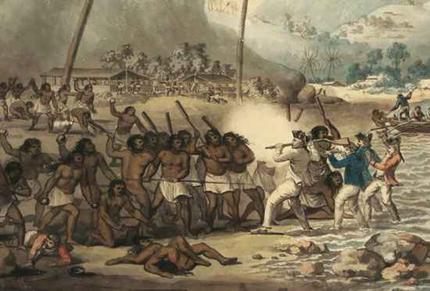
After a month of cordial relations complicated by Hawaiian expectations and mounting frictions, a dispute over a stolen boat escalated. Cook came ashore with marines to seize the Hawaiian king as hostage; when the crowd pressed in, he was struck and killed along with four of his men. The Resolution and Discovery completed the voyage home under Captain Charles Clerke, reaching England in October 1780.
Location: Kealakekua Bay, Hawaii
A Contested Legacy

Cook's voyages became the foundation of two centuries of Pacific colonization, missionization, and disease that devastated Indigenous populations. The 250th anniversary of the Endeavour's Australian landfall in 2020 was met in Australia and New Zealand by Indigenous-led protests and debate over monuments, alongside official commemorations — historians on all sides acknowledging that the maps, specimens, and journals of the voyages permanently transformed knowledge of the Pacific while opening its peoples to conquest.
Location: Sydney, Australia