
The Napoleonic Wars (1803–1815)
A series of major conflicts fought between the French Empire under Napoleon Bonaparte and shifting coalitions of European powers, the Napoleonic Wars reshaped the political map of Europe and the world. From the naval showdown at Trafalgar to the devastating French invasion of Russia and the final defeat at Waterloo, these wars established British naval supremacy, spread nationalist ideas across Europe, and set the stage for the modern state system that emerged from the Congress of Vienna.
Events
War of the Third Coalition — Britain, Austria, and Russia Unite Against France

Britain, Austria, Russia, Sweden, and Naples form the Third Coalition against France, following Napoleon's coronation as Emperor of the French and his aggressive expansion into Italy and Germany. Napoleon abandons his planned invasion of England and marches his Grande Armee eastward to confront the Austrian and Russian armies. The coalition aimed to contain French hegemony but was weakened by poor coordination and late entry by Prussia.
Battle of Trafalgar — British Naval Supremacy Secured
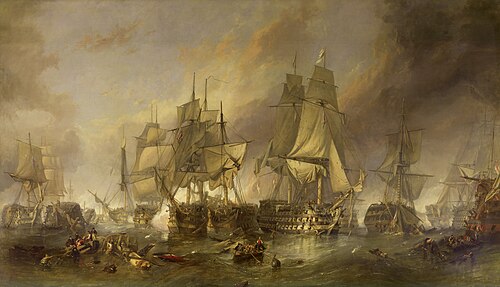
Vice-Admiral Horatio Nelson leads the British Royal Navy to a decisive victory over the combined French and Spanish fleets off the southwestern coast of Spain. Nelson is killed at the moment of victory but lives long enough to know the battle is won. The defeat destroys French naval power for the remainder of the wars and establishes Britain's undisputed command of the seas, preventing any French invasion of the British Isles and enabling Britain to project power globally.
Battle of Austerlitz — Napoleon's Greatest Victory

Napoleon defeats the combined Austrian and Russian armies at the Battle of Austerlitz, often regarded as his tactical masterpiece. By feigning weakness on his right flank, Napoleon lures the allies into attacking, then smashes their center. The battle shatters the Third Coalition. Austria signs the Treaty of Pressburg, ceding territory and recognizing French control of Italy and Germany. The Holy Roman Empire is soon dissolved, ending a political institution that had existed for over a millennium.
Prussia Crushed — Jena-Auerstedt and the Continental System

On a single day, Napoleon defeats the Prussian army at Jena while his marshal Louis-Nicolas Davout defeats the main Prussian force at Auerstedt. The double victory destroys Prussia as a military power. Napoleon occupies Berlin and issues the Berlin Decree, establishing the Continental System — a blockade aimed at crippling Britain economically by prohibiting European trade with the British Isles. The system would prove difficult to enforce and would later draw Napoleon into the Peninsular War and the invasion of Russia.
The Treaty of Tilsit — France and Russia Become Allies

Following Napoleon's victory over Russia at the Battle of Friedland (June 14, 1807), he and Tsar Alexander I meet on a raft anchored on the Niemen River to negotiate the Treaties of Tilsit. Russia agrees to join the Continental System and recognize French hegemony in Western and Central Europe, while France accepts Russia's claims against Sweden and the Ottoman Empire. Prussia is reduced to half its former territory. The agreement makes Napoleon the de facto master of continental Europe.
The Peninsular War Begins — Napoleon's Spanish Ulcer

Napoleon invades Spain, forces the abdication of King Charles IV and his son Ferdinand VII, and places his brother Joseph Bonaparte on the Spanish throne. The Spanish population erupts in the Dos de Mayo Uprising, beginning a brutal guerrilla war that would last six years. British forces under Arthur Wellesley (later the Duke of Wellington) land in Portugal to support the resistance. The Peninsular War drains French resources and becomes a persistent strategic liability, tying down hundreds of thousands of French troops.
The French Invasion of Russia — The Turning Point

Napoleon invades the Russian Empire with the Grande Armee, more than 600,000 soldiers — the largest army ever assembled in Europe up to that time. Tsar Alexander I refuses to negotiate and the Russian army retreats, employing scorched-earth tactics that deny the French food and shelter. The indecisive Battle of Borodino on September 7, 1812, leaves 70,000 casualties and allows the Russians to withdraw. Napoleon enters Moscow a week later to find the city abandoned and set ablaze. After five weeks of waiting for a surrender that never comes, Napoleon orders the retreat in mid-October.
The Great Retreat from Moscow

Napoleon begins the retreat from Moscow with approximately 100,000 troops. The withdrawal becomes a catastrophe as winter sets in, temperatures drop to minus 30 degrees Celsius (minus 22 degrees Fahrenheit), and Russian forces harass the retreating columns relentlessly. The crossing of the Berezina River at the end of November is particularly devastating, with thousands lost. Only around 25,000 to 30,000 soldiers survive to reach friendly territory. The disaster destroys Napoleon's reputation of invincibility and galvanizes his enemies.
The Battle of Leipzig — The Battle of Nations
The Sixth Coalition — Russia, Prussia, Austria, and Sweden — defeats Napoleon at the Battle of Leipzig, the largest battle in Europe prior to World War I, involving over 500,000 soldiers. The four-day battle ends with the French army in full retreat. Napoleon's refusal to sue for peace while still holding French territory leads to the coalition's decision to invade France itself. The battle effectively ends French control east of the Rhine.
Napoleon's First Abdication and Exile to Elba
Coalition forces capture Paris on March 31, 1814. Napoleon is forced to abdicate unconditionally at the Palace of Fontainebleau. Under the Treaty of Fontainebleau, he is exiled to the Mediterranean island of Elba with sovereignty over the island and a small imperial guard. Louis XVIII, brother of the executed King Louis XVI, is restored to the French throne. The Congress of Vienna convenes to redraw the European map and restore the balance of power.
The Hundred Days — Napoleon Returns
Napoleon escapes from Elba, landing in southern France with approximately 1,000 men. He marches northward, gathering support from army units sent to arrest him. Louis XVIII flees, and Napoleon re-enters Paris on March 20, 1815, without firing a shot. The European powers at the Congress of Vienna declare him an outlaw and form the Seventh Coalition, mobilizing armies to confront him once more. Napoleon raises a new army in just over two months, hoping to defeat the coalition forces separately before they can concentrate.
The Battle of Waterloo — The Final Defeat

Napoleon engages the Anglo-Allied army under the Duke of Wellington near Waterloo, south of Brussels. The battle rages all day, with repeated French assaults failing to break the British-held defensive position at Mont-Saint-Jean. The arrival of the Prussian army under Gebhard von Blucher in the late afternoon turns the tide. The French Imperial Guard makes its final attack and is repulsed, prompting a complete French collapse. Napoleon flees the battlefield, marking the end of his final campaign and more than two decades of near-continuous warfare.
The Congress of Vienna and the New European Order

The Congress of Vienna (which had been meeting since September 1814) concludes with the signing of the Final Act, establishing a new European balance of power that would last for nearly a century. The settlement restores monarchies, redraws national borders, and creates the German Confederation and the Kingdom of the Netherlands. Napoleon is exiled to the remote South Atlantic island of Saint Helena, where he would die in 1821. The Congress system of regular great-power conferences becomes a model for international diplomacy.