
Muhammad Ali of Egypt — Ottoman Viceroy and Founder of Modern Egypt
An Albanian-born Ottoman officer who rose from commander of a small regiment to hereditary ruler of Egypt (1805-1848). He destroyed the Mamluk elite, built a modern army and economy, conquered Sudan and Syria, and twice defeated the armies of his Ottoman overlord — founding a dynasty that ruled Egypt until 1952 and a state structure that endured far longer.
Events
Birth in Kavala

Muhammad Ali is born into an Albanian family in the Ottoman port town of Kavala; he works in his youth in tobacco trading and local administration. He enters Ottoman military service in the Bosnian and other campaigns before commanding troops in Egypt.
Location: Kavala, Macedonia, Ottoman Empire
Arrival in Egypt Against the French
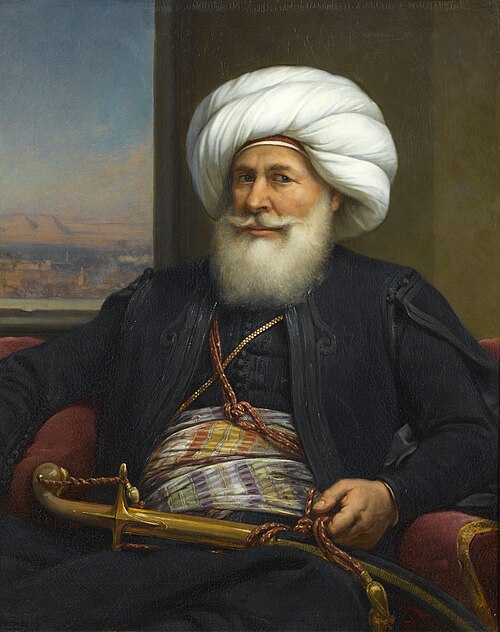
Muhammad Ali arrives as second-in-command of a 300-man Albanian regiment sent by Istanbul to help expel Napoleon's French expedition. In the chaos following the French and British withdrawals, he plays Ottoman officials, Mamluk beys, and Cairo notables against one another with skill.
Location: Egypt
Appointment as Viceroy of Egypt
After Cairo's notables and ulama petition Istanbul against the Ottoman governor, the Sultan appoints Muhammad Ali as wālī (viceroy) of Egypt with the rank of pasha. He begins the decades-long project of concentrating all real power in his own hands.
Location: Cairo, Egypt
Defeat of the British Expedition
A British force under General Fraser lands at Alexandria to oppose Muhammad Ali; Egyptian troops defeat a detachment at Rosetta and besiege the occupiers. The Anglo-Turkish Convention of September 1807 withdraws British troops, leaving Muhammad Ali unchallenged at home.
Location: Rosetta, Egypt
The Massacre of the Mamluks
Muhammad Ali invites Egypt's Mamluk leaders to a ceremony at the Cairo Citadel for the departure of his army to Arabia; his troops ambush and kill them, ending six centuries of Mamluk power in Egypt in a single afternoon. The move removes the last internal rival to his rule.
Location: Cairo Citadel, Egypt
The Arabian Campaign Against the Wahhabis
Campaigning since 1811 at Ottoman request against the Wahhabi Emirate of Diriyah, Muhammad Ali's army under his son Ibrahim destroys the Saudi capital Diriyah. The campaign projects Egyptian power into the Red Sea and Arabia for the first time.
Location: Diriyah, Arabia
State Monopolies and the Modernization Drive
Muhammad Ali builds a state-run economy: monopolies on cotton and grain, imported European machinery and experts, new irrigation works in the Delta, and factories producing textiles, arms, and sugar. Peasants are conscripted into a modern standing army and ordered to grow state-mandated crops — a transformation that European observers describe as the birth of modern Egypt, and that peasant communities experience as heavy state exaction, contributing to flight and famine in bad years.
Location: Egypt
Conquest of Sudan
Egyptian forces under Muhammad Ali's sons conquer Nubia, Sennar, and Kordofan, founding Khartoum as a garrison and trading post in 1821. The conquest supplies slave soldiers and gold for the viceroy's army and binds Sudan to Egypt — an expansion with consequences that last into the 21st century.
Location: Sudan
Intervention in the Greek Revolt and Navarino
Muhammad Ali's modern fleet and army fight the Greek revolt on the Ottomans' behalf in return for promised territory. At Navarino a combined British, French, and Russian fleet destroys the Ottoman-Egyptian fleet in a few hours — his first great strategic setback, which he later blamed on European duplicity.
Location: Navarino (Pylos), Greece
Conquest of Syria and the First Ottoman-Egyptian War

After the Sultan reneges on promised rewards, Muhammad Ali invades Ottoman Syria: his son Ibrahim takes Acre after a six-month siege and destroys the main Ottoman army at Konya. With Egyptian troops advancing on Istanbul, the Sultan accepts the Convention of Kütahya (May 1833), granting Muhammad Ali Syria and Adana.
Location: Konya, Anatolia
Nezib and the European Ultimatum
When Muhammad Ali moves for full independence, his army under Ibrahim routs the Ottomans again at Nezib — but the European powers act: the London Convention (July 1840) backs the Sultan, British and Austrian forces bombard Beirut and Acre, and Muhammad Ali is forced to abandon Syria and accept hereditary rule over Egypt alone by the 1841 firman.
Location: Nezib, Syria
Death and Dynasty

Muhammad Ali dies in Cairo after years of mental decline, having established hereditary rule confirmed for his family. His descendants, raised to khedives and later kings, govern Egypt until the 1952 revolution; historians still debate whether he was the founder of a modern Egyptian nation-state or a Balkan warlord whose system rested on the ruthless exploitation of Egyptian and Sudanese peasants.
Location: Cairo, Egypt