
The Malacca Sultanate (c. 1400–1511)
The Malay sultanate founded around 1400 by Parameswara on the Strait of Malacca, which grew into the great entrepôt connecting Indian Ocean and Chinese trade and the cradle of Malay-Islamic identity in Southeast Asia, until its capture by Portuguese conquest in 1511.
Events
Parameswara Founds Malacca

Parameswara, a prince of Srivijayan descent and the last ruler of the Kingdom of Singapura, established a new settlement at the mouth of the Bertam River after fleeing first Majapahit pressure and then Siamese suzerainty. The site commanded the narrow strait through which seaborne trade between China and India already flowed. The conventional founding date of about 1400 is debated by historians.
Location: Malacca, Malay Peninsula
Alliance with Ming China
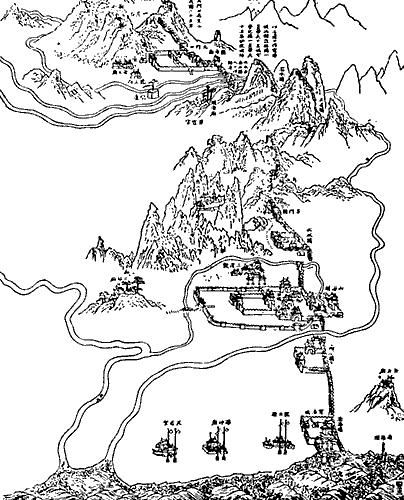
The Yongle Emperor sent the envoy Yin Qing to Malacca, beginning a formal relationship between the young port and Ming China. In 1411 Parameswara headed a royal party of 540 people to the imperial court aboard the fleet of Admiral Zheng He. Chinese recognition and protection freed Malacca from the threat of attack by Ayutthaya and drew traders to the safe harbor.
Islamization of the Court

The Ming Shilu recorded the death of Parameswara, succeeded by his son Megat Iskandar Shah, and by the reign of Muhammad Shah (1424-1444) the court had adopted the title "Sultan." Islam, carried by traders from Gujarat, Pasai, and the broader Indian Ocean world, became the religion of the ruling house and spread outward through the peninsula and archipelago, with Malacca as its principal Southeast Asian center of learning.
Malacca Defeats the Siamese Invasions

The Siamese kingdom of Ayutthaya launched a land invasion of Malacca during the reign of Sultan Muzaffar Shah, and Malaccan forces commanded with the leadership of Tun Perak defeated the invaders near Muar. A second naval expedition was driven off in 1456. The victories secured Malacca's independence and made its chief minister Tun Perak (Bendahara 1456-1498) the architect of its golden age.
Location: Near Muar, Malay Peninsula
Expansion Under Mansur Shah

Sultan Mansur Shah's reign expanded the sultanate across the Malay Peninsula, the Riau Islands, and part of eastern Sumatra, including the conquest of Pahang. The Malay Annals record a marriage alliance with a Chinese princess, Hang Li Po, an episode historians treat cautiously but which reflects the depth of the Ming connection. Malacca's legal code, the Undang-Undang Melaka, became a model law for later Malay states.
First Portuguese Contact

The Portuguese admiral Diogo Lopes de Sequeira reached Malacca, the first European fleet to the port. After the Malaccan court, advised by Indian Muslim merchants wary of Portuguese competition, moved against the visitors and seized some crewmen, the stage was set for armed confrontation.
The Great Entrepôt of Asia
By the early 16th century Malacca hosted merchant communities from Arabia, Persia, India, China, and the archipelago; the Portuguese apothecary Tomé Pires wrote that 84 languages were spoken there and that whoever controls Malacca has his hands on the throat of Venice. The port commanded the spice route between the Moluccas and the Indian Ocean, making it the most coveted prize in Asian trade.
Albuquerque Captures Malacca
Afonso de Albuquerque, governor of Portuguese India, stormed Malacca after a siege of several weeks with roughly 1,200 men against the sultan's defenses. Sultan Mahmud Shah fled south with his court. The fall of Malacca gave Portugal control of the strait's chokepoint, began over a century of Portuguese rule, and displaced Malacca's merchant networks toward rival ports.
Location: Malacca
The Successor Sultanates
After Mahmud Shah's death, his sons founded successor dynasties: the Johor Sultanate and the Sultanate of Perak, which carried the Malaccan royal line, its Islamic institutions, and Classical Malay language forward. Malacca's legacy as the fountainhead of Malay identity and statecraft persisted into the modern states of Malaysia, Singapore, and Indonesia.