
The 1755 Lisbon Earthquake — Catastrophe, Enlightenment, and the Birth of Seismology
A magnitude ~8 earthquake, tsunami, and firestorm destroyed one of Europe's richest capitals on All Saints' Day 1755, killing tens of thousands — and provoked the first scientific study of a disaster, a continent-wide philosophical debate over divine providence, and history's first earthquake-resistant city plan.
Events
The Earthquake Strikes on All Saints' Day
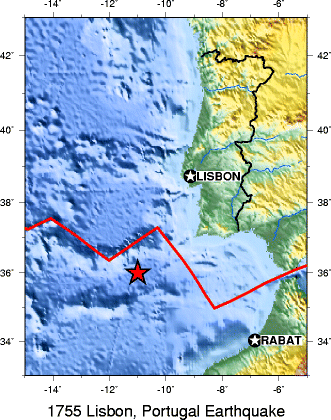
At about 09:40 on the morning of 1 November 1755, while Lisbon's churches were filled for All Saints' Day, an earthquake later estimated at magnitude 7.7-9.0 struck the Iberian Peninsula and Northwest Africa. The shaking lasted up to six minutes, opening fissures 5 metres (16 feet) wide in the city center and collapsing thousands of buildings, including nearly every church — with congregations inside.
Location: Lisbon, Portugal
Tsunami and Firestorm Complete the Destruction
Survivors who fled to the open docks watched the sea recede, then a tsunami — three waves in total — engulfed the harbor and lower city about 40 minutes after the quake. Tipped All Saints' Day candles then ignited a firestorm that burned for hours across the rubble, asphyxiating people up to 30 metres (98 feet) from the flames. An estimated 30,000-40,000 died in Lisbon, with perhaps 10,000 more in Morocco; roughly 85 percent of the city was destroyed.
Location: Lisbon, Portugal
Destruction Across the Portuguese World
The disaster extended far beyond Lisbon. Coastal towns of the Algarve were destroyed by the tsunami; damage reached Salamanca in Spain, Madeira, and the Azores; ports in Morocco suffered heavily. The catastrophe strained the finances and disrupted the trade networks of the Portuguese Empire at the height of its Brazilian gold boom.
Location: Portugal, Spain, Morocco
Pombal Takes Command — "Bury the Dead and Feed the Living"
King Joseph I turned to his minister Sebastião José de Carvalho e Melo — the future Marquis of Pombal — who is credited with the reply: "Bury the dead and feed the living." Pombal imposed order with troops, executed looters, requisitioned food, and prevented mass evacuation of the city, while his rivals and much of the clergy attributed the catastrophe to divine punishment for Lisbon's sins.
Location: Lisbon, Portugal
The Pombaline Questionnaire — First Scientific Disaster Survey
Pombal circulated a questionnaire to every parish asking when the shaking began, how long it lasted, from which direction it came, how many aftershocks followed, and how the sea behaved. The replies, collected across Portugal and beyond, allowed the event's effects to be studied over a wide area — making the Lisbon earthquake the first to be scientifically investigated and marking the effective birth of modern seismology.
Location: Lisbon, Portugal
Voltaire, Rousseau, and the Crisis of Optimism
The disaster convulsed European philosophy. Voltaire's "Poème sur le désastre de Lisbonne" (1756) attacked the doctrine that all is for the best in the best of all worlds; Rousseau replied that the deaths owed more to cramped urban building than to providence; Kant wrote scientific essays on the quake's likely natural causes. The debate over whether God, nature, or human choices were responsible reshaped Enlightenment theodicy.
Location: Geneva, Switzerland
The Pombaline Rebuilding — First Earthquake-Resistant City
Reconstruction of Lisbon's downtown (Baixa) proceeded on a rational grid plan with wide streets, standard building facades, and an anti-seismic wooden cage structure — the "gaiola" — built into walls, the first systematic attempt at earthquake-resistant construction. The new Pombaline district became a landmark of Enlightenment urban planning and 18th-century engineering.
Location: Lisbon, Portugal
Political Aftermath and the Decline of the Old Regime
The earthquake's aftermath transformed Portuguese politics. Pombal, empowered by his handling of the crisis, rose to virtual dictatorial authority and used it against the nobility and the Jesuits — who were expelled from Portugal in 1759, partly on accusations tied to the disaster's exploitation. The event, and the fiscal strain it imposed on the empire, marked the beginning of the end of Portugal's old regime.
Location: Lisbon, Portugal