
The Korean War (1950-1953)
The first major military conflict of the Cold War, fought between US-backed South Korea and Soviet/Chinese-backed North Korea. Starting with North Korea's surprise invasion on June 25, 1950, the war swept up and down the Korean Peninsula for three years, killing an estimated 2.5 million people and ending with an armistice rather than a peace treaty. Korea remains divided today, with the Korean Demilitarized Zone standing as the world's most heavily fortified border.
Events
North Korea Invades South Korea

North Korea's Korean People's Army launches a surprise invasion across the 38th parallel, catching South Korea and the United States off guard. The Soviet-equipped KPA quickly overwhelms the Republic of Korea Army, capturing the capital Seoul within three days. The invasion triggers the rapid US and UN response that will define the conflict.
UN Authorizes Military Support
With the Soviet Union boycotting the Security Council, the UN passes Resolution 83 recommending military assistance to South Korea. President Harry Truman orders US air and naval forces to support the ROK. Twenty-one countries ultimately contribute forces under a unified UN Command led by General Douglas MacArthur.
The Pusan Perimeter
North Korean forces push UN and South Korean troops into a small defensive pocket around the port of Pusan in the southeast. For six weeks, the Pusan Perimeter holds as desperately needed reinforcements, tanks, and supplies arrive by sea. The successful defense prevents complete defeat and buys time for MacArthur's planned counteroffensive at Inchon.
The Inchon Landing

General MacArthur executes a daring amphibious assault at Inchon, far behind North Korean lines. Despite extreme tidal conditions (33-foot tide variations) and skeptical military advisors, the operation succeeds brilliantly. UN forces recapture Seoul on September 28, cut off North Korean supply lines, and force a rapid North Korean retreat northward across the 38th parallel.
China Enters the War

As UN forces advance toward the Yalu River on the Chinese border, ignoring Chinese warnings, Mao Zedong sends 180,000 Chinese People's Volunteer Army troops secretly across the river. The Chinese intervention catches the UN off guard and reverses the momentum, turning a seemingly imminent UN victory into a prolonged war.
The Battle of Chosin Reservoir
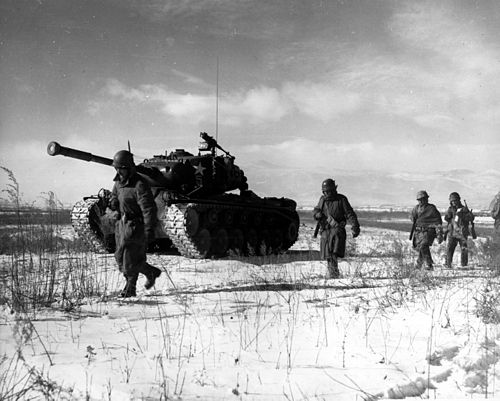
Chinese forces spring a massive ambush on the US X Corps and 1st Marine Division at Chosin Reservoir in subzero temperatures reaching minus 35 degrees Fahrenheit. Despite being surrounded and outnumbered, the Marines fight their way 78 miles to the coast at Hungnam, successfully evacuating 105,000 troops and nearly 100,000 Korean civilians in one of the most remarkable retreat operations in military history.
The War Stabilizes Near the 38th Parallel
Communist forces recapture Seoul. General Matthew Ridgway, who assumed command after MacArthur's dismissal in April 1951, leads a counteroffensive that retakes Seoul by March 14. By mid-1951, the front line stabilizes near the 38th parallel. Both sides realize that a decisive military victory is impossible, and territorial gains will come at unacceptable cost.
Armistice Negotiations Begin

Truce talks begin at Kaesong, later moving to Panmunjom, as both sides seek a way out of the costly stalemate. Negotiations drag on for two years, deadlocked mainly over the issue of prisoner repatriation (the UN refused to forcibly return POWs who did not want to go back to communist control). The fighting continues as a brutal war of attrition with heavy casualties but little territorial change.
The Bombing of North Korea

UN bombing of North Korea intensifies to unprecedented levels, targeting hydroelectric dams, factories, and cities. By the end of the war, US aircraft had dropped 635,000 tons of bombs and 32,557 tons of napalm on North Korea — destroying virtually every major city. North Korea becomes one of the most heavily bombed countries in history, surpassing the entire Pacific theater of World War II in bomb tonnage.
The Armistice Agreement
The Korean Armistice Agreement is signed at Panmunjom, ending three years of fighting. The agreement establishes a 4-kilometer wide Demilitarized Zone along the battle line, arranges for prisoner exchanges, and creates a Military Armistice Commission and the Neutral Nations Supervisory Commission to enforce terms. South Korea refuses to sign. No peace treaty is ever concluded, leaving the Korean conflict technically unresolved for over seven decades.