
Julius Caesar
The life, conquests, and assassination of the Roman general and dictator.
Events
Birth in Rome
Gaius Julius Caesar was born in the Suburra district of Rome to a patrician family, the gens Julia, which claimed descent from the goddess Venus through her son Aeneas. His father was a praetor and governor of Asia, and his mother Aurelia came from a politically influential family. Caesar was raised during a period of intense political violence between the populares and optimates factions.
Military Service and the Civic Crown
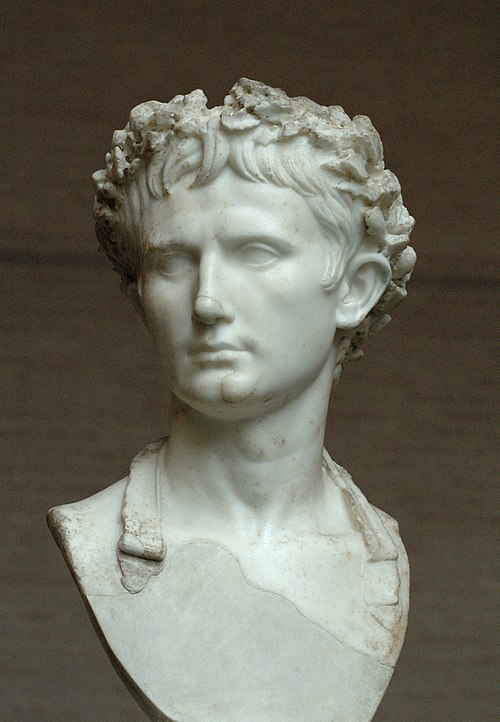
After refusing Sulla's order to divorce his wife Cornelia, Caesar fled Rome and joined the staff of the governor of Asia. During the Siege of Mytilene, he saved the life of a fellow Roman citizen in battle and was awarded the Civic Crown (corona civica), one of Rome's highest military honors. The crown's privileges — including the right to wear it at public occasions — whetted Caesar's ambition for political honors.
Elected to the Pontificate
In his absence from Rome, Caesar was co-opted into the College of Pontiffs, one of the four major priestly colleges of the Roman state religion. The appointment marked him as a well-accepted member of the aristocracy with strong political prospects. He was also elected one of the military tribunes for 71 BC, agitating for the restoration of powers stripped from the plebeian tribunate by Sulla.
Pontifex Maximus
Caesar stood for the praetorship and also for the post of pontifex maximus, the highest religious office in Rome. Despite facing two influential and experienced senators, Caesar won the election decisively. His victory demonstrated his growing popularity and political acumen. As praetor, he later spoke against executing Catilinarian conspirators without trial, advocating life imprisonment instead.
The First Triumvirate
Caesar formed an informal political alliance with Rome's two most powerful men: the general Pompey the Great and the wealthy Marcus Licinius Crassus. The First Triumvirate dominated Roman politics, with each member providing what the others lacked: Caesar's popularity, Pompey's military reputation, and Crassus's immense wealth. The alliance secured Caesar's election as consul for 59 BC.
The Gallic Wars — Conquest of Gaul
As proconsul of Gaul and Illyricum, Caesar launched a series of military campaigns that would conquer all of Gaul (modern France, Belgium, and parts of Germany, Switzerland, and the Netherlands) over eight years. He fought against dozens of tribes, most notably the Helvetii, the Belgae, and the chieftain Vercingetorix. Caesar wrote detailed commentaries on the campaigns (Commentarii de Bello Gallico), which remain classics of Latin literature and primary historical sources.
Invasions of Britain
Caesar led the first Roman expeditions to Britain, crossing the English Channel with a fleet of transport ships. The first invasion in 55 BC was a reconnaissance; the second in 54 BC was larger, advancing inland and defeating the British chieftain Cassivellaunus. Though no permanent occupation was established, the expeditions demonstrated Rome's power and opened Britain to Roman trade and influence.
Crossing the Rubicon — Civil War Begins
Ordered by the Senate to disband his army and return to Rome as a private citizen, Caesar instead crossed the Rubicon River — the boundary of his province — with his veteran Thirteenth Legion. This act of open defiance against the Senate and his former ally Pompey triggered a civil war. According to tradition, Caesar reportedly said "Alea iacta est" (the die is cast) as he crossed.
Defeat of Pompey at Pharsalus
Caesar decisively defeated Pompey the Great at the Battle of Pharsalus in central Greece, despite being outnumbered nearly two to one. Pompey's larger but less experienced army was shattered; Pompey himself fled to Egypt, where he was assassinated by Egyptian courtiers. The victory left Caesar as the undisputed master of the Roman world.
Dictator and the Julian Calendar
Caesar was appointed dictator for 10 years and set about a sweeping program of reforms. He reformed the Roman calendar, creating the Julian calendar with a 365-day year and leap years — used throughout Europe for over 1600 years. He enlarged the Senate, reformed debt laws, launched public works programs, and began plans for the conquest of Parthia. He also took Cleopatra as his mistress in Egypt.
Dictator for Life
The Senate proclaimed Caesar "dictator perpetuo" (dictator for life), making him the first Roman to hold perpetual dictatorial power. His image appeared on coins, statues were erected in his honor, and he was granted tribunician immunity for life. Many senators feared he intended to make himself king, especially after he accepted honors traditionally reserved for the monarchy.
Assassination on the Ides of March

A group of approximately 60 senators led by Marcus Junius Brutus and Gaius Cassius Longinus stabbed Caesar to death at a meeting of the Senate in the Theatre of Pompey. According to accounts, Caesar initially resisted but resigned himself upon seeing Brutus among the conspirators, reportedly saying "Et tu, Brute?" (And you, Brutus?). His assassination triggered a new series of civil wars that ultimately led to the end of the Roman Republic and the rise of his adopted heir Octavian as Emperor Augustus.