
The Indian Rebellion of 1857
A major uprising against the rule of the British East India Company that lasted from May 1857 to November 1858 across northern and central India. The rebellion — variously known as the "Sepoy Mutiny" in older British historiography and the "First War of Independence" in Indian nationalist writing — ended the Company's 263-year rule and led to the establishment of the British Raj. It was a watershed in Anglo-Indian relations and a foundational event in the political memory of modern India.
Events
The Doctrinaire of Lapse and the New Cartridges

Between 1848 and 1856, Governor-General Lord Dalhousie pursued the "Doctrine of Lapse" — the annexation of princely states whose rulers died without natural heirs. The most consequential was Oudh, annexed in February 1856, which absorbed one of the largest and most populous Indian states and alienated its dispossessed officials and soldiers. In January 1857, the British Indian Army began issuing new Enfield rifle cartridges rumored to be greased with cow and pig fat — offensive to Hindu and Muslim sepoys respectively. The immediate trigger, the cartridge controversy, was amplified by years of accumulated grievances: low pay, racial discrimination, foreign service in Burma, and the erosion of traditional patronage under Company rule.
Location: Calcutta and Bengal, India
The Meerut Mutiny
On 10 May 1857, 85 sepoys of the Bengal Army's 3rd Cavalry at Meerut — about 64 km (40 miles) northeast of Delhi — refused to use the new cartridges and were court-martialed and sentenced to long imprisonment. The same day, their comrades mutinied, released the prisoners, killed several British officers, and marched toward Delhi. The timing was partly fortuitous: many of the Bengal Army's most disciplined regiments were then serving in China during the Second Opium War and could not return in time to reinforce British positions. The Meerut mutiny is generally taken as the formal beginning of the rebellion.
Location: Meerut, North-Western Provinces, British India
Capture of Delhi and the Restoration of Bahadur Shah Zafar
On 11 May 1857, the mutineers from Meerut reached Delhi and were joined by the city's garrison, which rose against its British officers. The 82-year-old Mughal emperor Bahadur Shah Zafar, who had reigned as a Company pensioner since the 1856 exile of his son, was proclaimed Emperor of Hindustan. The capture of Delhi gave the rebellion a symbolic focal point and a link to the once-imperial Mughal tradition, but Bahadur Shah was an aged figurehead with no military or administrative authority. The British immediately began planning a siege to recover the city, which was the seat of both rebellion and prestige.
Location: Delhi, India
The Cawnpore Massacre
In June 1857, Indian rebel forces under Nana Sahib, the dispossessed Peshwa, besieged the British garrison at Cawnpore (now Kanpur) under General Sir Hugh Wheeler. After a three-week siege in sweltering heat, with mounting casualties and dwindling supplies, the British surrendered on 25 June on a promise of safe passage. On 27 June, as the surviving British were embarking on boats at Satichaura Ghat, firing broke out, and many were killed. The surviving women and children were confined in the Bibighar and killed on 15 July. The Cawnpore massacre became the most powerful British atrocity narrative of the rebellion, hardening British public opinion against any negotiated settlement.
Location: Cawnpore (Kanpur), North-Western Provinces, British India
The Siege and Recapture of Delhi

From June to September 1857, British forces under General Archibald Wilson and Brigadier John Nicholson besieged Delhi, assembling artillery and reinforcements from Punjab. The final assault began on 8 September with fierce street-by-street fighting. The city was fully recaptured on 20 September; Nicholson was mortally wounded during the assault and died on 23 September. Bahadur Shah Zafar fled to Humayun's Tomb, where he was captured by Captain William Hodson on 21 September. The fall of Delhi deprived the rebellion of its symbolic capital, but the fighting in central India and Oudh continued, with no single battlefield decision ending the conflict.
Location: Delhi, India
The Siege and Relief of Lucknow

The British Residency at Lucknow was besieged from late June 1857 by rebel forces under Begum Hazrat Mahal of Oudh. The garrison — including women, children, and wounded — held out under Sir Henry Lawrence (killed in early July) and Brigadier John Inglis. A first relief column under Sir Henry Havelock and Sir James Outram fought through to the Residency on 25 September, but was too weak to lift the siege. A larger force under Sir Colin Campbell finally broke through on 19 November, evacuating the non-combatants while leaving a garrison to hold the city. A final British offensive under Sir Colin Campbell and Sir Hugh Wheeler re-took Lucknow in March 1858.
Location: Lucknow, Oudh, British India
Rani Lakshmibai of Jhansi and Tantia Tope
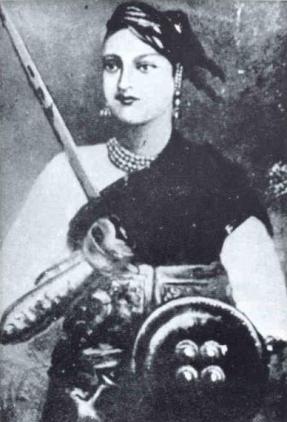
Rani Lakshmibai of Jhansi, who had lost her throne under the Doctrine of Lapse after her husband died without a natural heir, joined the rebellion in 1857 and defended Jhansi against British assault in March 1858. After the city fell, she continued to fight and was killed in battle near Gwalior on 18 April 1858, becoming the most celebrated female warrior of the rebellion and a foundational figure in Indian nationalist memory. Her ally, the general Tantia Tope — Nana Sahib's chief military commander — continued guerrilla operations through 1858 before being captured in April 1859 and executed.
Location: Jhansi and Gwalior, Central India
The Central India Campaign and the Battle of Gwalior

From February to June 1858, Sir Hugh Rose led a British force through central India. His column captured Jhansi in April 1858 after a fierce assault in which the Rani of Jhansi died, and won the Battle of Gwalior on 19 June 1858, scattering the remaining rebel forces. The combination of these victories and the loss of the principal leaders (the Rani of Jhansi dead, Tantia Tope in flight, Bahadur Shah Zafar captured) effectively broke the major organized resistance in the Hindi heartland. Small bands of rebels continued operations into 1859, but the rebellion's military center had collapsed.
Location: Central India
The Government of India Act 1858

On 2 August 1858, the British Parliament passed the Government of India Act, transferring authority from the East India Company to the British Crown. The Company's 263-year rule in India, which had grown from a 17th-century trading license into a sovereign territorial power, was formally dissolved. The Company's stockholders were compensated; its administrative functions were absorbed into a new India Office in London, headed by a Secretary of State for India who would sit in the British cabinet. The act was the last major step toward the formal British Raj that would govern India until independence in 1947.
Location: London, United Kingdom
The Queen's Proclamation of 1858
On 1 November 1858, Queen Victoria issued a proclamation at Allahabad, addressed to "the Princes, Chiefs and People of India." It promised that Indians would be admitted to public office "without distinction of race or creed," that the Crown would respect the rights of existing princely states (reversing the Doctrine of Lapse), and that it would "strictly respect the religious feelings and usages" of Indian communities. Victoria also assumed the title Empress of India in 1876. The Proclamation is still cited as a founding document of the British Raj and is sometimes invoked in contemporary debates about Indian minority rights. It marked both the end of the rebellion and the beginning of a new phase of direct imperial governance that would last nearly 90 years.
Location: Allahabad, North-Western Provinces, British India