
IBM
American multinational technology company founded in 1911 as the Computing-Tabulating-Recording Company (CTR) and renamed IBM in 1924. One of the world's oldest and most influential tech companies, IBM pioneered mainframe computing with System/360, the IBM PC, and has reinvented itself through AI (Watson), cloud computing, and quantum computing. Headquarters: Armonk, New York, USA.
Events
Formation of Computing-Tabulating-Recording Company (CTR)

CTR was formed through the merger of four companies: the Tabulating Machine Company (Herman Hollerith), Computing Scale Company, Bundy Manufacturing, and International Time Recording, creating the foundation for IBM.
Renamed to International Business Machines (IBM)
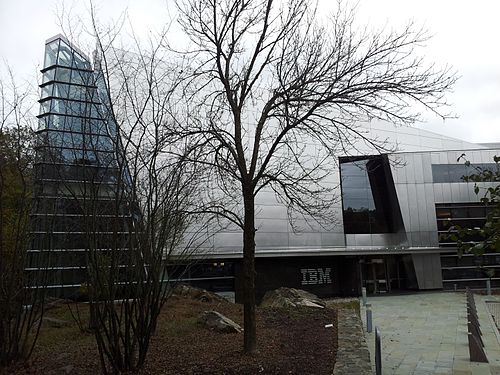
Thomas J. Watson renamed CTR to International Business Machines Corporation, reflecting the company's expanding global ambitions beyond tabulating equipment.
Launch of IBM 701 First Mass-Produced Scientific Computer

IBM delivered the IBM 701, its first mass-produced scientific computer, to Los Alamos National Laboratory. The 701 introduced the concept of a stored-program computer for scientific calculations and could perform over 16,000 additions per second. It marked IBM's transition from punch-card tabulating machines to electronic computing and established IBM as a leader in the emerging computer industry.
Creation of FORTRAN Programming Language Revolutionizes Computing

IBM released FORTRAN (FORMula TRANslation), the first high-level programming language, developed by a team led by John Backus. FORTRAN allowed programmers to write code using mathematical notation instead of assembly language, dramatically reducing programming time. It became the dominant language for scientific and engineering computing for decades and fundamentally changed how humans interacted with computers.
Introduction of System/360 Mainframe

IBM announced the System/360 family of mainframe computers, a revolutionary unified architecture that made software and peripherals compatible across models, cementing IBM's dominance in enterprise computing for decades.
Launch of the IBM Personal Computer (5150)
IBM launched the IBM PC (model 5150), which used an Intel 8088 processor and Microsoft's MS-DOS, creating the open architecture that became the standard for the PC industry.
Launch of ThinkPad 700C Establishes Iconic Laptop Brand
IBM launched the ThinkPad 700C, the first model in what would become the most iconic laptop brand in business computing. Designed by Richard Sapper, the ThinkPad introduced the distinctive black design, red TrackPoint pointing stick, and sturdy construction that defined the brand. The ThinkPad line went on to win numerous design awards and became the standard corporate laptop before IBM sold the brand to Lenovo in 2005.
Acquisition of Lotus Development Corporation
IBM acquired Lotus Development Corporation for $3.5 billion in a hostile takeover battle, gaining Lotus Notes groupware and the 1-2-3 spreadsheet. The acquisition was IBM's largest ever at the time and strengthened IBM's position in the desktop software market. Lotus Notes became the backbone of IBM's collaboration software strategy for the next two decades.
Deep Blue Defeats Kasparov
IBM's Deep Blue supercomputer defeated world chess champion Garry Kasparov in a six-game match, marking the first time a computer defeated a reigning world champion under standard tournament conditions.
Watson Wins Jeopardy!
IBM's Watson AI system defeated former Jeopardy! champions Ken Jennings and Brad Rutter, demonstrating natural language processing and question-answering capabilities to a global audience.
Acquisition of SoftLayer Lays Foundation for IBM Cloud
IBM acquired SoftLayer Technologies, a cloud infrastructure provider, for approximately $2 billion. SoftLayer's bare-metal cloud servers became the foundation for the IBM Cloud platform. The acquisition marked IBM's major commitment to competing with Amazon Web Services and Microsoft Azure in the public cloud market. SoftLayer's global data centers gave IBM an immediate international cloud footprint.
Launch of IBM Quantum System One

IBM unveiled IBM Q System One, the world's first integrated quantum computing system designed for commercial and scientific use, marking a milestone in quantum computing.
Acquisition of Red Hat

IBM completed its $34 billion acquisition of Red Hat, the largest software acquisition in history at the time, to strengthen its hybrid cloud and open-source capabilities.
IBM Spins Off Kyndryl Managed Infrastructure Services
IBM completed the spin-off of its managed infrastructure services division as Kyndryl, a separate publicly traded company. The separation was the largest corporate restructuring in IBM's history, allowing the company to focus on hybrid cloud and artificial intelligence while shedding its low-margin legacy IT services business that generated approximately $19 billion in annual revenue.
IBM Launches 433-Qubit Osprey Quantum Processor
IBM unveiled the Osprey quantum processor with 433 qubits, more than tripling the qubit count of its predecessor Eagle. Osprey represented a major step toward IBM's quantum roadmap goal of achieving 4,000+ qubits by 2025 and demonstrated IBM's continued leadership in quantum computing hardware for scientific and commercial applications.
IBM Watsonx Platform Launches to Compete in Enterprise AI
IBM launched watsonx, its enterprise AI and data platform designed to help organizations train, tune, and deploy AI models in a trusted and governed manner. The platform includes a studio for foundation models, a data store, and an AI governance toolkit, positioning IBM as a key player in enterprise AI with a focus on responsible AI deployment for regulated industries.
Acquisition of HashiCorp for $6.4 Billion
IBM acquired HashiCorp, the cloud infrastructure automation company behind Terraform and Vault, for $6.4 billion. The acquisition bolstered IBM's hybrid cloud capabilities and AI-powered automation portfolio, bringing HashiCorp's widely adopted infrastructure-as-code tools into IBM's ecosystem to compete more effectively in the multi-cloud management market.
IBM Acquires Confluent for USD 11 Billion to Bolster AI and Data Platform
IBM completed its acquisition of Confluent, the data streaming platform built by the creators of Apache Kafka, for USD 11 billion. The deal, IBM's largest acquisition since Red Hat in 2019, gives IBM a real-time data backbone critical for enterprise AI workloads. Combined with the earlier HashiCorp acquisition, the move positions IBM as a leader in AI-ready hybrid cloud infrastructure.
IBM Debuts World's First Sub-1 Nanometer Chip Technology With NanoStack Architecture

IBM unveiled a major semiconductor breakthrough at the VLSI Symposium, introducing the world's first sub-1 nanometer chip technology with a revolutionary 'NanoStack' 3D transistor architecture at the 0.7nm (7 angstrom) node. The prototype squeezes approximately 100 billion transistors onto a chip the size of a fingernail, roughly doubling transistor density over competing designs. While a research milestone rather than a commercial product, the breakthrough positions IBM as a leader in semiconductor research and advanced chip architecture despite no longer manufacturing at scale.
IBM Connects First Modular Cryogenic Quantum Systems, Advancing Toward Fault-Tolerant Computing

IBM successfully joined and cooled down two modular cryogenic quantum modules into a single environment, reaching temperatures below 15 millikelvin (more than 180 times colder than deep space). The new architecture is designed to scale into a system capable of linking hundreds of quantum chips. The milestone advances IBM's roadmap to deliver IBM Quantum Starling in 2029, expected to be the world's first fault-tolerant quantum computer.
IBM Unveils First Dual-Architecture Mainframe Processor with Native Arm Support at Hot Chips 2026

At the Hot Chips conference, IBM announced the first dual-architecture mainframe processor designed to run both IBM Z and Arm instruction sets on the same processor cores. Built on a 2nm node with 11 high-performance cores operating above 5.7 GHz, the chip includes dedicated AI inference accelerators and an on-chip data processing unit. The processor is the first milestone from the IBM and Arm collaboration established in April 2026, enabling enterprises to run Arm-native Linux environments alongside z/OS on future IBM Z and LinuxONE systems.
IBM Completes Acquisition of HRL Laboratories to Accelerate Quantum Computing
IBM completed its acquisition of HRL Laboratories, LLC, a research and development institution jointly owned by Boeing and General Motors. HRL brings expertise in silicon-spin qubits, quantum sensing, advanced communications, electronics, manufacturing, and materials science. Boeing and GM will continue to partner with IBM on quantum applications following the transaction. The acquisition was originally announced in July 2026 and closed on August 26, 2026.
Anderon, IBM's Quantum Foundry Spinoff, Finalizes USD 1 Billion CHIPS Act Award With Commerce Department
The U.S. Department of Commerce signed a final R&D award of up to USD 1 billion under the CHIPS and Science Act with Anderon, a newly formed IBM subsidiary, to establish America's first pure-play quantum semiconductor foundry. The deal, first set out in a May 2026 letter of intent, finalizes federal backing for 300-millimeter quantum wafer manufacturing and marks the largest U.S. government commitment to date aimed at onshoring quantum chip production.