
The History of Stock Exchanges
The four-century history of organized securities trading, from Amsterdam's 1602 exchange built to trade Dutch East India Company shares, through the London and New York markets, to electronic trading and the retail investing era — including the bubbles, crashes, and waves of regulation that shaped each chapter.
Events
The Amsterdam Stock Exchange
The Dutch East India Company (VOC) issued shares to the public to finance its trading ventures, and Amsterdam created the world's first official stock exchange to trade them. The exchange introduced continuous trading, futures and options contracts, and short selling — the essential machinery of modern markets — all within a generation.
Location: Amsterdam, Netherlands
Coffee-House Trading in London
London brokers began quoting share prices at Jonathan's Coffee-House, trading the debt and shares of the Bank of England, the East India Company, and government securities. After Jonathan's burned in 1748, its traders moved to new premises, and in 1773 the group formally adopted the name the Stock Exchange — Britain's market acquiring a permanent institutional home.
Location: London, England
The Buttonwood Agreement and the New York Exchange
Twenty-four New York brokers signed the Buttonwood Agreement outside 68 Wall Street, committing to trade securities only among themselves and to cap commissions. The pact organized what became the New York Stock Exchange, formalized with a constitution and board in 1817 as the New York Stock and Exchange Board.
Location: New York City, New York, USA
The London Stock Exchange Formalizes

The London Stock Exchange established formal membership rules and its own premises, moving beyond the club of coffee-house brokers into a regulated institution. Admission was tightly restricted — women were excluded from membership until 1973 — and the exchange became the central marketplace for the securities of Britain's expanding railways and empire trade.
Location: London, England
The Stock Ticker Accelerates the Markets
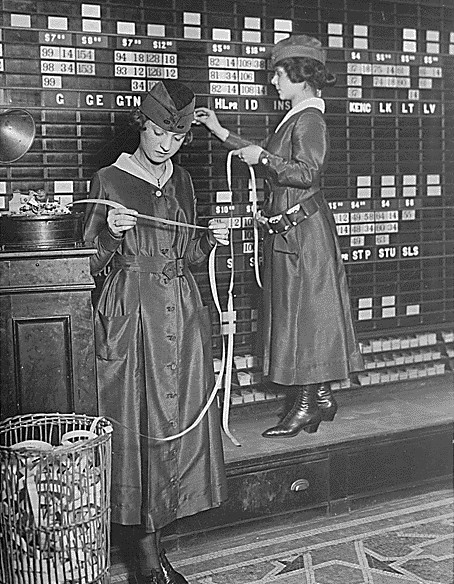
Edward Calahan's stock ticker transmitted prices over telegraph lines to brokers' offices, ending the era in which prices traveled by messenger. Faster information concentrated liquidity in the major exchanges and set off a century-long race between information speed and market practice that culminated in electronic trading.
Location: New York City, New York, USA
Exchanges Spread with Industrial Finance

Securities exchanges proliferated worldwide during the nineteenth century as railways and industrial firms needed capital: Bombay's Native Share & Stock Brokers Association — Asia's oldest exchange, ancestor of the BSE — was established in 1875, following exchanges founded in Frankfurt, Paris, and Tokyo. By 1900, listed securities were a global channel for moving savings into industry.
Location: Mumbai, India
The Crash of 1929 and the Birth of Securities Regulation

After the 1929 Wall Street crash and the Depression that followed, the United States created the Securities and Exchange Commission in 1934, requiring exchange registration, financial disclosure, and rules against manipulation and insider trading. The American model of regulated securities markets became a template adopted worldwide in the decades that followed.
Location: Washington, D.C., USA
NASDAQ — The First Electronic Exchange

The National Association of Securities Dealers Automated Quotations began operating as the world's first electronic stock market, displaying quotes on computer screens rather than trading floors. Electronic matching steadily drained business from floor-based exchanges and eventually enabled the millisecond trading of the modern market.
Location: New York City, New York, USA
The Big Bang Deregulates London

London's "Big Bang" reforms abolished fixed commissions, opened membership to foreign banks, and switched trading to electronic screens, ending two centuries of face-to-face dealing. The deregulation consolidated London as Europe's financial center and triggered a global wave of exchange modernization and eventual demutualization, as exchanges from New York to Frankfurt converted from member clubs into listed companies.
Location: London, England
Cross-Border Mergers and Global Exchanges
The NYSE's merger with Euronext — itself a 2000 combination of the Paris, Brussels, and Amsterdam exchanges — created the first transatlantic exchange group and symbolized the consolidation of national exchanges into global operators. Further mergers, blocked and completed, reshaped the industry into a handful of listed exchange companies through the 2010s.
Location: Amsterdam and New York
The Flash Crash and the High-Frequency Era
The Dow Jones average plunged nearly 1,000 points in minutes before rebounding, with some stocks trading at a penny — a "flash crash" later attributed to the interaction of algorithmic trading systems. The episode prompted circuit breakers and a decade of regulatory scrutiny of high-frequency trading, which by then accounted for the majority of trading volume on major exchanges.
Location: New York City, New York, USA
Retail Traders and the Pandemic Market
Retail trading surged during the COVID-19 pandemic as commission-free apps met lockdown-era savings, culminating in the GameStop episode of January 2021, in which coordinated small investors drove a short squeeze that briefly priced the retailer above established giants. The episode forced trading halts and margin-collateral crises at brokerages and brought a new class of participants into a market structure built for institutions.
Location: New York City, New York, USA