
The History of Polio and Its Eradication
The history of polio and its eradication is one of the most significant public health narratives of the 20th and 21st centuries. From devastating epidemics that paralyzed hundreds of thousands of children annually to the development of two successful vaccines and the largest coordinated international health effort in history, the story of polio spans scientific breakthroughs, political mobilization, and a global campaign that has brought the world to the brink of eradicating only the second human disease after smallpox.
Events
Early Epidemics and the Discovery of Poliovirus
A major polio epidemic struck New York City in June 1916, the largest in US history at that time, with over 27,000 cases and 6,000 deaths nationally. Panic swept across cities as parents kept children indoors and families fled to the countryside. Poliovirus had been recognized as a distinct disease in the 1840s, but it was not until 1908 that Karl Landsteiner and Erwin Popper identified the virus as the causative agent. The 1916 epidemic revealed polio as a disease of sanitation — paradoxically, improved hygiene delayed childhood exposure, allowing infection to strike older children and adults with more severe paralysis.
FDR and the National Foundation for Infantile Paralysis

Franklin D. Roosevelt, who was paralyzed by polio in 1921 at age 39, co-founded the National Foundation for Infantile Paralysis (NFIP) in 1938. The foundation created the "March of Dimes" fundraising campaign, which asked Americans to send dimes directly to the White House — collecting over $1.8 million (approximately $40 million today) in its first year. The NFIP funded polio patient care, rehabilitation research, and eventually vaccine development. FDR never publicly acknowledged the extent of his disability, but his foundation transformed polio from an individual tragedy into a national cause and mobilized unprecedented levels of public health fundraising.
The 1952 Epidemic — Polio's Peak
The 1952 polio epidemic was the worst in US history, with 57,628 reported cases, 21,269 resulting in paralysis, and 3,145 deaths. Hospitals were overwhelmed; iron lungs — large metal cylinders that used negative pressure to help paralyzed patients breathe — became a symbol of the era. The epidemic generated intense public demand for a vaccine. Jonas Salk, a virologist at the University of Pittsburgh, had been working on a killed-virus (inactivated) polio vaccine funded by the March of Dimes. The urgency created by the 1952 epidemic accelerated the timeline for human trials.
The Salk Vaccine Declared Safe and Effective
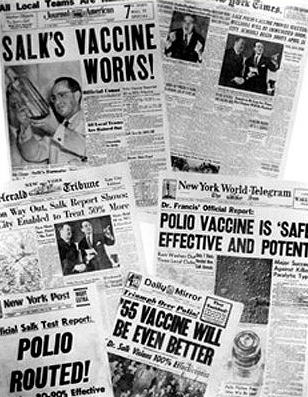
On April 12, 1955 — the tenth anniversary of FDR's death — the results of the Salk vaccine field trial were announced. The trial involved 1.8 million children, the largest public health experiment in history. The vaccine was declared "safe, effective, and potent." In a matter of minutes, news spread by radio, and church bells rang across the country. The vaccine was licensed the same day. Within five years, annual US polio cases dropped from 58,000 to 161. Salk famously refused to patent the vaccine, saying: "There is no patent. Could you patent the sun?" The announcement was hailed as a triumph of American science.
The Cutter Incident — A Setback for Inoculation

Just two weeks after the Salk vaccine was licensed, Cutter Laboratories in Berkeley, California, released batches of the vaccine that contained live poliovirus due to incomplete inactivation. The Cutter Incident caused 40,000 cases of polio, 164 cases of severe paralysis, and 10 deaths. The incident led to the suspension of the vaccination program, a nationwide panic, and congressional hearings. It resulted in stricter federal regulation of vaccine manufacturing and the establishment of the Division of Biologics Standards. The vaccination program resumed within weeks after safety protocols were tightened, and public confidence gradually recovered.
The Sabin Oral Vaccine Licensed

Dr. Albert Sabin's live-attenuated oral polio vaccine (OPV) was licensed in the United States in 1961. Unlike Salk's injected killed-virus vaccine, Sabin's oral vaccine — administered on a sugar cube — was easier to administer, cheaper to produce, and provided intestinal immunity that could interrupt person-to-person transmission. Sabin had tested the vaccine on millions of people in the Soviet Union, Eastern Europe, and other countries before US licensing. The oral vaccine became the primary tool for global eradication campaigns because of its ease of mass administration. By 1962, both vaccines had reduced US polio cases to under 1,000 annually.
The Global Polio Eradication Initiative Launched
The World Health Assembly passed a resolution in May 1988 to eradicate polio globally by 2000, launching the Global Polio Eradication Initiative (GPEI). At the time, polio was endemic in 125 countries and caused an estimated 350,000 cases annually. The initiative involved the WHO, UNICEF, Rotary International, and the US Centers for Disease Control and Prevention. Rotary International had already been working on polio immunization since 1985 and contributed hundreds of millions of dollars. The GPEI became the largest coordinated public health effort in history, with millions of volunteer vaccinators reaching children in remote areas. The target year of 2000 was ultimately missed.
The Americas Declared Polio-Free
The International Commission for the Certification of Polio Eradication declared the Americas polio-free on September 29, 1994 — three years after the last confirmed case, a child in Peru in 1991. The certification was a landmark achievement demonstrating that polio eradication was feasible. The Pan American Health Organization's campaign, led by Dr. Ciro de Quadros, employed mass national immunization days and door-to-door vaccination. The success in the Americas provided the model and momentum for accelerated eradication efforts in other regions. India and sub-Saharan Africa, with their logistical challenges, remained the greatest obstacles.
India Declared Polio-Free
The World Health Organization certified the Southeast Asia region, including India, as polio-free on March 27, 2014. India's achievement was considered the most difficult victory in the eradication campaign due to the country's dense population, high birth rate, poor sanitation, and vaccine hesitancy in some communities. The campaign involved 2.3 million vaccinators administering vaccines to 170 million children twice a year, supported by social mobilization efforts and community engagement. India's success proved that polio could be eliminated even in the most challenging conditions, raising hope for the final eradication of the disease.
Afghanistan and Pakistan — The Final Frontier
As of 2024, polio remains endemic in only two countries: Afghanistan and Pakistan, where the disease has proven stubbornly resistant to eradication efforts due to conflict, insecurity, vaccine misinformation, and targeted attacks on vaccination workers. In Pakistan, polio vaccination teams have been attacked, and in Afghanistan, the Taliban banned house-to-house vaccination campaigns in some areas. Vaccine-derived poliovirus outbreaks (where the weakened vaccine virus mutates and regains virulence in under-immunized populations) have also emerged in parts of Africa and Asia. The world has reduced polio by 99.9 percent from 1988 levels, but the last 0.1 percent has proven the most difficult.