
The Han Dynasty (206 BC-220 AD)
One of the great classical dynasties of China, the Han Dynasty ruled for over four centuries, establishing the foundations of Chinese civilization that have endured to the present day. From the founding by the commoner-turned-emperor Liu Bang through the golden age of Emperor Wu, the opening of the Silk Road, the invention of paper, and the spread of Buddhism, the Han era defined Chinese identity, governance, and culture. The name "Han" became the ethnic name of the Chinese people.
Events
Liu Bang Founds the Han Dynasty

After the collapse of the Qin Dynasty, Liu Bang, a farmer and former local official who rose through the ranks of rebel armies, proclaims himself King of Han. He defeats his chief rival, the warlord Xiang Yu, at the decisive Battle of Gaixia in 202 BC and becomes Emperor Gaozu of Han. The transition from the harsh Legalist rule of the Qin to the more moderate Han approach marks a turning point in Chinese history. Gaozu reduces taxes, lightens laws, and promotes Confucian values.
Location: China
Empress Lu Rules as Regent

Following Emperor Gaozu's death, his wife Empress Lu Zhi takes control of the imperial government, ruling as regent for their young son, Emperor Hui, and later for puppet child emperors. She is the first woman to effectively rule China, eliminating rivals from imperial power. Her reign is controversial — traditional historians portray her as ruthless, but she also preserves the economic and administrative policies of Gaozu, maintaining stability during a fragile period of dynastic consolidation.
Location: Chang'an, China
Emperor Wu - The Golden Age Begins
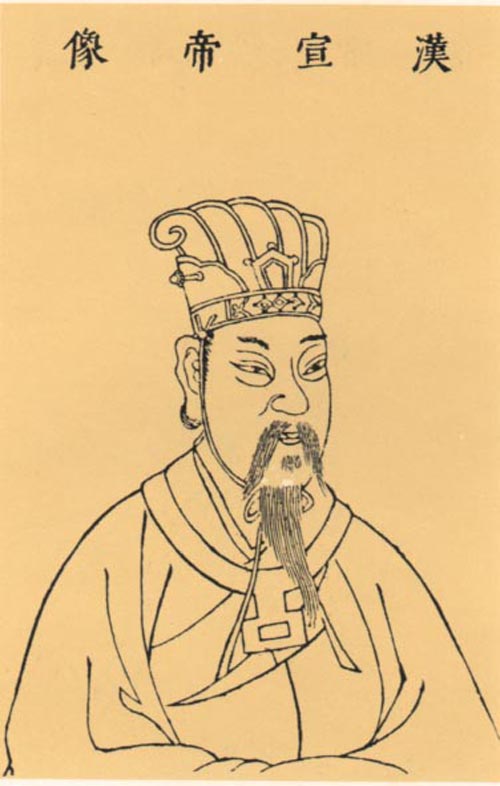
Emperor Wu (Han Wudi) ascends the throne at age 15 and rules for 54 years, presiding over the most expansive period of the Han Dynasty. He launches military campaigns that push the empire's borders into Korea, Vietnam, and Central Asia, defeating the Xiongnu confederation that had plagued China for centuries. Wu makes Confucianism the official state philosophy, establishes the Imperial Academy, and introduces civil service examinations based on Confucian classics. His reign marks the peak of Han military and territorial power.
Location: Chang'an, China
Zhang Qian Opens the Silk Road

Emperor Wu sends envoy Zhang Qian on a diplomatic mission to forge an alliance with the Yuezhi people against the Xiongnu. Though the alliance fails, Zhang Qian spends 13 years traveling across Central Asia, reaching regions that correspond to modern Uzbekistan, Afghanistan, and Iran. His reports introduce China to the kingdoms of the Ferghana Valley, Bactria, and Parthia. This expedition lays the groundwork for the Silk Road trade network, connecting China with Central Asia, India, the Middle East, and eventually Europe.
Location: Central Asia
Records of the Grand Historian Completed

Sima Qian, the Grand Historian of the Han court, completes the Records of the Grand Historian (Shiji), a monumental work covering Chinese history from the mythical Yellow Emperor to his own day. The 130-chapter work establishes the standard for Chinese historical writing and is considered the foundational text of Chinese historiography. Sima Qian had been castrated by Emperor Wu for defending a defeated general, but continued his historical work in prison. The Shiji influences all subsequent Chinese dynastic histories.
Wang Mang Seizes the Throne - Western Han Ends

Wang Mang, a powerful official and regent, seizes the throne from the Liu family, declaring the Xin Dynasty and ending the Western Han period. He implements radical reforms, including land redistribution, abolition of slavery, and currency changes, but his policies alienate the wealthy elite while failing to help the peasantry. Natural disasters and widespread rebellion follow. Wang Mang is killed in 23 AD when rebel armies storm the capital. His short-lived dynasty is traditionally treated as an illegitimate interruption of Han rule.
Location: Chang'an, China
Guangwu Restores the Han - Eastern Han Begins

Liu Xiu, a distant descendant of the Han imperial family, defeats rival warlords and restores Han rule as Emperor Guangwu. He moves the capital east from Chang'an to Luoyang, beginning the Eastern Han (Later Han) period. Guangwu consolidates power by reducing the authority of regional governors and rebuilding the administrative system. The restoration demonstrates the deep legitimacy the Han dynasty had established — even after the interregnum, the Liu family was able to reclaim the throne.
Location: Luoyang, China
Buddhism Arrives in China Via the Silk Road
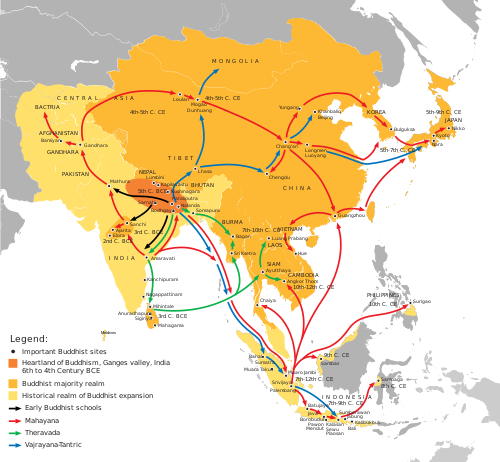
Buddhism is formally introduced to China during the reign of Emperor Ming, when he dispatches envoys to India who return with Buddhist scriptures and two Indian monks, Kasyapa Matanga and Dharmaratna. The White Horse Temple (Baima Si) is built in Luoyang to house the scriptures, traditionally recognized as the first Buddhist temple in China. Over subsequent centuries, Buddhism blends with Chinese philosophies, particularly Taoism and Confucianism, becoming one of China's three major religious traditions and profoundly shaping its culture.
Location: Luoyang, China
Cai Lun Standardizes Papermaking

Cai Lun, a eunuch official in the Han court, announces a refined method of papermaking using tree bark, hemp, rags, and fishing nets. While paper existed in earlier Chinese forms, Cai Lun's standardized process makes it cheap and consistent enough for widespread use. Paper gradually replaces bamboo slips and silk as writing materials, enabling the proliferation of books, education, and bureaucratic record-keeping. The technology later spreads via the Silk Road to the Islamic world, Europe, and beyond.
Location: Luoyang, China
Zhang Heng Invents the Seismograph
Zhang Heng, a Han astronomer, mathematician, and inventor, creates the first known seismoscope — a device capable of detecting earthquakes hundreds of kilometers away. The instrument uses a pendulum mechanism that drops a bronze ball from the mouth of a dragon into the mouth of a frog, indicating the direction of the seismic event. Zhang Heng also improves the Chinese calendar, develops an early armillary sphere, and writes poetic and philosophical works. His invention reflects the advanced scientific capabilities of Han China.
Location: Luoyang, China
Yellow Turban Rebellion Weakens the Dynasty
The Yellow Turban Rebellion, a massive peasant uprising led by the Taoist sect founder Zhang Jue, erupts across eastern China. Motivated by famine, official corruption, and land concentration, the rebels number in the hundreds of thousands and wear yellow headbands as their symbol. The Han court survives by delegating military authority to regional governors and generals, who crush the rebellion but retain their armies and territories. This decentralization of power effectively ends the central government's control and sets the stage for the dynasty's collapse.
Location: Eastern China
The Han Dynasty Falls - Three Kingdoms Period Begins

Emperor Xian, the last Han ruler, is forced to abdicate by Cao Pi, son of the warlord Cao Cao. The abdication ends the 400-year Han Dynasty and inaugurates the Three Kingdoms period (220-280 AD), during which the Wei, Shu, and Wu kingdoms compete for control of China. The fall of Han is a foundational event in Chinese history and literature, immortalized in the 14th-century historical novel Romance of the Three Kingdoms. The ethnic Chinese majority continues to call itself "Han" to this day, a testament to the dynasty's enduring legacy.
Location: Luoyang, China