
Gamal Abdel Nasser — President of Egypt and Arab Nationalist Leader
An Egyptian military officer who led the 1952 revolution that ended the monarchy, nationalized the Suez Canal, and championed pan-Arabism across the Middle East, governing Egypt from 1954 until his death in 1970. His presidency combined sweeping land reform and industrial projects with the suppression of political opposition, and his legacy remains contested between anti-colonial achievement and authoritarian rule.
Events
Birth in Alexandria

Gamal Abdel Nasser was born in Alexandria during the British-dominated Sultanate of Egypt, the son of a postal clerk. His upbringing across provincial towns exposed him to the inequalities of a country governed under indirect British control.
Location: Alexandria, Egypt
Commissioned into the Egyptian Army

Nasser graduated from the Royal Military Academy and was commissioned into the Egyptian Army. In the officer corps he and fellow younger officers found a sphere where merit mattered more than aristocratic connection, and began organizing against the corruption of the palace and the British presence.
Location: Cairo, Egypt
Palestine War and the Fallujah Siege

Nasser served as a junior officer in the 1948 Arab-Israeli War, where his unit was besieged in the Fallujah pocket but held out until a ceasefire. The war and Egypt's poor performance deepened his conviction that the monarchy and its politics, not the soldiers, were responsible for Arab defeat.
Location: Fallujah, Mandatory Palestine
The Free Officers Overthrow the Monarchy

The Free Officers movement led by Nasser and General Mohamed Naguib seized power in a bloodless coup, forcing King Farouk into exile. The revolutionary command abolished titles and set Egypt on course to end its constitutional monarchy.
Location: Cairo, Egypt
Egypt Declared a Republic

The Revolutionary Command Council declared Egypt a republic, ending the monarchy formally. Naguib became president and prime minister, but power struggles within the junta soon emerged between Naguib's civilian-transition line and Nasser's officer faction.
Location: Cairo, Egypt
Nasser Takes Power After Assassination Attempt

After a Muslim Brotherhood member attempted to assassinate Nasser during a public speech in Alexandria, the government cracked down on the organization, imprisoned thousands of its members, and placed Naguib under house arrest. Nasser emerged as the effective head of state, holding the posts of prime minister and chairman of the Revolutionary Command Council.
Location: Cairo, Egypt
Land Reform and Election as President
Following a new constitution, a national referendum elected Nasser president with an official count near 99 percent. His government's land reform, launched from 1953, had capped individual landholdings and redistributed about 560,000 hectares (1.4 million acres) of land to smallholders, breaking the political power of the large landowning class.
Location: Cairo, Egypt
The Suez Crisis — Nationalization and Victory

After the United States and Britain withdrew financing for the Aswan High Dam, Nasser nationalized the Suez Canal Company to fund the project with canal revenues. Britain, France, and Israel invaded in late October, but American financial pressure and United Nations condemnation forced their withdrawal, leaving Nasser in control of the canal and at the height of his regional prestige.
Location: Alexandria, Egypt
The United Arab Republic with Syria

Egypt and Syria united to form the United Arab Republic, the concrete embodiment of Nasser's pan-Arab ideology. The union gave Egypt's leadership a regional mandate, but Syrian resentment of Egyptian domination led Syria to secede in September 1961, a blow from which pan-Arab unity politics never fully recovered.
Location: Cairo, Egypt
The Aswan High Dam and Non-Aligned Leadership

Construction of the Aswan High Dam began with Soviet financing after the West withdrew its loan offer. The dam, completed in 1970, ended the Nile's destructive floods, doubled Egypt's electricity supply, and became the symbol of Nasser's state-led development model, while his co-founding leadership of the Non-Aligned Movement and chairmanship of the Organisation of African Unity made Egypt a voice for postcolonial states.
Location: Aswan, Egypt
The Six-Day War Defeat

Israel destroyed most of Egypt's air force on the ground and overran the Sinai Peninsula in six days. Nasser announced his resignation on June 9, but mass demonstrations demanding he stay brought him back to office the next day; he spent his remaining years rebuilding the military and fighting a war of attrition along the Suez Canal.
Location: Sinai Peninsula, Egypt
The War of Attrition on the Canal
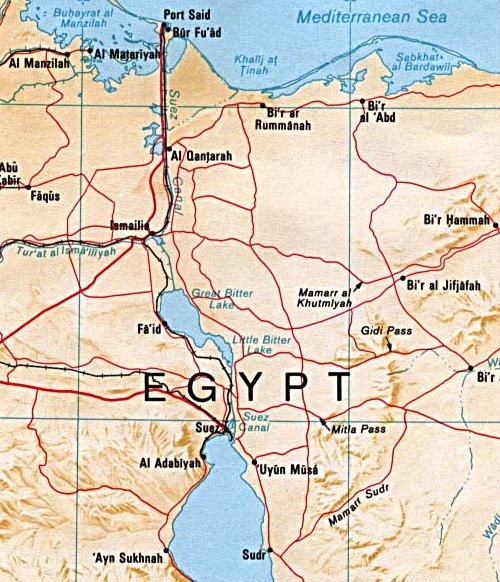
Egypt launched a sustained campaign of artillery raids and commando attacks along the Suez Canal to wear down Israeli positions, which Israel answered with deep airstrikes and its own raids. The attrition fighting, backed by Soviet rearmament, restored some Egyptian offensive capability and set the stage for the 1973 crossing, while ceasefire talks brokered by the United States began in 1970.
Location: Suez Canal, Egypt
Death in Cairo

Nasser died suddenly of a heart attack at age 52, hours after mediating an Arab summit on Jordan's civil conflict. His funeral drew millions of mourners, and Vice President Anwar Sadat succeeded him, steering Egypt away from Nasser's socialist and pan-Arab policies within a few years.
Location: Cairo, Egypt