
Queen Elizabeth I — Tudor Queen of England
Elizabeth I was the last Tudor monarch of England, reigning for 44 years from 1558 to 1603. Her reign, known as the Elizabethan era, saw England emerge as a major European power through the defeat of the Spanish Armada, the flourishing of English drama led by William Shakespeare, the founding of the Church of England, and the establishment of English naval exploration. Known as the Virgin Queen, Elizabeth never married, using her singleness as a diplomatic tool while navigating the treacherous politics of 16th-century Europe.
Events
Elizabeth Born to Henry VIII and Anne Boleyn
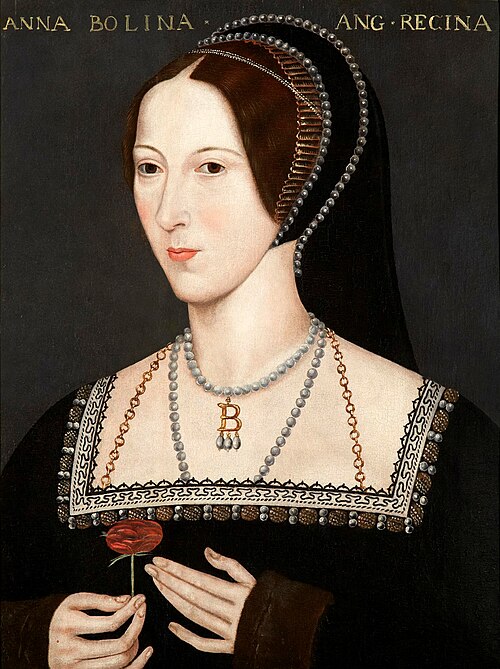
Elizabeth is born at the Palace of Placentia in Greenwich, the second daughter of King Henry VIII and his second wife, Anne Boleyn. Her birth is a disappointment to Henry, who desperately wanted a male heir. Elizabeth is christened three days later and named after her grandmother, Elizabeth of York.
Anne Boleyn Executed

When Elizabeth is not yet three, her mother Anne Boleyn is executed on charges of adultery and treason. Parliament declares Elizabeth illegitimate through the Second Succession Act, removing her from the line of succession. Elizabeth is sent away from court and raised in relative obscurity, a traumatic beginning that shapes her cautious personality.
Third Succession Act Restores Elizabeth

Henry VIII's Third Succession Act restores both Mary and Elizabeth to the line of succession after Edward, though they remain legally illegitimate. Elizabeth receives an excellent humanist education under tutor Roger Ascham, becoming fluent in Latin, Greek, French, and Italian — one of the best-educated women of her generation.
Elizabeth Imprisoned During Wyatt's Rebellion

Under the Catholic reign of her half-sister Mary I, Elizabeth is suspected of involvement in Thomas Wyatt's Protestant rebellion against Mary's marriage to Philip II of Spain. She is imprisoned in the Tower of London and interrogated for two months. Despite the threat of execution, Elizabeth maintains her innocence and is eventually released to house arrest.
Elizabeth Becomes Queen of England

Queen Mary I dies, and Elizabeth succeeds to the throne at age 25. Upon hearing the news at Hatfield House, she quotes Psalm 118: "This is the Lord's doing; it is marvelous in our eyes." Elizabeth inherits a kingdom deeply divided by religious conflict, bankrupt from Mary's wars, and regarded as a secondary power in Europe.
Establishment of the Church of England

Parliament passes the Acts of Supremacy and Uniformity, establishing Elizabeth as Supreme Governor of the Church of England. The settlement is a middle course between Catholicism and radical Protestantism — the English monarch becomes head of the church, services are in English, but traditional vestments and ceremony are retained. This compromise largely ends religious civil war in England.
Coronation of Elizabeth I

Elizabeth is crowned at Westminster Abbey in a ceremony conducted by the Catholic Bishop of Carlisle (as the Archbishop of Canterbury refuses to participate). She processes through London to cheering crowds and later writes her first speech to Parliament promising to be "a good queen to my country."
Mary Queen of Scots Flees to England
Mary Stuart, Queen of Scots and Elizabeth's Catholic cousin, flees Scotland after being deposed by rebellious nobles. She arrives in England seeking Elizabeth's protection. Elizabeth instead places her under house arrest — beginning 19 years of captivity. Mary becomes the focus of Catholic plots to overthrow Elizabeth, making her a constant threat to the throne.
Pope Pius V Excommunicates Elizabeth
Pope Pius V issues the papal bull Regnans in Excelsis, declaring Elizabeth a heretic and illegitimate ruler, releasing English Catholics from any allegiance to her. The bull has the opposite of its intended effect — it strengthens English patriotic feeling and makes English Catholics suspect as potential traitors, leading to stricter anti-Catholic laws.
Mary Queen of Scots Executed
After the discovery of the Babington Plot to assassinate Elizabeth and place Mary on the throne, Elizabeth reluctantly signs Mary's death warrant. Mary is executed by beheading at Fotheringhay Castle. The execution removes the greatest Catholic threat to Elizabeth's throne but also incenses Catholic Europe, particularly King Philip II of Spain.
English Fleet Defeats the Spanish Armada
King Philip II of Spain launches the Spanish Armada — a massive fleet of 130 ships — to invade England and restore Catholicism. The smaller, more maneuverable English fleet harries the Armada up the English Channel. Fire ships scatter the Spanish at Calais, and a storm finishes the destruction. England is saved, and Elizabeth delivers her famous speech at Tilbury.
Flourishing of English Drama and Culture
The Elizabethan era witnesses an extraordinary cultural renaissance centered on London's theater scene. William Shakespeare writes many of his greatest plays — Romeo and Juliet, Hamlet, A Midsummer Night's Dream. Christopher Marlowe, Edmund Spenser, and Francis Bacon also flourish. Elizabeth's patronage of the arts and stability of her reign enable this golden age of English literature.
East India Company Chartered
Elizabeth grants a royal charter to the British East India Company, giving it a 15-year monopoly on English trade with the East Indies. This charter lays the foundation for the British Empire's expansion into India and Asia, a development that would reshape global trade and geopolitics for the next 350 years.
Elizabeth Dies, Ending the Tudor Dynasty
Elizabeth I dies at Richmond Palace at age 69 after 44 years on the throne. She refuses to go to bed in her final days, standing for hours in silence. Her reign was so long and transformative that the second half of the 16th century is known as the Elizabethan era. The Tudor dynasty ends with her; she is succeeded by James VI of Scotland (James I of England), uniting the crowns.