
The Delhi Sultanate (1206-1526)
The Delhi Sultanate was the first long-lasting Islamic sultanate to rule northern India, founded by former Turkic slave-generals of the Ghurid Empire. Over 320 years under five dynasties, it repelled Mongol invasions, reshaped the subcontinent's architecture and court culture, and fell at Panipat in 1526 to the Mughal founder Babur.
Events
Qutb ud-Din Aibak Founds the Sultanate

After the death of Muhammad of Ghor, his Turkic slave-general Qutb ud-Din Aibak declared himself ruler of the Ghurid territories in northern India, establishing the Mamluk dynasty of Delhi. The sultanate would endure for 320 years under five successive dynasties.
Location: Lahore, present-day Pakistan
The Qutb Minar Rises Over Delhi

The Qutb Minar, begun by Aibak around 1199 as a victory tower and completed under his successor Iltutmish, became the centerpiece of the first monumental Indo-Islamic architecture in Delhi. Iltutmish (reigned 1211-1236) consolidated the young sultanate's administration and secured the dynasty's survival.
Location: Delhi, India
Balban Centralizes the Sultanate

Ghiyath al-Din Balban (reigned 1266-1287), himself a former slave of Turkic origin, rebuilt the sultanate after decades of palace intrigue by asserting absolute royal authority and a court culture modeled on Persian kingship. His centralization allowed Delhi to withstand internal rivals and prepared the state for the Mongol threat on its northwest frontier.
Location: Delhi, India
The Khalji Revolution

Jalal ud-Din Khalji overthrew the Mamluk dynasty in 1290, opening the sultanate's rule to a wider Turkish-Afghan military aristocracy. The coup marked the first dynastic change of the sultanate and set the stage for its most aggressive phase of expansion.
Location: Delhi, India
Alauddin Khalji's Rule and Market Reforms

Alauddin Khalji (reigned 1296-1316) seized the throne from his uncle, repelled repeated Mongol invasions, and extended Delhi's rule across much of the subcontinent. He imposed sweeping market controls, fixing prices for grain, cloth, and other essentials to sustain a large standing army, and taxed the Hindu peasantry at rates that chroniclers recorded as half of the harvest.
Location: Delhi, India
The Capital Moves to Daulatabad and Back

Muhammad bin Tughluq (reigned 1325-1351) ordered the transfer of the capital and much of Delhi's population 1,100 kilometers (680 miles) south to Daulatabad, a plan he reversed within a few years after enormous disruption. His reign also introduced token copper currency decades before such money became practical, an experiment chroniclers described as collapsing amid counterfeiting.
Location: Daulatabad, present-day Maharashtra, India
Timur Sacks Delhi

The Central Asian conqueror Timur (Tamerlane) sacked Delhi over three days in December 1398, carrying away vast treasure and, by contemporary accounts, large numbers of captive artisans. The devastation broke the Tughlaq dynasty's authority and inaugurated a century of weaker rule under the Sayyid and Lodi dynasties.
Location: Delhi, India
The Lodi Dynasty and the Afghan Ascendancy
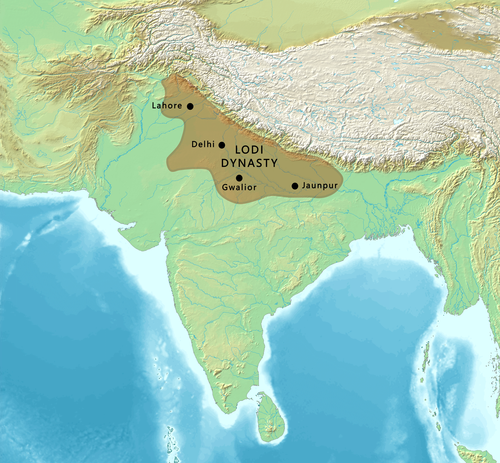
Bahlul Lodi founded the sultanate's final dynasty in 1451, the first Afghan ruling house of Delhi, and his successors moved the effective capital toward Agra. Under Ibrahim Lodi, tensions within the Afghan nobility and with regional Rajput powers weakened the state on the eve of the Mughal invasion.
Location: Delhi and Agra, India
The First Battle of Panipat
Babur, a Timurid prince from Central Asia, defeated Sultan Ibrahim Lodi at Panipat using artillery and disciplined cavalry tactics, killing the sultan and ending the Delhi Sultanate. The battle founded the Mughal Empire, which inherited and expanded the sultanate's domains and much of its administrative vocabulary.
Location: Panipat, present-day Haryana, India