
The Chola Dynasty (848–1279)
A Tamil dynasty of southern India that built one of the medieval world's most powerful maritime empires. From its heartland in the Kaveri river valley, the Chola state unified peninsular India, projected naval power into Sri Lanka and Southeast Asia, and produced a distinctive tradition of temple architecture and bronze sculpture.
Events
Vijayalaya Founds the Medieval Chola Line at Tanjore

Around 848 CE the chieftain Vijayalaya captured Tanjore (Thanjavur) from the Mutharayar rulers and established the line that became the imperial Chola dynasty. The Tanjore region's Kaveri delta gave the dynasty an agricultural and commercial base. Chola kingdoms of the earlier Sangam age had faded centuries before; Vijayalaya's house revived the name. Tanjore became the dynasty's capital for the next two centuries, and later Chola kings traced their legitimacy to Vijayalaya's conquest in their copper-plate charters. His revival of the Chola name came amid a three-way contest between the Pandyas, the declining Pallavas and the new Chola power in the Kaveri delta. The agricultural surplus of the delta irrigation works funded the armies and temples of the imperial age that followed.
Location: Thanjavur, Tamil Nadu, India
Parantaka I Extends Chola Rule Across Southern India
Parantaka I, who became king around 907, conquered the Pandya country and extended Chola authority across much of the peninsula south of the Tungabhadra River, a unity the dynasty maintained for roughly three centuries. Later in his reign Chola forces suffered a major defeat to the Rashtrakuta king Krishna III at Takkolam around 949. Inscriptions from this period record land grants, taxes and village assemblies that structured the expanding realm. Parantaka I is also remembered for patronising the Nataraja temple at Chidambaram and for the land and revenue surveys recorded in his inscriptions. The defeat at Takkolam around 949 checked Chola expansion for a generation and handed the Tondaimandalam region to the Rashtrakutas. His long reign nevertheless set the administrative pattern that Rajaraja I later scaled into an empire.
Location: Tamil Nadu, India
Rajaraja I Ascends the Chola Throne

Rajaraja I became king around 985 and reorganized the empire's army and navy, launching campaigns that brought northern Sri Lanka, the Maldives and the Malabar coast into the Chola sphere. His administration was recorded in stone and copper-plate inscriptions documenting land grants, taxes and local assemblies. The Chola navy became a major force in the Bay of Bengal and the Arabian Sea. His roughly twenty-five-year reign brought the Chola state to imperial scale, and the Tanjore temple inscriptions record his titles claiming victories from Sri Lanka to the Maldives. He introduced systematic land and revenue surveys and reorganized village assemblies, documented in the famous Uttaramerur inscriptions. The navy he built protected the trade routes that carried Chola commerce to Song China and the ports of Southeast Asia.
Location: Thanjavur, Tamil Nadu, India
The Brihadeeswarar Temple Is Completed at Tanjore

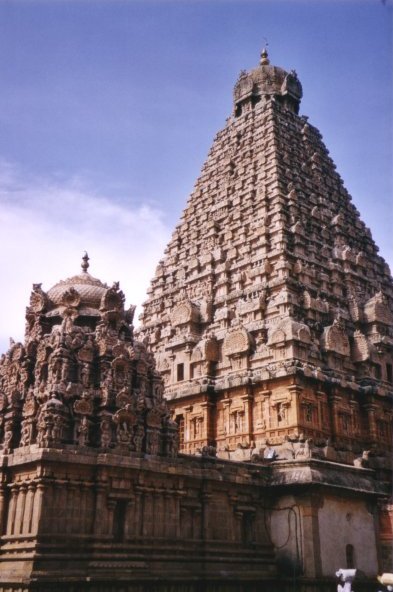
Rajaraja I's royal temple at Tanjore, the Brihadeeswarar Temple, was completed around 1010 and dedicated to Shiva. Its vimana tower rises about 66 meters (217 feet), and its walls record the temple's endowments and the king's titles. The building is one of the Great Living Chola Temples inscribed on UNESCO's World Heritage List. Built largely in granite hauled from hundreds of kilometres away, the temple's tower is crowned by a single cupola stone of around 80 tonnes whose raising remains debated among engineers. The complex served as a state temple, treasury and record office as well as a place of worship. Its wall inscriptions itemize the temple's dancers, lamps, lands and endowments in extraordinary detail, making it one of the best-documented buildings of the medieval world.
Location: Thanjavur, Tamil Nadu, India
Rajendra I Succeeds and Builds Gangaikonda Cholapuram

Rajendra I succeeded his father Rajaraja I in 1014 and carried Chola arms further than any previous king, with inscriptions recording campaigns into Odisha and Bengal and a royal title commemorating a northern expedition. He founded a new capital, Gangaikonda Cholapuram, and built a royal temple there modeled on Tanjore. Chola trade and tribute networks reached deep into mainland Southeast Asia. His northern expedition of around 1023 reached the Ganges valley, and royal inscriptions record carrying river water back to the new capital in golden vessels, commemorated in the title Gangaikonda, he who took the Ganges. The capital's royal temple, completed around 1035, was modelled on Tanjore and marked the empire at its peak. Under him the Cholas received embassies from Song China and Srivijaya and levied tribute across the Bay of Bengal.
Location: Ariyalur district, Tamil Nadu, India
Chola Naval Raids Strike Srivijaya

In 1025 Rajendra I launched naval raids against the ports of the Srivijaya empire in Sumatra and the Malay Peninsula and against Pegu in Burma. The campaign was a plundering expedition rather than a lasting occupation, but it weakened Srivijayan control of the sea lanes. Tamil merchant guilds expanded their influence across the region, shifting the balance of trade between Indian and Malay merchants. The raids of 1025 struck ports from Sumatra to the Malay Peninsula and are remembered in Malay tradition as a Chola invasion. Historians debate the cause: interference with Chola commerce, Srivijayan tolls on Tamil merchants, or dynastic politics within the region. Whatever the motive, the balance of maritime power shifted toward the Tamil merchant guilds, and Chola trade with Song China expanded through the straits the raids had opened.
Location: Sumatra and Malay Peninsula
Kulothunga I Begins the Later Chola Dynasty

After the last Chalukya-Chola king was killed in a civil disturbance in 1070, Kulothunga I took the throne and founded the Later Chola line. His reign, lasting until about 1120, marked a second phase of stability and of diplomatic contact across the Bay of Bengal. Later historians distinguish this dynasty from the earlier imperial house of Rajaraja I. His accession reunited Chola and Eastern Chalukya territories through his maternal line, and he maintained diplomatic ties with Song China and Srivijaya. Later Chola tradition remembers his reign as a second phase of stability and administrative competence. Historians treat the close of his reign as the conventional boundary between the imperial Chola state and the diminished later dynasty.
Location: Tamil Nadu, India
The Airavatesvara Temple Is Built at Darasuram

Under Rajaraja II (1146-1175) the Chola realm remained largely intact, and the chariot-shaped Airavatesvara Temple at Darasuram was built as the third of the Great Living Chola Temples. Its stone carvings treat the temple as a celestial chariot. The building reflects the artistic confidence of the 12th-century court. The temple's main mandapa is carved as a celestial chariot with stone wheels drawn by horses and elephants, its name taken from the elephant of the god Indra. Its sculpture and inscriptions show the Chola workshops at their most refined, in stone and in the bronze tradition that produced the Nataraja icons. With Tanjore and Gangaikonda Cholapuram it forms the Great Living Chola Temples inscribed on UNESCO's World Heritage List.
Location: Darasuram, Tamil Nadu, India
Kulothunga III Ends Chalukya Power
Between 1185 and 1190 the Cholas under Kulothunga III defeated the Eastern Chalukyas and their allies, dissolving what remained of Chalukya power. The campaigns marked the last major Chola expansion. The wars also strained the treasury at a time when Pandya power was growing in the south. His forty-five-year reign was the last imperial phase: campaigns against the Western Chalukyas and their allies dissolved what remained of Chalukya power. The effort exhausted Chola resources just as Pandya power grew under Jatavarman Sundara Pandya. Within decades of his death Chola authority in the core Kaveri delta began to slip away.
Location: South India
Pandya Power Rises as Chola Authority Fades
The Chola state held together until about 1215, after which the Pandyas became the dominant power in southern India. Chola rulers continued to hold territory and titles but progressively lost control of their core regions. Inscriptions from the 13th century record the transfer of Tanjore and the surrounding country into Pandya hands. The Pandyas under Jatavarman Sundara Pandya I reduced Chola kings to feudatory status and took control of Tanjore and the surrounding country. Chola titles lingered into the thirteenth century but real authority had passed. The shift ended roughly three centuries of Chola dominance over the Coromandel coast and its sea lanes.
Location: Tamil Nadu, India
Rajendra III Is Deposed and the Dynasty Ends
In 1279 the last main-line Chola king, Rajendra III, was deposed, and the dynasty ceased to rule. The Chola empire was absorbed by the Pandya state. Its administrative practices, temple architecture and bronze-casting traditions outlasted the dynasty across South and Southeast Asia. Rajendra III reigned as a powerless sovereign over a shrinking realm before being deposed by the Pandyas in 1279. The Chola state disappeared as a political entity, but its model of temple-centred administration, its bronze casting, above all the Nataraja, and its maritime commerce endured across South and Southeast Asia. The dynasty's vast inscriptional record makes the Cholas one of the best-documented states of the premodern world.
Location: Tamil Nadu, India