
The Chinese Civil War (1927-1949)
The Chinese Civil War was a decades-long conflict between the Kuomintang (Chinese Nationalist Party) led by Chiang Kai-shek and the Chinese Communist Party (CCP) led by Mao Zedong. Fought intermittently from 1927 to 1949, the war determined the political fate of modern China. The CCP's victory led to the establishment of the People's Republic of China on the mainland, while the Kuomintang retreated to Taiwan, a division that persists to the present day.
Events
The First United Front and the Northern Expedition
Sun Yat-sen's Kuomintang (KMT) formed the First United Front with the Chinese Communist Party (CCP) in 1924, an alliance aimed at ending warlord rule and unifying China. With Soviet advisors and support, the KMT established the Whampoa Military Academy, appointing Chiang Kai-shek as commandant. The National Revolutionary Army launched the Northern Expedition in 1926, rapidly defeating warlord armies. The alliance was pragmatic — the CCP was a small party operating within the KMT's organizational structure, and tensions over strategy and ideology were present from the start.
The Shanghai Massacre and the End of the United Front
On April 12, 1927, Chiang Kai-shek ordered the violent suppression of Communist organizations and leftist elements in Shanghai, an event known as the Shanghai Massacre. KMT troops and aligned gangsters killed thousands of CCP members, trade unionists, and suspected sympathizers in coordinated raids across the city. Similar purges followed in other KMT-controlled areas. The massacre effectively ended the First United Front and began the Chinese Civil War. The CCP leadership was decimated; survivors fled to rural areas. Chiang established a rival KMT government in Nanjing, splitting with the left-KMT faction based in Wuhan.
The Nanchang Uprising and the Birth of the Red Army
On August 1, 1927, the CCP launched the Nanchang Uprising, a military rebellion led by Zhou Enlai, Zhu De, He Long, and Ye Ting. The uprising involved approximately 20,000 troops and captured Nanchang city briefly. It was crushed by KMT forces within days, but August 1 is celebrated as the founding date of the People's Liberation Army (PLA). The survivors retreated southward, and many later joined Mao Zedong in the Jinggang Mountains. The uprising established the principle that the CCP needed its own military force — a lesson Mao famously summarized as "political power grows out of the barrel of a gun."
The Autumn Harvest Uprising and the Jinggangshan Base
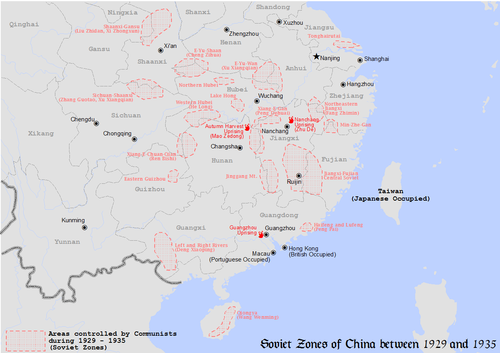
Mao Zedong led the Autumn Harvest Uprising in September 1927, a peasant-based rebellion in Hunan province. The uprising failed and Mao's forces were reduced from 5,000 to fewer than 1,000 men. Retreating to the Jinggang Mountains on the Hunan-Jiangxi border, Mao established the first rural revolutionary base area. There, he began developing his strategy of peasant-based guerrilla warfare, arguing that the CCP should focus on building support in the countryside rather than attempting to capture cities. This "rural包围 city" strategy — encircling the cities from the countryside — became the CCP's central military doctrine.
The Chinese Soviet Republic and KMT Encirclement Campaigns

The CCP proclaimed the Chinese Soviet Republic on November 7, 1931, with its capital at Ruijin in Jiangxi province. Mao Zedong was elected chairman. The Soviet Republic controlled territory with a population of approximately 3 million and implemented land reform, redistributing land from wealthy landlords to poor peasants. The KMT launched a series of five "Encirclement Campaigns" against the Soviet Republic between 1930 and 1934. The first four campaigns were repelled by Communist forces using guerrilla tactics under Mao and Zhu De. The KMT's fifth campaign, led by Chiang Kai-shek with German military advisors, employed fortified blockhouse tactics and a total economic blockade.
The Long March

Breaking through the KMT encirclement, the CCP's main forces (approximately 86,000 troops and cadres) embarked on the Long March from Jiangxi in October 1934. The retreat covered approximately 9,000 kilometers (5,600 miles) over 370 days across 12 provinces, crossing 18 mountain ranges, 24 rivers, and vast grasslands. Only 7,000-8,000 survivors reached the new base at Yan'an in Shaanxi in October 1935. During the march, the Zunyi Conference (January 1935) established Mao Zedong as the CCP's de facto leader, marking a critical turning point for the Communist movement.
The Xi'an Incident and the Second United Front
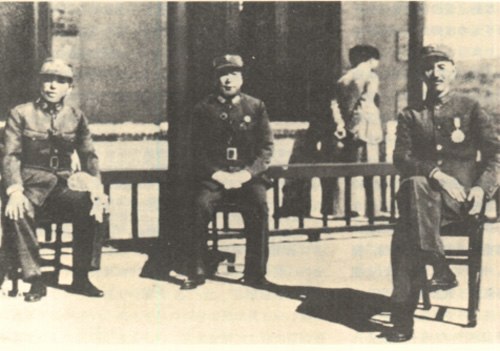
In December 1936, KMT General Zhang Xueliang, stationed in Xi'an, kidnapped Chiang Kai-shek in a dramatic coup attempt. Zhang demanded an end to the civil war and the formation of a united front against Japan. After negotiations involving CCP representatives Zhou Enlai and Soviet mediation, Chiang was released on December 25. The Xi'an Incident led to the formal establishment of the Second United Front in 1937, suspending major civil war hostilities. Both sides agreed to resist Japan's invasion, though they maintained separate armies and continued low-level clashes throughout the war.
Civil War During the Anti-Japanese War — The New Fourth Army Incident

Despite the united front against Japan, tensions between the KMT and CCP erupted violently in January 1941 when KMT forces ambushed the CCP's New Fourth Army in Anhui province during its planned redeployment. Over 7,000 Communist troops were killed and the army's commander, Ye Ting, was captured. The CCP denounced the attack as KMT treachery, but the Second United Front nominally continued. After the incident, the CCP focused on expanding its base areas and building its military strength, controlling approximately 100 million people by 1945 through a network of bases across northern and central China.
Japanese Surrender and the Race to Accept Surrender

Japan's surrender on August 15, 1945, ended the Second Sino-Japanese War and removed the common enemy that had held the fragile KMT-CCP alliance together. Both sides rushed to accept Japanese surrenders and seize territory and equipment. The KMT, as the internationally recognized government, received most Japanese arms, but the CCP's forces, having operated extensively behind enemy lines, controlled large areas of northern and central China. The Sino-Soviet Treaty of Friendship and Alliance (August 1945) granted the CCP indirect Soviet support and access to Manchuria. Full-scale civil war resumed almost immediately.
Full-Scale Resumption — The Campaigns of 1946-1947
Full-scale civil war resumed in mid-1946. The KMT initially held major cities and had superior numbers and equipment backed by US support, including lend-lease supplies and airlift capacity. The CCP, though less well-equipped, had strong peasant support, effective guerrilla tactics, and unified command under Mao. Key campaigns included the Battle of Siping and the Menglianggu Campaign. By mid-1947, the CCP had shifted from strategic defense to offense. The KMT's overextension, corruption, and inflation-weakened economy eroded its popular support. The CCP's land reform policies won widespread peasant backing in the countryside.
The Three Great Campaigns — Liaoshen, Huaihai, and Pingjin
Between September 1948 and January 1949, the CCP's People's Liberation Army won three decisive campaigns that ended KMT control of mainland China. The Liaoshen Campaign (September-November 1948) secured Manchuria. The Huaihai Campaign (November 1948-January 1949), the largest, involved 1.4 million troops on both sides and broke KMT forces in central China. The Pingjin Campaign (November 1948-January 1949) led to the capture of Beijing and Tianjin without the destruction of the ancient capital — achieved through negotiations that secured Fu Zuoyi's defection. These campaigns destroyed the KMT's main military strength.
The Crossing of the Yangtze and the Fall of Nanjing
After failed peace negotiations, the PLA crossed the Yangtze River on April 21, 1949, with a force of over one million troops. They captured Nanjing, the KMT capital, on April 23. The KMT government fled south, first to Guangzhou, then to Chongqing, and finally to Taipei, Taiwan. The PLA swept through southern and western China over the following months, meeting increasingly disorganized resistance. The crossing of the Yangtze signaled the end of effective KMT rule on the mainland.
Proclamation of the People's Republic of China
On October 1, 1949, Mao Zedong proclaimed the establishment of the People's Republic of China at Tiananmen Square in Beijing. The proclamation marked the formal CCP victory in the civil war. The KMT government retreated to Taiwan, relocating its capital to Taipei on December 7, 1949. Both governments continued to claim sovereignty over all of China, a position that defines cross-strait relations to the present day. The Chinese Civil War never formally ended — no peace treaty was ever signed — creating the unresolved cross-strait conflict between the PRC and ROC.