
The Chilean Coup and the Pinochet Dictatorship (1970-2006)
The overthrow of Chile's elected president Salvador Allende on 11 September 1973 and the seventeen years of military rule that followed under Augusto Pinochet. The story covers the polarization of Allende's presidency, the coup and its international dimensions, the repression documented by Chile's own truth commissions, the economic transformation of the dictatorship, and the long reckoning through the 1988 plebiscite, the return to democracy, and human-rights prosecutions.
Events
Salvador Allende Elected President

Socialist physician Salvador Allende won the presidential election with 36.6 percent of the vote as candidate of the left-wing Popular Unity coalition, and was confirmed by Congress on 24 October after accepting a statute of guarantees. His program of nationalization and agrarian reform alarmed Chilean business groups and the United States, where the Nixon administration authorized covert efforts to prevent his taking office and later to weaken his government, documented in declassified files. Supporters saw a democratic road to socialism; opponents saw an unconstitutional project.
Location: Santiago, Chile
Nationalization of the Copper Industry

The Chilean Congress approved the nationalization of the copper industry, then dominated by the US companies Anaconda and Kennecott, with support across the political spectrum. The government declared that "excess profits" would not be compensated, and the United States responded by cutting off credit and investment. Copper revenues became the state's main income, and nationalization remained popular in Chile even among many of Allende's opponents.
Location: Santiago, Chile
The Truckers' Strike and Economic Crisis

A nationwide strike by truck owners, backed by business associations and opposition parties and lasting nearly a month, paralyzed distribution and deepened shortages, inflation, and political conflict. The government accused the opposition of economic sabotage with US backing, while strikers cited expropriations, price controls, and what they called the destruction of the rule of law. Earlier protests, including the women's "March of the Empty Pots" in December 1971, had shown the depth of middle-class opposition.
Location: Chile
The Tanquetazo
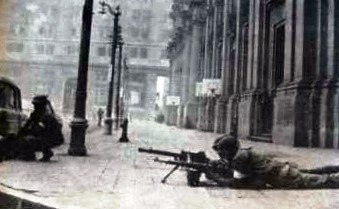
A tank regiment under Colonel Roberto Souper attacked the presidential palace of La Moneda in an attempted coup before being turned back by loyal units under General Augusto Pinochet and other commanders. The failure deepened the crisis rather than resolving it: both the government and its opponents concluded that a further confrontation was coming. The rebels' motto, "the homeland against Marxist slavery," previewed the language used later that year.
Location: Santiago, Chile
The Coup of 11 September 1973
The armed forces seized Santiago, bombarded the La Moneda palace, and overthrew the government; Allende died in the palace during the attack, with a 2011 forensic examination confirming suicide, a conclusion disputed in some political circles for decades. The junta, headed by army commander Augusto Pinochet, said it acted to stop Marxism, restore order, and prevent civil war, and immediately banned political parties and detained thousands, many at the National Stadium. The United States recognized the junta within days, while Cuba and the Soviet Union condemned the coup; Washington's role in undermining Allende is documented in declassified records and was investigated by the US Senate's Church Committee.
Location: Santiago, Chile
Economic Shock Therapy
The junta, advised by the "Chicago Boys" group of US-trained economists, imposed a drastic stabilization program: public spending was cut sharply, tariffs lowered, and state enterprises reprivatized. Inflation fell from triple digits and, after a severe recession and a debt crisis in 1982, Chile recorded strong growth from the mid-1980s, a record the regime presented as an economic miracle. Critics point to rising inequality, unemployment, and the social costs of the adjustment; assessments of the model remain divided among economists.
Location: Santiago, Chile
Operation Condor
The security services of Chile, Argentina, Uruguay, Paraguay, Bolivia, and Brazil formalized Operation Condor, a system of intelligence sharing and cross-border operations against political exiles and opposition groups. Chile's DINA, led by Manuel Contreras, was a central participant; thousands of regime opponents were killed or disappeared during the 1970s, including through the 1976 "Caravan of Death" killings of detained prisoners. The scale of repression was later documented by Chile's own Rettig and Valech commissions and by archives opened in Paraguay and the United States.
Location: Santiago, Chile and the Southern Cone
Assassination of Orlando Letelier in Washington
A car bomb killed Orlando Letelier, Allende's former ambassador to the United States, and his colleague Ronni Moffitt on Embassy Row in Washington. US investigators traced the operation to DINA agent Michael Townley and Chilean intelligence; Manuel Contreras was later convicted in Chile for the murders, while Letelier's family and US officials held that responsibility reached the junta's leadership, which denied involvement. The assassination severely damaged Chile's relations with the United States.
Location: Washington, D.C., United States
The 1980 Constitution
A new constitution approved in a plebiscite held without open campaigning, with official results of about 67 percent in favor, entrenched the legal framework of military rule. It set an eight-year presidential term for Pinochet beginning in 1981 and required a further plebiscite in 1988, a provision the regime expected to win. Opposition figures disputed the fairness of the vote and the authenticity of the count, and the constitution continued to govern Chile after the return to democracy, with major amendments in 1989 and 2005.
Location: Chile
The 1988 Plebiscite
Voters rejected a further eight-year term for Pinochet by 55.99 percent to 44.01 percent on a turnout of nearly 98 percent, in a campaign the opposition unified around the slogan "Chile, joy is coming" after most parties were legalized and a mass voter-registration drive succeeded; Marxist parties remained banned. The "No" campaign's television advertising outperformed the government's effort, and Pinochet accepted the result as the constitution required, opening a one-year transition. The vote is regarded as a decisive moment in the negotiated end of the dictatorship.
Location: Chile
Return to Democracy
Patricio Aylwin, the Christian Democrat elected in December 1989, took office as president, formally ending seventeen years of military rule. The transition was negotiated: Pinochet remained commander of the army until 1998, appointed senators retained influence, and a 1978 amnesty law limited prosecutions for the worst abuses. The new government's approach of establishing the truth while working within the amnesty constraints was both praised as pragmatic and criticized as impunity.
Location: Santiago, Chile
The Rettig Report

The National Commission for Truth and Reconciliation, chaired by diplomat Raúl Rettig, finalized its report documenting more than 2,000 killings and disappearances for political reasons under military rule and recommending reparations. The commission had access to official records and its findings were accepted by the Aylwin government, which created a reparations program. Victims' groups welcomed the official acknowledgment but criticized a framework that established truth without prosecuting perpetrators.
Location: Santiago, Chile
Pinochet Arrested in London

British police arrested the 82-year-old Pinochet in London on a Spanish warrant issued by judge Baltasar Garzón seeking his extradition to face charges of torture and murder of Spanish citizens. The House of Lords ruled in 1999 that a former head of state enjoyed no immunity from such charges, a landmark in international criminal law, but the British government released him on health grounds in March 2000 and he returned to Chile. Chilean courts subsequently stripped him of immunity and indicted him in several cases; he died before any verdict.
Location: London, United Kingdom
The Valech Report

The National Commission on Political Imprisonment and Torture, chaired by bishop Sergio Valech, published its report finding that 38,254 people had been imprisoned for political reasons, the majority tortured, during the dictatorship, with victims receiving official recognition and pensions. The commission's testimonies were sealed until 2054, a decision criticized by victims' organizations seeking access for prosecutions. A later review added further cases to the record.
Location: Santiago, Chile
Death of Augusto Pinochet

Pinochet died at 91 while under house arrest and facing charges in multiple human-rights cases, including the Caravan of Death killings and the murder of General Carlos Prats in Argentina, as well as tax-evasion charges over accounts abroad. He was never tried to a verdict, though dozens of his agents were later convicted. His death left Chile's assessment of his rule divided: his supporters credited the economic changes and the defeat of the left, while the commissions' record and the convictions of his agents defined the era's cost in political prisoners, torture, and disappearances.
Location: Santiago, Chile