
The Bronze Age Collapse (c. 1200-1150 BC)
The sudden disintegration of the interconnected palace civilizations of the Eastern Mediterranean around 1200 BC, which ended the Hittite Empire, destroyed the Mycenaean centers and Ugarit, and began the Greek Dark Ages. Its causes — raiders, drought, earthquakes, and systems failure — remain one of archaeology's most debated questions.
Events
The Late Bronze Age International System
By the mid-fourteenth century BC, the New Kingdom of Egypt, the Hittite Empire, Assyria, Babylon, Mitanni, Mycenaean Greece, and Levantine city-states formed an interconnected world of diplomacy and trade. The Amarna letters archive records royal correspondence, and royal-gift exchanges moved copper, tin, glass, and luxury goods from the Baltic to the Nile.
Location: Eastern Mediterranean
The Uluburun Shipwreck

A merchant ship sank off the Anatolian coast carrying ten tons of copper ingots, tin, glass, ivory, Baltic amber, and Canaanite jewelry — cargo from at least seven different lands. Discovered in 1982, the wreck illustrates how dense and long-distance Late Bronze Age trade networks had become, and how much depended on them.
Location: Off Uluburun, southern Anatolia
The Fall of the Hittite Empire

The Hittite capital Hattusa was abandoned and destroyed around 1190 BC, and the empire that had dominated Anatolia and challenged Egypt at Kadesh a century earlier vanished from the record. Fragmentary Neo-Hittite successor states survived in southern Anatolia and Syria, but the imperial system of Hatti ended within a generation.
Location: Anatolia
The Destruction of Ugarit
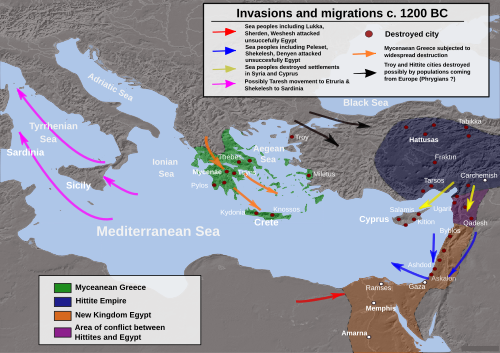
The Syrian port city of Ugarit, hub of the eastern Mediterranean coppers trade, was sacked and burned around 1185 BC. Its final clay tablets include a desperate letter reporting that enemy ships had appeared and the city's troops were away — one of the last written testimonies of the Bronze Age world in the Levant.
Location: Ugarit, Syria
The Fall of the Mycenaean Palaces

The palace centers of Pylos, Mycenae, Tiryns, and Thebes were destroyed or abandoned within decades of each other. The Linear B administrative script was lost, palace economies disappeared, population fell sharply, and Greece entered the Greek Dark Ages — a centuries-long period of reduced literacy and isolation that lasted until roughly 800 BC.
Location: Peloponnese and central Greece
The Battle of the Delta and the Sea Peoples

In the eighth year of Ramesses III, a coalition the Egyptian inscriptions called the Sea Peoples attacked Egypt by land and sea. Reliefs at Medinet Habu record that the pharaoh defeated them, but the victory came at the end of decades of raids that had already shattered the Levant and Anatolia.
Location: Nile Delta, Egypt
The Phoenician Recovery and the Alphabet
The Phoenician cities of Tyre and Sidon survived the collapse with their institutions intact. Freed from Hittite and Egyptian domination, they expanded maritime trade across the Mediterranean and developed the alphabetic script from which Greek, Latin, Arabic, and Hebrew writing systems descend — one of the most consequential inventions of the post-collapse world.
Location: Levant
The Transition to the Iron Age
The collapse of the tin trade networks that supplied bronze production pushed smiths toward the locally available technology of iron working. By around 1000 BC iron tools and weapons were spreading across the region, marking the transition to the Iron Age and the end of the palace-based economic world of the Late Bronze Age.
Location: Eastern Mediterranean
The Debate Over the Causes
No single cause of the collapse has won consensus. Proposed explanations include the Sea Peoples raids, multi-year drought confirmed by pollen and cave-deposit studies, earthquake storms, revolt of peripheral populations against palace elites, and cascading failure of interdependent trade networks. Since the 2010s many archaeologists favor a multi-causal systems-collapse model over a single-invasion account.
Location: Global scholarship