
Augustus — First Roman Emperor (63 BC – 14 AD)
The life of Gaius Octavius, the heir of Julius Caesar who ended the Roman Republic through a combination of war, law, and careful stagecraft, and ruled as Augustus, the first Roman emperor, for four decades of transformation and peace.
Events
Birth of Gaius Octavius

Gaius Octavius was born into an equestrian family of modest political standing, related to Julius Caesar through his mother Atia. His rise from this relatively obscure beginning to master of the Roman world within two decades made him one of history's most unlikely autocrats.
Location: Rome, Roman Republic
Adopted by Julius Caesar

After Julius Caesar's assassination on the Ides of March (15 March 44 BC), his will named the 18-year-old Octavian as his adopted son and principal heir. Octavian accepted the name Gaius Julius Caesar Octavianus and claimed the inheritance, entering a Rome controlled by Caesar's assassins and by Mark Antony.
Location: Rome, Roman Republic
The Second Triumvirate and the Proscriptions
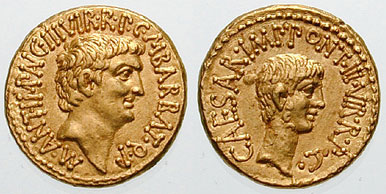
Octavian, Mark Antony, and Lepidus were granted five-year emergency powers by the Lex Titia, forming the Second Triumvirate. Their proscription lists condemned hundreds of senators and knights, including the orator Cicero, who was killed in December 43 BC. The episode demonstrated the brutal consolidation that preceded the final destruction of republican government.
Location: Rome, Roman Republic
Battle of Philippi
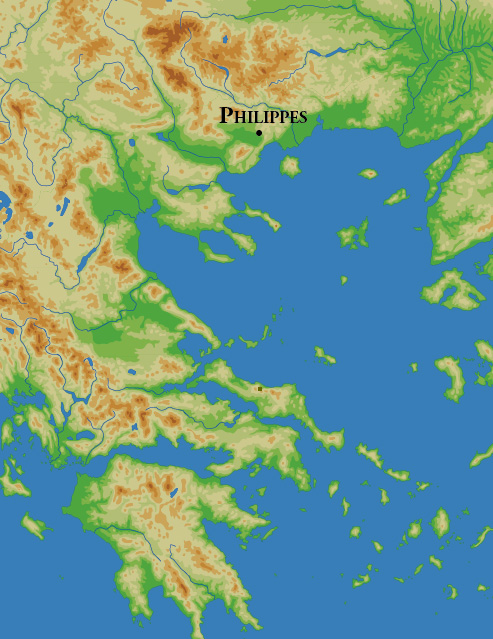
The armies of the triumvirs defeated the forces of Brutus and Cassius, the leading assassins of Caesar, in two engagements. Both republican commanders committed suicide. The battle removed the last organized aristocratic resistance to Caesarian rule and left Octavian and Antony as the dominant powers in the Roman world.
Location: Philippi, Macedonia
Battle of Actium

The fleets of Octavian, commanded by Agrippa, defeated the combined fleet of Mark Antony and Cleopatra VII of Egypt. The victory decided the final civil war of the Republic. Antony and Cleopatra fled to Alexandria, and within a year both were dead; Egypt was annexed as Octavian's personal province, supplying Rome with grain and him with immense wealth.
Location: Actium, western Greece
The First Settlement — Augustus
Octavian formally "returned the Republic to the Senate and people of Rome," transferring some provinces to senatorial control while keeping the strategically critical ones under his own command. The Senate awarded him the honorific Augustus ("the revered one"). Historians regard the settlement as the founding of the Principate — a monarchy in republican dress, which Augustus consistently presented as restoration.
Location: Rome, Roman Empire
The Second Settlement
After a serious illness and a constitutional crisis, Augustus received tribunician power (tribunicia potestas) for life, giving him veto authority over all magistrates and personal inviolability. Combined with his proconsular command, this gave him legal supremacy without holding the title of king — the core constitutional mechanism of the Principate.
Location: Rome, Roman Empire
The Cantabrian Wars End the Conquest of Spain

The Cantabrian Wars concluded with the pacification of the last independent peoples of the Iberian peninsula, completing Rome's two-century conquest of Spain. The unification of the Roman world under one ruler, from the Atlantic to the Euphrates, prompted Augustus to close the doors of the Temple of Janus, the traditional signal of general peace.
Location: Cantabria, Hispania
The Ara Pacis and the Marble City

The Ara Pacis Augustae (Altar of Augustan Peace) was dedicated, celebrating the peace and prosperity of the new order. Augustus famously wrote that he had found Rome a city of brick and left it a city of marble; his building program reshaped the capital's forums, aqueducts, and temples and employed vast numbers of workers.
Location: Rome, Roman Empire
Father of His Country

The Senate voted Augustus the title Pater Patriae, the capstone of an honorific accumulation that included princeps senatus and pontifex maximus (assumed in 12 BC after Lepidus's death). His Res Gestae Divi Augusti, his own account of his achievements, was later inscribed across the empire — a carefully constructed self-portrait of a ruler who claimed to serve, not to rule.
Location: Rome, Roman Empire
Disaster at the Teutoburg Forest

An alliance of Germanic tribes led by Arminius, a Roman-trained auxiliary officer, ambushed and destroyed three Roman legions (the XVII, XVIII, and XIX) under Publius Quinctilius Varus. Augustus abandoned the conquest of Germany east of the Rhine, fixing that river as the empire's permanent European frontier — one of the most consequential military defeats in Roman history.
Location: Teutoburg Forest, Germania
Death, Deification, and Succession

Augustus died at age 75 after a 41-year predominance. The Senate deified him, and Tiberius, his adopted stepson, succeeded him smoothly — proving the transfer mechanism of the Principate. The political system Augustus built endured for roughly three centuries, and the era of relative internal peace it inaugurated, the Pax Romana, is conventionally dated from his settlement of 27 BC.
Location: Nola, Italy