
The Space Race (1957–1972)
The Space Race was a Cold War competition between the Soviet Union and the United States for supremacy in space exploration, spanning from the launch of Sputnik 1 in October 1957 to the final Apollo Moon landing in December 1972. The era saw a rapid succession of historic firsts — first satellite, first human in space, first Moon landing — driven by geopolitical rivalry but yielding extraordinary scientific and technological achievements.
Events
Sputnik 1 — First Artificial Satellite Launched

The Soviet Union launched Sputnik 1, the world's first artificial Earth satellite, aboard a Sputnik-PS rocket from Site No. 1/5 at the Tyuratam range (now Baikonur Cosmodrome). The 83.6 kg polished metal sphere transmitted radio signals on 20.005 and 40.002 MHz that were detectable by amateur radio operators worldwide for 22 days before its batteries depleted. The launch shocked the United States, precipitated the "Sputnik crisis," and is widely regarded as the start of the Space Race. Sputnik 1 completed 1,440 orbits before burning up on reentry on January 4, 1958.
Explorer 1 — First U.S. Satellite Launched

Explorer 1 became the first satellite launched by the United States, lifting off from Launch Complex 26A at the Cape Canaveral Missile Annex atop a Juno I rocket. Designed and built by the Jet Propulsion Laboratory (JPL) in just 84 days, the 13.97 kg satellite was the first spacecraft to detect the Van Allen radiation belts. It returned data for nearly four months before its batteries were exhausted and remained in orbit until 1970. The launch marked America's entry into the Space Race.
NASA Established
President Dwight D. Eisenhower signed the National Aeronautics and Space Act into law, establishing the National Aeronautics and Space Administration (NASA) as an independent civilian agency of the U.S. federal government. NASA succeeded the National Advisory Committee for Aeronautics (NACA), which had been founded in 1915. The new agency was created in direct response to the Soviet Union's launch of Sputnik and was tasked with giving the U.S. space program a distinct civilian orientation focused on peaceful applications of space exploration.
Yuri Gagarin — First Human in Space
Soviet cosmonaut Yuri Gagarin became the first human being to journey into outer space aboard the Vostok 1 spacecraft. The flight lasted 108 minutes and completed one orbit of Earth, reaching a peak altitude of 327 km. Gagarin's achievement was a major milestone for the Soviet Union in the Space Race, making him an international celebrity and earning him the title Hero of the Soviet Union. The flight intensified American efforts to catch up, coming less than a month before the first U.S. crewed spaceflight.
Alan Shepard — First American in Space
NASA astronaut Alan Shepard became the second person and the first American to travel into space, aboard the Mercury-Redstone 3 mission in a spacecraft he named Freedom 7. The 15-minute suborbital flight reached an altitude of 187 km before splashing down in the Atlantic Ocean. Shepard's flight did not achieve orbit, but it demonstrated the United States' crewed spaceflight capability and was a significant step in America's response to Gagarin's orbital mission. Shepard later became the fifth person to walk on the Moon during Apollo 14 in 1971.
Kennedy's Moon Speech to Congress
President John F. Kennedy addressed a joint session of Congress and proposed that the nation "should commit itself to achieving the goal, before this decade is out, of landing a man on the Moon and returning him safely to the Earth." The proposal came amid Cold War tensions, the Bay of Pigs fiasco, and the Soviet Union's recent successes in space. Kennedy's ambitious goal provided a specific direction for NASA's Apollo program and galvanized the American space effort. The goal was ultimately achieved with Apollo 11 in July 1969.
John Glenn — First American to Orbit Earth

NASA astronaut John Glenn became the first American to orbit the Earth, flying the Mercury-Atlas 6 mission in a spacecraft named Friendship 7. Glenn completed three orbits of Earth in a flight lasting 4 hours, 55 minutes, and 23 seconds. The mission restored some American prestige after the Soviet Union had achieved both the first human spaceflight and the first orbital flight. Glenn later returned to space at age 77 aboard Space Shuttle Discovery (STS-95) in 1998, making him the oldest person to enter Earth orbit.
First Spacewalk — Alexei Leonov

On March 18, 1965, Soviet cosmonaut Alexei Leonov performed the first extravehicular activity (spacewalk) in history during the Voskhod 2 mission. He spent 12 minutes outside the spacecraft, though his spacesuit inflated dangerously in the vacuum, nearly preventing his re-entry. The U.S. followed with Ed White's spacewalk on June 3, 1965 during Gemini 4.
Gemini Program — Proving the Path to the Moon

The Gemini program (1965-1966) bridged the Mercury and Apollo programs with ten crewed missions. Gemini proved critical capabilities for the Moon landings: orbital maneuvering, spacewalking, rendezvous and docking with the Agena target vehicle, and long-duration flights of up to 14 days. Every Gemini mission achieved most of its objectives, building NASA's confidence for Apollo.
Apollo 1 Fire — Grissom, White, and Chaffee Killed
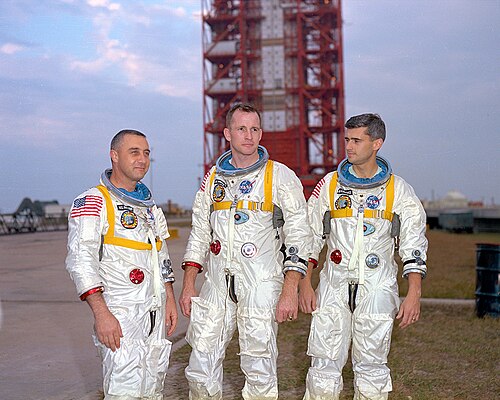
A flash fire erupted inside the Apollo command module (CM-012) during a launch rehearsal test at Cape Kennedy Air Force Station Launch Complex 34, killing all three crew members: Command Pilot Gus Grissom, Senior Pilot Ed White, and Pilot Roger B. Chaffee. The fire was caused by an electrical ignition source and spread rapidly due to combustible nylon material and the high-pressure pure oxygen cabin atmosphere. The tragedy led to a 20-month suspension of crewed Apollo flights while the command module underwent major redesign for safety. The mission was posthumously designated Apollo 1 in honor of the crew.
Apollo 8 — First Humans to Orbit the Moon
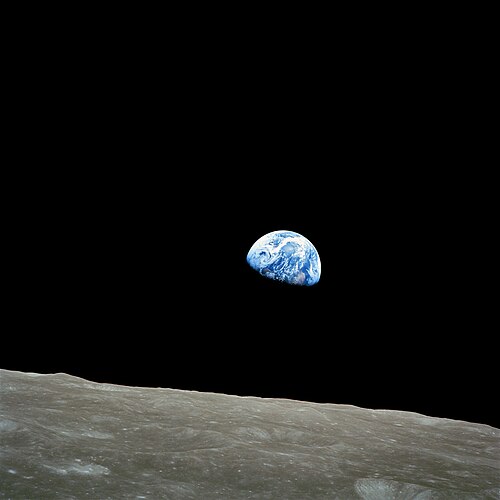
Apollo 8 became the first crewed spacecraft to leave Earth's gravitational sphere of influence and the first human spaceflight to reach the Moon. Astronauts Frank Borman, Jim Lovell, and William Anders launched on December 21, 1968, aboard a Saturn V rocket and orbited the Moon ten times over twenty hours. The crew were the first humans to see and photograph the far side of the Moon and captured the iconic "Earthrise" photograph. On Christmas Eve, they made a television broadcast — then the most-watched TV program ever — reading the first ten verses from the Book of Genesis.
Apollo 11 — First Humans Walk on the Moon

Apollo 11 was the American spaceflight that first landed humans on the Moon. Commander Neil Armstrong and Lunar Module Pilot Buzz Aldrin landed the Lunar Module Eagle on the lunar surface at 20:17:40 UTC on July 20, 1969, while Command Module Pilot Michael Collins orbited above. Armstrong became the first person to step onto the Moon, declaring "That's one small step for [a] man, one giant leap for mankind." Armstrong and Aldrin spent approximately 2 hours and 31 minutes outside the Lunar Module, collected 21.55 kg of lunar samples, and planted the U.S. flag. The mission achieved Kennedy's goal of landing a man on the Moon before the end of the decade.
Apollo 13 — "Houston, We've Had a Problem"

Apollo 13 launched on April 11, 1970, as the seventh crewed Apollo mission and was intended to be the third Moon landing. On April 13, approximately 56 hours into the mission, an oxygen tank in the service module exploded after a routine stir, disabling the spacecraft's electrical and life-support systems. Commander Jim Lovell, Command Module Pilot Jack Swigert, and Lunar Module Pilot Fred Haise used the Lunar Module Aquarius as a lifeboat. Mission Control in Houston improvised new procedures to bring the crew home. The crew looped around the Moon in a circumlunar trajectory and returned safely to Earth on April 17, 1970. The mission has been described as NASA's "successful failure."
Apollo 17 — Final Crewed Moon Landing

Apollo 17, launched on December 7, 1972, was the eleventh and final crewed mission of NASA's Apollo program and the sixth time humans set foot on the Moon. Commander Gene Cernan and Lunar Module Pilot Harrison Schmitt — the only professional geologist to walk on the Moon — landed in the Taurus–Littrow valley on December 11. They completed three moonwalks totaling over 22 hours, drove 35.7 km using the Lunar Roving Vehicle, and collected 115 kg of lunar samples. Command Module Pilot Ronald Evans remained in lunar orbit. Cernan was the last person to walk on the lunar surface. The mission concluded on December 19, 1972, marking the end of the Apollo program and, effectively, the Space Race era of crewed lunar exploration.