
Ancient Mesopotamia — The Cradle of Civilization (c. 3500-539 BC)
A chronicle of ancient Mesopotamia, the region between the Tigris and Euphrates rivers where the world's first cities, writing systems, legal codes, and empires emerged. From the Sumerians through the Akkadian, Babylonian, and Assyrian empires, Mesopotamia laid the foundations of urban civilization, law, literature, and organized governance.
Events
Cyrus the Great Conquers Babylon — The Fall of Mesopotamia
The Persian king Cyrus the Great captures Babylon without a battle, reportedly diverting the Euphrates River and entering through the lowered river gates. The fall of Babylon ends native Mesopotamian rule after nearly 3,000 years of continuous civilization. Cyrus issues an edict allowing exiled peoples, including the Judeans, to return to their homelands. Mesopotamia is incorporated into the Achaemenid Persian Empire, shifting the center of power eastward.
Nebuchadnezzar II Builds the Hanging Gardens of Babylon
King Nebuchadnezzar II transforms Babylon into the most magnificent city of the ancient world. He builds the Ishtar Gate (inscribed with glazed brick reliefs of dragons and bulls), the Etemenanki ziggurat (a towering stepped temple often linked to the biblical Tower of Babel), and the legendary Hanging Gardens, one of the Seven Wonders of the Ancient World. He also conquers Jerusalem in 597 BC, destroying the First Temple and deporting thousands of Judeans into the Babylonian Captivity.
The Neo-Assyrian Empire Becomes the Largest Empire of Its Time
Under kings Tiglath-Pileser III, Sargon II, and Sennacherib, the Neo-Assyrian Empire expands to become the largest empire the world has yet seen, stretching from the Caucasus to Egypt, and from the Mediterranean coast to the Persian Gulf. The Assyrians develop advanced siege warfare, a network of royal roads for rapid communication, and the world's first organized postal system. Their capital Nineveh becomes the largest city of its time.
Hammurabi Issues His Legal Code
Babylonian King Hammurabi issues one of the most famous legal codes in ancient history, inscribed on a 2.25-meter (7.4-foot) stele of black diorite. The Code of Hammurabi contains 282 laws covering trade, property, family, and criminal justice, based on the principle of lex talionis ("an eye for an eye"). Discovered in 1901 in Susa, the stele provides historians with extraordinary insight into Babylonian society and jurisprudence.
The Code of Ur-Nammu — The Oldest Known Law Code

Ur-Nammu, king of the Third Dynasty of Ur, issues the oldest known written legal code. The code establishes fines and punishments for offenses including bodily injury, false accusations, and property crimes, predating Hammurabi's more famous code by approximately three centuries. It reflects the principle of monetary compensation rather than physical retribution, a significant development in legal philosophy.
Sargon of Akkad Establishes the First Empire
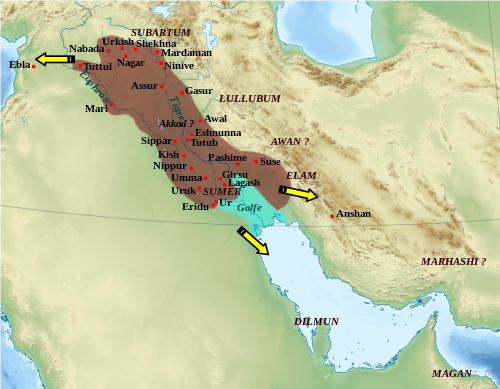
Sargon of Akkad conquers the Sumerian city-states and establishes the Akkadian Empire, the world's first multi-ethnic empire. Ruling from his capital of Akkad (location unknown), Sargon creates a centralized administration, standardizes weights and measures, and establishes trade networks from the Mediterranean to the Persian Gulf. The empire unites Mesopotamia under a single ruler for the first time.
The Invention of Cuneiform Writing

The Sumerians invent cuneiform, the world's first known writing system. Initially developed for recording economic transactions on clay tablets, cuneiform evolves into a full writing system capable of expressing literature, law, and religious texts. The earliest tablets from Uruk contain pictographic symbols representing goods, quantities, and administrative records. Writing fundamentally transforms human civilization's ability to preserve and transmit knowledge across generations.
The First Cities Emerge in Sumer

The Sumerians, settling in southern Mesopotamia, develop the world's first urban civilization. Cities such as Uruk, Ur, and Eridu grow into centers of trade, governance, and religious worship centered on ziggurat temples. The Sumerians develop irrigation systems that transform the arid floodplain into productive farmland, enabling population growth, social stratification, and organized labor.