
Ancient Egypt — The Pharaohs and the Civilization of the Nile (c.3150-30 BC)
Ancient Egypt was the civilization of the Nile Valley, unified around 3150 BC under King Narmer and lasting more than three millennia to the Roman annexation of 30 BC. Rule by pharaohs presented as divine intermediaries produced monumental architecture, a sophisticated writing system, and legal, religious, and artistic traditions that shaped the ancient Mediterranean world and continue to fascinate the modern one.
Events
Unification of Upper and Lower Egypt

King Narmer (also known as Menes) unified Upper and Lower Egypt, creating the first centralized state in world history. The Narmer Palette, one of the earliest surviving historical documents, commemorates this unification. Narmer founded the First Dynasty and established his capital at Memphis, near modern Cairo. This event marks the beginning of pharaonic civilization and over 3,000 years of continuous Egyptian statehood.
The Step Pyramid of Djoser

Pharaoh Djoser and his architect Imhotep built the Step Pyramid at Saqqara, the world's first monumental stone structure. Rising in six mastaba-like tiers, it stood 62 meters tall and marked a revolutionary leap in architecture. Imhotep, later deified as a god of medicine and architecture, is the first named architect and engineer in history. The pyramid complex introduced stone construction on a massive scale.
The Great Pyramid of Giza

Pharaoh Khufu (Cheops) constructed the Great Pyramid of Giza, the largest of the three Giza pyramids and the only surviving Wonder of the Ancient World. Originally 146.6 meters tall, it was built from approximately 2.3 million limestone blocks, each weighing an average of 2.5 tons. The precision of its construction — aligned to true north within 0.05 degrees — remains a marvel of engineering. It stood as the world's tallest structure for over 3,800 years.
Reunification Under Mentuhotep II — The Middle Kingdom

After a period of fragmentation known as the First Intermediate Period, Pharaoh Mentuhotep II of Thebes reunified Egypt, founding the Middle Kingdom. The new era saw a cultural renaissance in literature, art, and architecture. Thebes emerged as the religious and political center, with the god Amun rising in prominence. Egypt expanded south into Nubia and built the fortress network that secured its southern borders.
Expulsion of the Hyksos — The New Kingdom

Ahmose I, a Theban king, expelled the Hyksos rulers who had dominated northern Egypt for a century, and reunified the country. His victories founded the 18th Dynasty and the New Kingdom, the most powerful and prosperous period in Egyptian history. The war against the Hyksos introduced new military technologies to Egypt — horse-drawn chariots, composite bows, and bronze weapons — which Egyptians quickly adopted and refined.
Hatshepsut — The Female Pharaoh

Hatshepsut became one of the few women to rule Egypt as pharaoh, initially as regent for her stepson Thutmose III before assuming full kingship. She presented herself in traditional pharaonic regalia, including the false beard. Her reign was a period of peace and prosperity: she built the magnificent mortuary temple at Deir el-Bahri, restored trade networks, and launched an expedition to the land of Punt (possibly modern Somalia).
Akhenaten's Religious Revolution

Pharaoh Amenhotep IV changed his name to Akhenaten and instituted a radical religious revolution, abandoning Egypt's traditional polytheism in favor of the worship of a single god — the Aten, the sun disk. He moved the capital to a new city at Akhetaten (modern Amarna). His revolutionary changes were widely unpopular with the priesthood and the people. His reign represents the first recorded instance of monotheism in history.
Tutankhamun and the Restoration
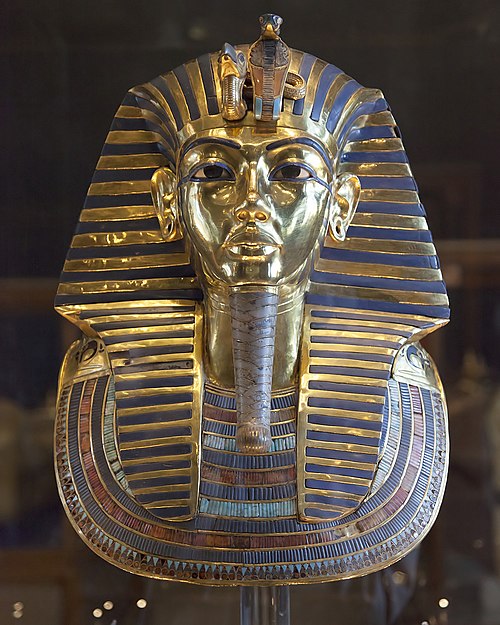
Tutankhamun ascended the throne as a child and, guided by his advisors, restored the traditional Egyptian religion, reopening temples and reinstating the priesthood of Amun. He changed his name from Tutankhaten to Tutankhamun, signaling the rejection of Atenism. His reign was brief and historically minor, but his nearly intact tomb — discovered by Howard Carter in 1922 — made him the most famous pharaoh in the modern world.
Ramesses II and the Battle of Kadesh

Ramesses II (the Great) reigned for 66 years, one of the longest in Egyptian history. In 1274 BC, he fought the Hittite Empire at the Battle of Kadesh, one of the largest chariot battles in history. Though military accounts differ on the outcome, the battle led to the world's first known peace treaty, signed between Ramesses II and Hattusili III. Ramesses built prolifically across Egypt, including the temples of Abu Simbel, Luxor, and the Ramesseum.
Persian Conquest of Egypt

The Persian king Cambyses II defeated Pharaoh Psamtik III at the Battle of Pelusium, conquering Egypt and establishing the 27th Dynasty. Egypt became a satrapy (province) of the Achaemenid Persian Empire. Though the Persians adopted some Egyptian customs and portrayed themselves as pharaohs, Persian rule was resented and marked by recurring Egyptian rebellions. Egypt would gain brief periods of independence before being reconquered.
Alexander the Great and the Ptolemaic Period

Alexander the Great conquered Egypt without resistance, as the Persians had become deeply unpopular. He was welcomed as a liberator and crowned pharaoh. He founded the city of Alexandria, which would become the greatest cultural and intellectual center of the ancient world. After Alexander's death, his general Ptolemy I founded the Ptolemaic dynasty, which ruled Egypt for the next 300 years and built the famous Library of Alexandria.
Egypt Becomes a Roman Province

After the deaths of Cleopatra VII and Mark Antony, Octavian (future Emperor Augustus) annexed Egypt as a Roman province. Cleopatra's death ended the Ptolemaic dynasty and more than 3,000 years of pharaonic rule. Egypt became the personal property of the Roman emperor, serving as the empire's primary source of grain. Though Egyptian culture and religion persisted for centuries, the age of the pharaohs was over.