
The American Revolution (1765-1783)
The American Revolution (1765-1783) was the colonial revolt that transformed thirteen British colonies into an independent republic. It established the world's first federal democracy founded on Enlightenment principles of natural rights and popular sovereignty.
Events
The Stamp Act and Colonial Resistance

The British Parliament passed the Stamp Act, the first direct tax on the American colonies, requiring official stamps on all documents, newspapers, and even playing cards. Colonists protested under the slogan "No taxation without representation," arguing that only their own elected assemblies could tax them. The Sons of Liberty formed in every colony, using boycotts, protests, and intimidation to make the Act unenforceable.
The Stamp Act Congress

Nine colonies sent delegates to the Stamp Act Congress in New York City, the first unified colonial response to British policy. The Congress issued a Declaration of Rights and Grievances, asserting that the colonists were entitled to all the rights of English subjects, including the right to be taxed only by their own representatives.
The Boston Massacre

A crowd gathered around British soldiers on a Boston street, throwing snowballs, rocks, and debris. The soldiers panicked and fired into the crowd, killing five civilians. The event was quickly dubbed the "Boston Massacre." John Adams defended the soldiers at trial, winning acquittals for most, but the incident became a powerful propaganda tool for the Patriot cause.
The Boston Tea Party

In protest of the Tea Act, which granted the British East India Company a monopoly on tea sales in the colonies, a group of colonists disguised as Mohawks boarded three ships in Boston Harbor and dumped 342 chests of tea into the water. The British government responded with the Intolerable Acts, closing Boston Harbor and revoking Massachusetts's charter.
The First Continental Congress

Delegates from 12 of the 13 colonies met in Philadelphia for the First Continental Congress. They endorsed the Suffolk Resolves, which declared the Intolerable Acts unconstitutional, called for a boycott of British goods, and urged the colonies to begin training militias. The Congress petitioned King George III for redress of grievances.
Lexington and Concord — The War Begins

British troops marched from Boston to Concord to seize colonial military supplies. At Lexington, they confronted a small militia force; a shot was fired — "the shot heard round the world" — and a brief skirmish left eight Americans dead. The British continued to Concord, where they faced a much larger force. As the British retreated to Boston, colonial militiamen harried them along the route, inflicting over 250 casualties.
George Washington Appointed Commander-in-Chief

The Second Continental Congress appointed George Washington as Commander-in-Chief of the newly formed Continental Army. Washington, a Virginia planter and veteran of the French and Indian War, accepted without salary, asking only that Congress cover his expenses. The Continental Army then surrounded British forces in Boston in the Siege of Boston.
The Declaration of Independence
The Second Continental Congress unanimously adopted the Declaration of Independence, drafted primarily by Thomas Jefferson. The document proclaimed that "all men are created equal" and that governments derive "their just powers from the consent of the governed." It enumerated grievances against King George III and declared the colonies "free and independent states." The 56 signers committed treason against the Crown.
Washington Crossing the Delaware and the Trenton-Princeton Campaign
After a series of defeats that drove the Continental Army across New Jersey and into Pennsylvania, Washington launched a daring counterattack. On Christmas night, he crossed the ice-choked Delaware River with 2,400 troops and captured a Hessian garrison at Trenton. A week later, he defeated a British force at Princeton. These victories revived American morale after a disastrous year.
The Saratoga Campaign — Turning Point
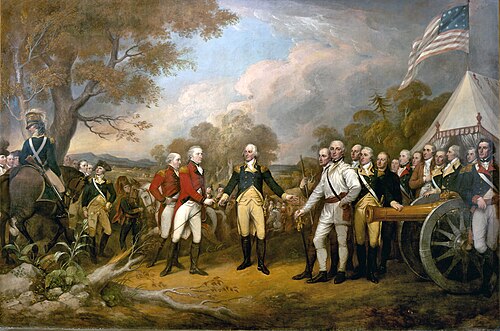
The British planned to split the colonies by capturing New York's Hudson River valley. British General John Burgoyne advanced from Canada but was slowed by difficult terrain and American forces. After the Battles of Freeman's Farm and Bemis Heights, Burgoyne's army was surrounded at Saratoga. He surrendered his entire army of 5,800 men. The American victory convinced France to enter the war as an American ally.
Winter at Valley Forge

Washington's army encamped at Valley Forge, Pennsylvania, for the winter. The army suffered from severe cold, disease, and food shortages. Of the 12,000 troops, approximately 2,500 died. However, Prussian military officer Baron Friedrich von Steuben arrived and drilled the soldiers, transforming the ragged Continental Army into a disciplined fighting force capable of standing against British regulars.
The French Alliance

The United States and France signed the Treaty of Alliance, formalizing French entry into the war. France provided crucial military, naval, and financial support. French troops under the Comte de Rochambeau and the French fleet under Admiral de Grasse proved decisive in the war's final campaign. Spain and the Netherlands would later also enter the war against Britain.
The Siege of Yorktown
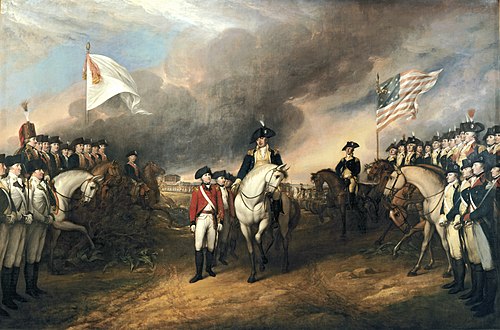
The combined American and French armies, totaling 17,000 troops, surrounded British General Cornwallis's 8,000-man army at Yorktown, Virginia. The French fleet blocked British escape by sea. After a three-week siege, Cornwallis surrendered on October 19. According to legend, the British band played "The World Turned Upside Down." The surrender effectively ended major fighting in the war.
The Treaty of Paris
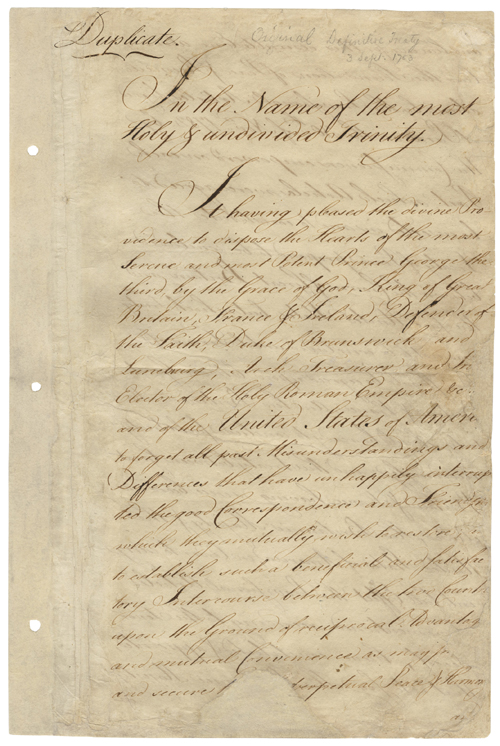
The Treaty of Paris was signed, formally ending the American Revolutionary War. Great Britain recognized the United States as an independent nation and ceded nearly all territory east of the Mississippi River and south of the Great Lakes. The treaty established U.S. sovereignty over the 13 former colonies and set the boundaries of the new nation.
The Constitution and the Founding of the Federal Republic

The Constitutional Convention in Philadelphia produced the U.S. Constitution, establishing the world's first federal republic based on popular sovereignty, separation of powers, and checks and balances. Ratified in 1788, it took effect in 1789 with George Washington as the first President. The Bill of Rights was added in 1791. The American Revolution's legacy of constitutional government, natural rights, and democratic self-rule became a model for the world.