
Alexander the Great — King of Macedon and Conqueror of the Persian Empire
Alexander III of Macedon, known as Alexander the Great, was one of history's greatest military commanders who created one of the largest empires in the ancient world. Tutored by Aristotle and succeeding his father Philip II at age 20, he led a ten-year campaign that conquered the Persian Achaemenid Empire, invaded India, and spread Greek culture across three continents. His death at 32 ended an era of conquest and ushered in the Hellenistic period that shaped civilization for centuries.
Events
Birth of Alexander the Great

Alexander is born in Pella, the capital of the Kingdom of Macedon, to King Philip II and Queen Olympias. Legend holds that on the same day, the Temple of Artemis at Ephesus burned down, and Philip's armies achieved a great victory. Alexander would grow up believing himself descended from Heracles and Achilles.
Tutored by Aristotle

Philip II summons the philosopher Aristotle to tutor the teenage Alexander at the Temple of the Nymphs at Mieza. Over three years, Aristotle instills in Alexander a love of Greek literature, science, philosophy, and medicine. Alexander develops a deep admiration for Homer's Iliad and keeps a copy annotated by Aristotle throughout his campaigns.
Alexander Rules as Regent at Age 16
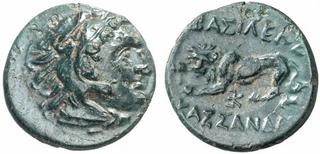
While Philip campaigns against Byzantium, the 16-year-old Alexander is left as regent of Macedon. He swiftly suppresses a rebellion by the Maedi tribe, founding the city of Alexandropolis — his first act of both military command and city-founding, foreshadowing his future empire-building.
Command at Chaeronea

At age 18, Alexander leads the Companion Cavalry in the decisive Battle of Chaeronea against the combined forces of Athens and Thebes. His cavalry charge breaks the Theban Sacred Band, securing Macedon's dominance over the Greek city-states and establishing Philip's League of Corinth. It is Alexander's first major battlefield command.
Alexander Becomes King of Macedon
Philip II is assassinated at the wedding of his daughter in Aigai by his bodyguard Pausanias. Alexander, aged 20, is immediately proclaimed king by the Macedonian army with the support of General Antipater. He swiftly executes potential rivals, securing his claim. The Greek city-states, sensing vulnerability, begin to rebel.
Balkan Campaign and Destruction of Thebes
After securing Macedon's northern borders through a campaign in Thrace and Illyria, Alexander marches south when Thebes rises in revolt. He captures the city and orders its complete destruction — the walls, temples, and homes are razed, and surviving citizens are sold into slavery. The brutal example quells rebellion across Greece.
Crossing into Asia and Victory at the Granicus

Alexander leads an army of approximately 37,000 men across the Hellespont into Asia Minor. At the Granicus River, he defeats a Persian force led by Greek mercenary Memnon. The victory opens Asia Minor to Macedonian conquest and secures Alexander's reputation as a commander willing to lead personally from the front.
Defeat of Darius III at Issus

Alexander meets the Persian Great King Darius III in battle at Issus in Cilicia. Despite being outnumbered, Alexander's decisive cavalry charge forces Darius to flee, leaving his family — his mother, wife, and daughters — captured. Alexander treats them with respect, beginning his policy of incorporating Persian nobility into his court.
Siege of Tyre and Liberation of Egypt

Alexander besieges the island city of Tyre for seven months, building a kilometer-long causeway to breach its walls. After capturing Tyre, he marches into Egypt, which surrenders without a fight. In Egypt, he founds the city of Alexandria and visits the Oracle of Siwa, where he is proclaimed son of the god Ammon.
Decisive Victory at Gaugamela

Alexander defeats the massive Persian army under Darius III at Gaugamela in Mesopotamia. The battle is a masterpiece of tactical maneuver — Alexander creates a gap in the Persian line with a feint and drives his Companion Cavalry through it, routing the Persian center. Darius flees again, and the Achaemenid Empire collapses.
Burning of Persepolis

Alexander captures the Persian ceremonial capital of Persepolis, the richest city in the known world. After a drunken banquet, the palace complex is set ablaze — whether by accident or deliberate act (perhaps to signal the end of Persian rule) remains debated. Alexander then pursues Darius III, who has been betrayed and killed by his own satrap Bessus.
Victory at the Hydaspes Against King Porus

Alexander crosses the Indus River and invades India. At the Hydaspes River (modern Jhelum), he faces King Porus and his war elephants in one of his most difficult battles. Alexander wins through tactical brilliance, crossing the river in a storm to flank Porus. He is impressed by Porus's bravery and reinstates him as a satrap.
Army Mutiny Halts the Advance
Alexander pushes eastward but his army, exhausted by eight years of continuous campaigning and fearful of the great armies reported beyond, mutinies at the Beas River. After three days of refusal to march further, Alexander relents — the only time his troops forced his hand. The army begins the long march back west.
Susa Weddings Unite Macedonian and Persian Nobility
Alexander holds a mass wedding ceremony at Susa where 80 of his senior officers marry Persian noblewomen. Alexander himself marries Stateira, daughter of Darius III, and Parysatis, daughter of Artaxerxes III. The event is part of Alexander's controversial policy of fusion between Macedonian and Persian elites.
Alexander Dies in Babylon at Age 32
Alexander dies in the palace of Nebuchadnezzar II in Babylon at age 32 after a brief illness. His last days are clouded by fever and possible poisoning. On his deathbed, when asked who should succeed him, he reportedly says "to the strongest." His empire immediately fractures into warring successor states, beginning the Hellenistic era.