
Adolf Hitler — Dictator of Nazi Germany (1889-1945)
Adolf Hitler was the Austrian-born leader of the National Socialist German Workers' Party (Nazi Party) and dictator of Germany from 1933 to 1945, whose policies triggered World War II in Europe and the systematic genocide of six million Jews in the Holocaust.
Events
Birth and Early Life in Austria
Adolf Hitler was born on 20 April 1889 in Braunau am Inn, a town in Austria-Hungary near the German border. He was the fourth of six children of Alois Hitler, a customs official, and Klara Pölzl. After his family moved several times during his childhood, Hitler attended school in Linz, where he performed poorly. His father died in 1903, and his mother died of breast cancer in 1907. Twice-rejected from the Vienna Academy of Fine Arts, the young Hitler moved to Munich in 1913, where he earned a living selling watercolors.
Location: Braunau am Inn, Austria-Hungary
World War I Service and Iron Cross
At the outbreak of World War I in August 1914, Hitler volunteered for the Bavarian Army and served as a dispatch runner on the Western Front in France and Belgium. He was decorated with the Iron Cross, Second Class in 1914 and the rarely-awarded Iron Cross First Class in August 1918, on the recommendation of his Jewish superior, Lieutenant Hugo Gutmann. Hitler was temporarily blinded in a mustard gas attack near Ypres in October 1918. His wartime service reinforced his German nationalism and his belief in the Dolchstoßlegende (stab-in-the-back myth) that Jews and Marxists had betrayed Germany.
Location: Munich and Western Front
Joining the German Workers' Party
In July 1919, Hitler was appointed an intelligence agent of the Reichswehr and assigned to monitor political parties. At a meeting of the German Workers' Party (DAP) on 12 September 1919, party chairman Anton Drexler was impressed by Hitler's oratory and admitted him as member 555. The party was renamed the National Socialist German Workers' Party (Nazi Party) in February 1920, with Hitler designing its swastika banner. In his earliest known written statement, the 16 September 1919 Gemlich letter, Hitler argued that "the aim of the government must unshakably be the removal of the Jews altogether."
Location: Munich, Germany
Beer Hall Putsch and Imprisonment
On 8 November 1923, Hitler and the SA stormed a public meeting at the Bürgerbräukeller beer hall in Munich, declaring the start of a national revolution. The attempted coup, modeled on Mussolini's March on Rome, collapsed when police dispersed marchers the following day, killing 16 Nazis and 4 police officers. Hitler was arrested on 11 November for high treason, tried in February 1924, and sentenced to five years of fortress confinement at Landsberg Prison. He was released on 20 December 1924 after serving just over one year, during which he dictated most of the first volume of Mein Kampf to Rudolf Hess.
Location: Munich, Germany
Publication of Mein Kampf
Published in two volumes in 1925 and 1926, Mein Kampf ("My Struggle") laid out Hitler's autobiographical narrative and political ideology, including plans for territorial expansion and the transformation of German society into a racial dictatorship. Throughout the book, Jews are equated with "germs" and presented as "international poisoners" of society, with their extermination presented as the only solution. The first volume sold 228,000 copies between 1925 and 1932; one million copies were sold in 1933, Hitler's first year in office.
Location: Munich, Germany
Appointment as Chancellor

Following the November 1932 Reichstag elections in which the Nazi Party became the largest party but failed to win a majority, former chancellor Franz von Papen and conservative politicians convinced President Paul von Hindenburg to appoint Hitler as chancellor on 30 January 1933. Hitler headed a short-lived coalition with the German National People's Party. The new cabinet included Wilhelm Frick as Minister of the Interior and Hermann Göring as Minister of the Interior for Prussia, giving the Nazis control over the police in much of Germany.
Location: Berlin, Germany
Reichstag Fire and Enabling Act

On 27 February 1933, the Reichstag building was set on fire; the Dutch communist Marinus van der Lubbe was found at the scene. At Hitler's urging, Hindenburg signed the Reichstag Fire Decree on 28 February, suspending basic rights. In elections on 6 March, the Nazi share of the vote increased to 44 percent. On 23 March 1933, the Reichstag passed the Enabling Act by a vote of 444 to 94, with all parties except the Social Democrats voting in favor, transforming Hitler's government into a de facto legal dictatorship.
Location: Berlin, Germany
Night of the Long Knives

Between 30 June and 2 July 1934, Hitler purged the entire SA leadership in what became known as the Night of the Long Knives. The purge targeted SA chief Ernst Röhm and other SA leaders, along with political adversaries including former chancellor Kurt von Schleicher and Gregor Strasser, who were rounded up, arrested, and shot. While the international community and some Germans were shocked by the killings, many in Germany believed Hitler was restoring order. When President Hindenburg died on 2 August 1934, the cabinet enacted a law merging the offices of president and chancellor, and Hitler became Führer und Reichskanzler.
Location: Germany
Nuremberg Race Laws
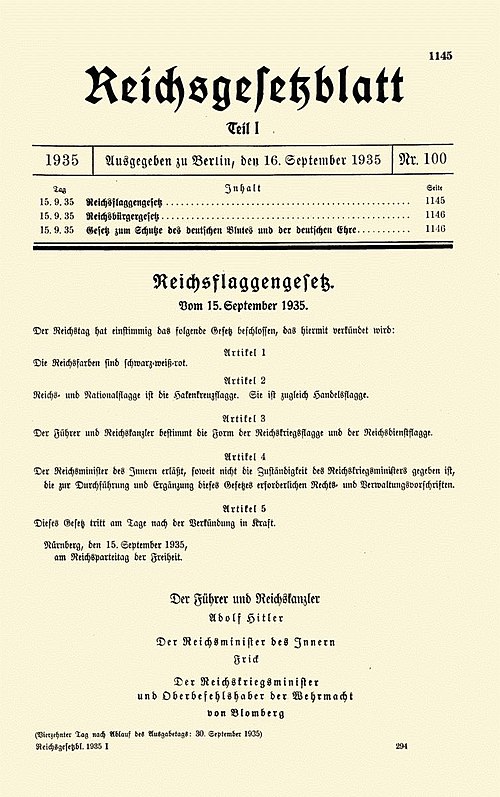
At the annual Nazi Party rally in Nuremberg on 15 September 1935, Hitler presented two laws known as the Nuremberg Laws to the Reichstag. The laws banned sexual relations and marriages between "Aryans" and Jews and were later extended to include "Gypsies, Negroes or their bastard offspring." The laws stripped all non-Aryans of German citizenship and forbade the employment of non-Jewish women under the age of 45 in Jewish households. The Nuremberg Laws formed the legal basis for the systematic exclusion and persecution of Jewish Germans over the following decade.
Location: Nuremberg, Germany
Anschluss with Austria

On 12 March 1938, German troops crossed into Austria, and Hitler announced the unification of Austria with Germany in the Anschluss. Born Austrian, Hitler had long advocated for the union of his homeland with Germany. The annexation was followed by a wave of violence against Austrian Jews, with the SS orchestrating arrests and the expropriation of Jewish-owned property. In a plebiscite held in April 1938, 99.7 percent of Austrian voters approved the Anschluss, though the vote was conducted under Nazi administration and intimidation.
Location: Austria
Kristallnacht Pogrom

On the night of 9-10 November 1938, the Nazi regime orchestrated a nationwide pogrom against Jews in Germany and Austria known as Kristallnacht ("Night of Broken Glass"). SA and Hitler Youth members, often supported by local police, destroyed thousands of synagogues, Jewish businesses, homes, and schools, killing an estimated 91 Jews and arresting around 30,000 Jewish men who were sent to concentration camps. The pogrom marked a major escalation from legal discrimination to open, state-coordinated physical violence against Jews, foreshadowing the systematic genocide to come.
Location: Germany and Austria
Invasion of Poland and Start of World War II
On 1 September 1939, Germany invaded western Poland under the pretext of denied claims to the Free City of Danzig and extraterritorial roads across the Polish Corridor. The invasion, codenamed Fall Weiss, was preceded by the Molotov-Ribbentrop Pact with the Soviet Union, which included a secret protocol to partition Poland. On 3 September, Britain and France declared war on Germany, surprising Hitler and prompting him to ask Foreign Minister Joachim von Ribbentrop, "Now what?" On 17 September, Soviet forces invaded eastern Poland, and Poland was partitioned between Nazi Germany and the Soviet Union.
Location: Poland
Operation Barbarossa and the Holocaust
On 22 June 1941, contravening the Molotov-Ribbentrop Pact, more than three million Axis troops attacked the Soviet Union in Operation Barbarossa. The invasion was intended to destroy the Soviet Union and seize its natural resources. Following the invasion, special SS units called Einsatzgruppen followed the German army into the Soviet Union, conducting mass shootings of Jews, communist officials, and others. On 18 December 1941, Heinrich Himmler asked Hitler what to do with the Jews of Russia; Hitler replied, "als Partisanen auszurotten" ("exterminate them as partisans"). This order is considered by historians as the closest thing to a definitive order for the Holocaust.
Location: Soviet Union
Wannsee Conference and the Final Solution
On 20 January 1942, Reinhard Heydrich chaired the Wannsee Conference at a villa in Berlin with 15 senior Nazi officials, coordinating the implementation of the "Final Solution to the Jewish Question." The conference's records provide the clearest evidence of systematic planning for the Holocaust. By summer 1942, Auschwitz-Birkenau had been expanded to accommodate large numbers of deportees. The Nazi regime and its collaborators ultimately murdered approximately six million Jews and millions of other victims, including Soviet prisoners of war, Romani people, disabled persons, and political opponents.
Location: Berlin, Germany
The 20 July Plot
On 20 July 1944, Colonel Claus von Stauffenberg planted a bomb in a briefcase during a meeting at Hitler's Wolf's Lair headquarters in Rastenburg, East Prussia. The briefcase was moved behind a heavy oak table leg by Colonel Heinz Brandt, deflecting much of the blast. Hitler survived with minor injuries. The failed assassination attempt, part of Operation Valkyrie, prompted immediate reprisals, resulting in the execution of more than 4,900 people in the following weeks. By December 1944, Hitler was placed on the United Nations War Crimes Commission's first list of war criminals.
Location: Rastenburg, East Prussia
Final Defeat and Suicide in the Führerbunker
By April 1945, Soviet forces had surrounded Berlin. On 20 April, his 56th birthday, Hitler made his last trip from the Führerbunker to the surface. During a military conference on 22 April, Hitler declared for the first time that "everything is lost." After midnight on 28-29 April, Hitler married Eva Braun in a small civil ceremony. On 30 April 1945, Soviet troops were within 500 meters of the Reich Chancellery when Hitler shot himself in the head and Braun bit into a cyanide capsule. Their bodies were carried to the garden behind the Reich Chancellery, doused with petrol, and set on fire. Hitler had appointed Grand Admiral Karl Dönitz as his successor.
Location: Berlin, Germany